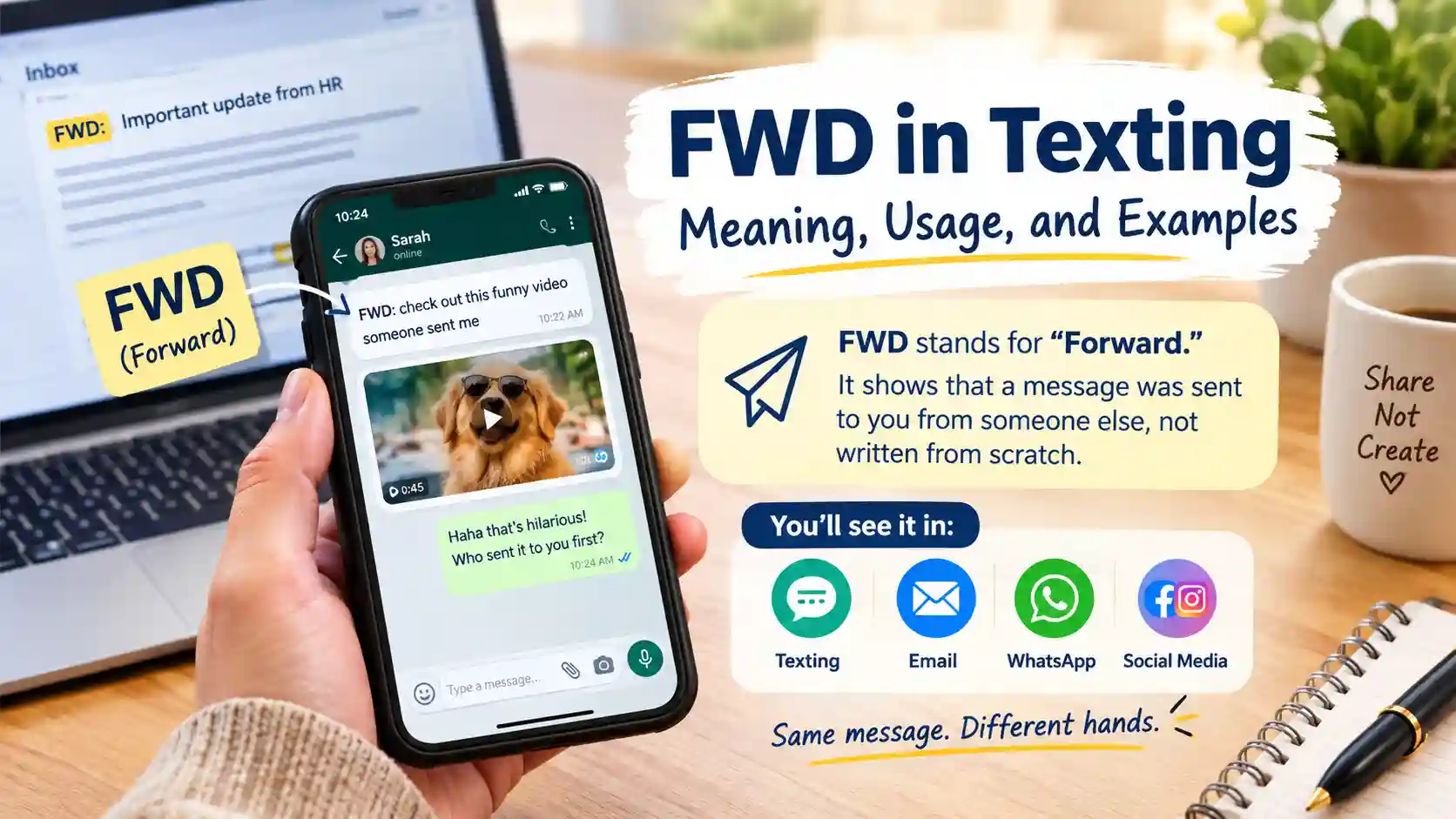
You open a text or an email, and at the top it says “FWD:” before the subject line. What does it mean? Why does it show up so often in messages?
“FWD” stands for “Forward.” It shows that a message was sent to you from someone else, not written from scratch. You will see it in emails, group texts, social media shares, and even memes. It tells you the message has already traveled through other hands before reaching you.
Understanding “FWD” matters because it helps you know where a message came from. It also helps you spot chain messages, shared jokes, or important forwarded updates. This guide explains what “FWD” means. It also shows how people use it across texting, email, and social media today.
FWD Meaning in Text: Definition & Explanation
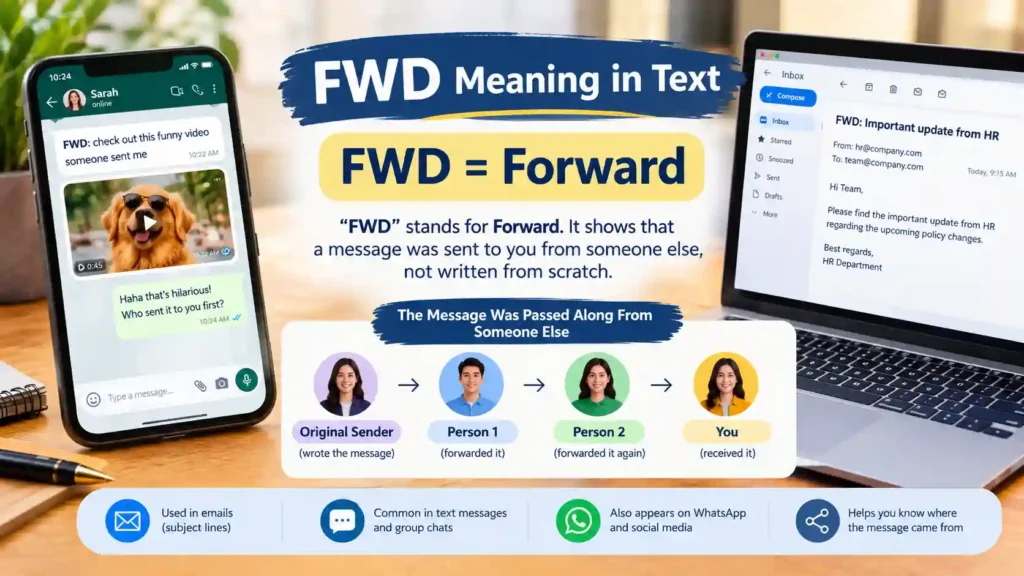
“FWD” stands for “Forward.” It shows that someone sent a message that was first written or sent by another person. Instead of typing a new message, the sender simply passes along the original one.
Example in dialogue:
Friend: FWD: check out this funny video someone sent me
You: haha that’s hilarious, who sent it to you first?
Here, “FWD” tells you the video did not come directly from your friend. It came from someone else first.
It’s also common in email subject lines:
Email subject: FWD: Important update from HR
This tells the reader the email was forwarded, not written new. The real message likely came from another department or person.
Sometimes people use “FWD” in texts to share warnings or news:
Group chat: FWD: heads up, the roads are icy near downtown
You: thanks for sharing, I’ll be careful
In each case, “FWD” signals that the content passed through someone else first. It helps the reader understand the message’s origin.
Background & History of FWD Meaning
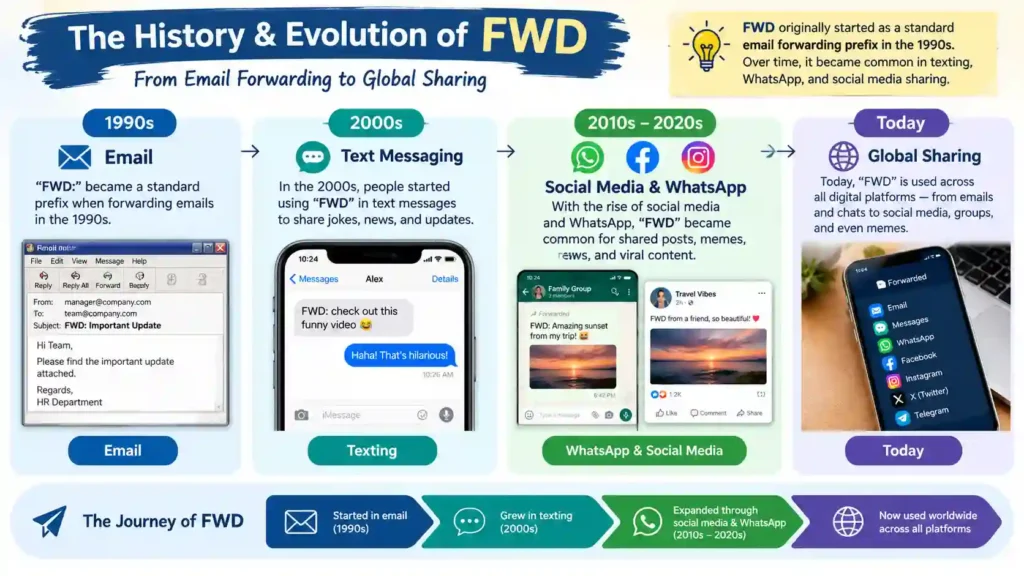
The term “forward” has long been used in communication, especially in mail and messaging systems. When email became popular in the 1990s, “FWD:” became a standard prefix. It automatically appeared when someone forwarded an email to another person.
As texting grew in the 2000s, people began using “FWD” in text messages too. It helped clarify that a message, photo, or video did not originate from the sender. This became especially useful for chain messages, jokes, or viral content passed between friends.
Social media expanded this use even further. Platforms like Facebook and WhatsApp made sharing content simple. “FWD” became a common label for messages that traveled through many people before reaching the final reader.
Today, “FWD” appears in:
- Email subject lines
- Group texts sharing jokes, warnings, or updates
- WhatsApp and messaging apps with forwarded message tags
- Social media posts labeled as shared or reposted content
The meaning hasn’t changed much over time. It still means the same thing: this message came from someone else first.
FWD Meaning in Text: Usage in Various Contexts

The term “FWD” shows up in many different types of digital conversations.
In Texting
Friend: FWD: someone sent me this joke, thought you’d like it
You: lol that’s a good one
In Email
Subject: FWD: Meeting rescheduled to 3 PM
In WhatsApp Messages
WhatsApp often labels forwarded messages automatically, showing a small “Forwarded” tag above the text, similar to typing “FWD” manually.
In Social Media Posts
A shared post might include a caption like: “FWD from a friend, too good not to share”
In each case, “FWD” helps clarify that the message is not original. It shows the reader where the content likely came from.
Common Misconceptions About FWD Meaning

Some people think “FWD” always means the message is unimportant or spam. That’s not accurate.
Misconception 1: It always means spam or chain mail.
Not true. While chain messages often use “FWD,” it’s also used for important updates, useful information, or funny content shared between friends.
Misconception 2: It’s only used in email.
Wrong. “FWD” is common in texting, WhatsApp, and social media too, not just formal email systems.
Misconception 3: It means the sender wrote the message.
Incorrect. “FWD” specifically means the sender did not write the message. They are simply passing it along from someone else.
Clarification: “FWD” is a neutral term. It simply shows a message’s path, not its importance or accuracy. Always double-check forwarded information, especially news or warnings, since it may have changed slightly as it passed between people.
Similar Terms & Alternatives to FWD Meaning
Several related terms are used in similar situations. Here’s how they compare:
| Term | Meaning | Common Use |
| FWD | Forward | Emails, texts, shared messages |
| RT | Retweet | Twitter/X shared posts |
| Repost | Sharing someone else’s content | Instagram, Facebook |
| CC | Carbon copy | Emails, sharing with multiple people |
| Shared | General sharing term | Social media platforms |
While these terms all relate to sharing content, “FWD” specifically refers to passing along a message, while terms like “RT” or “repost” are more platform-specific, especially tied to social media sharing features.
How to Respond When Someone Sends You FWD in Text

Your response should match the type of content being forwarded.
Casual Response
“haha thanks for sending this over”
Funny Response (for jokes or memes)
“this made my day lol, who even started this chain”
Professional Response (in work-related forwards)
“Thanks for forwarding, I’ll review the details.”
Privacy-Conscious Response (if unsure about the source)
“Thanks, I’ll double-check this before sharing further.”
Since forwarded messages can sometimes carry outdated or incorrect information, especially in group chats, it’s often helpful to verify important content before passing it along again.
Regional & Cultural Differences in FWD Meaning

“FWD” is used worldwide, largely because email and messaging systems function similarly across most countries.
- United States: Common in both email and text messaging, especially for jokes, warnings, and casual sharing.
- United Kingdom: Used the same way, particularly in professional email communication.
- India and South Asia: Extremely common in WhatsApp forwards, often used for news, jokes, religious messages, or viral content.
- Non-English-speaking regions: The term is often kept in English, even within local-language messages, since “FWD” originated from English-language email systems.
The core meaning of “FWD” remains the same globally, though its cultural use varies. In some regions, like South Asia, WhatsApp forwards are an especially widespread and sometimes debated form of communication, often associated with viral misinformation concerns.
FWD Meaning Compared to Similar Terms
Here’s how “FWD” compares to other sharing-related terms:
| Expression | Primary Platform | Indicates Original Source Unknown? | Common Concern |
| FWD | Email, texting, WhatsApp | Often | Misinformation risk |
| RT | Twitter/X | Sometimes | Amplifying false claims |
| Repost | Instagram, Facebook | Sometimes | Content credit issues |
| CC | No | Just visibility, not forwarding |
The key difference is that “FWD” specifically shows a message has been passed along, often without clear confirmation of its original source, making it important to verify forwarded information before trusting it fully.
FWD Meaning in Online Communities & Dating Apps
On dating apps like Tinder, Bumble, or Hinge, “FWD” is rarely used directly, since these conversations are usually original rather than forwarded content.
However, it appears frequently in online communities and messaging platforms:
- WhatsApp groups: Extremely common for sharing news, jokes, or warnings among family and friends.
- Facebook groups: Often used when sharing posts or messages from other sources.
- Gaming communities: Occasionally used when sharing important updates or game-related news from official sources.
Tips for responding appropriately:
- In WhatsApp groups, verify important forwarded information before sharing it further.
- On social media, credit original sources when possible instead of only labeling something as “FWD.”
- In gaming communities, confirm forwarded updates against official announcements when possible.
Hidden or Offensive Interpretations of FWD Meaning
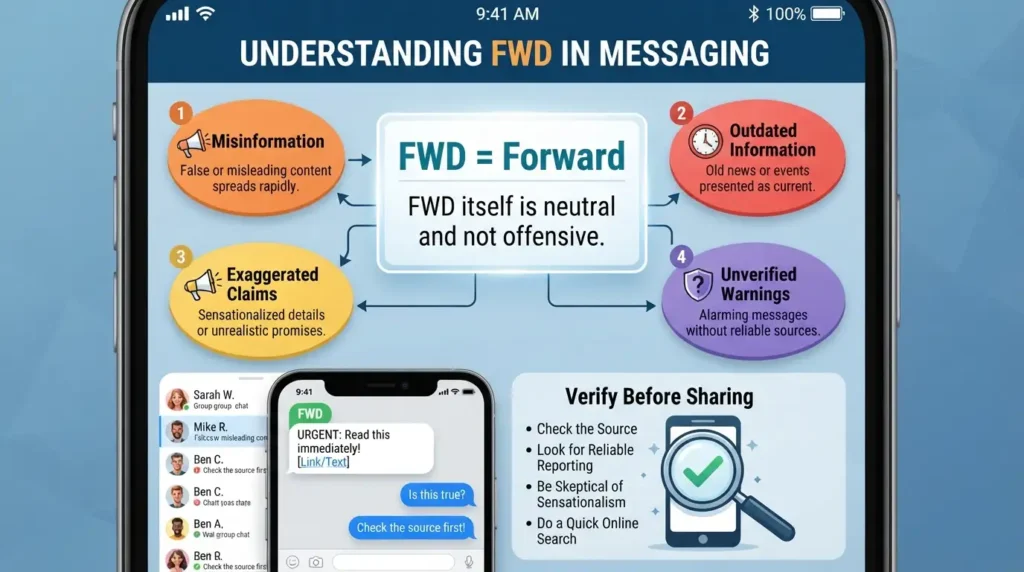
“FWD” itself carries no hidden or offensive meaning. It’s a neutral term simply indicating that a message was passed along from someone else.
However, forwarded content itself can sometimes carry risks:
- Misinformation concerns: Since forwarded messages pass through multiple people, details can become exaggerated, outdated, or inaccurate over time.
Group chat: FWD: breaking news about a new health warning
You: let me verify this before sharing further
This kind of caution is common, especially with viral WhatsApp or social media forwards.
Why tone and context matter: While “FWD” itself is harmless, the forwarded content can sometimes spread false information. Always consider the reliability of the original source before trusting or sharing forwarded messages.
Is FWD Meaning Suitable for Professional Communication?
Yes, “FWD” is completely appropriate for professional communication, especially in email systems where it’s a standard, built-in feature.
Example in a workplace setting:
“FWD: Client feedback from yesterday’s meeting”
This usage is professional and clear, showing that the message originated from another conversation or source.
Professional alternatives (if clarity is needed):
- “Forwarded message:”
- “Sharing this update from [source]:”
- “Passing along important information:”
Unlike casual texting slang, “FWD” doesn’t need to be avoided in professional settings, since it originated from formal email communication systems.
FAQs
1. What does “FWD” mean in texting?
It means “Forward,” showing that a message was passed along from someone else.
2. Is “FWD” only used in email?
No, it’s common in texting, WhatsApp, and social media as well.
3. Does “FWD” mean the message is spam?
Not necessarily. It simply shows the message wasn’t written by the person sending it to you.
4. Is “FWD” appropriate for professional use?
Yes, it’s commonly used in formal email communication.
5. Should I trust all forwarded messages?
Not always. It’s a good idea to verify important information before believing or sharing it further.
6. Is “FWD” used internationally?
Yes, it’s widely recognized, especially in regions with heavy WhatsApp usage like South Asia.
7. What’s the difference between “FWD” and “RT”?
“FWD” is used for forwarding messages in texts and emails, while “RT” specifically refers to retweeting on Twitter/X.
Conclusion
“FWD” stands for “Forward,” a simple term used to show that a message came from someone else before reaching you. It’s widely used in emails, texts, WhatsApp, and social media platforms.
While harmless on its own, forwarded messages can sometimes carry outdated or inaccurate information. Understanding “FWD” helps you recognize a message’s origin and encourages a habit of double-checking important forwarded content before sharing it further.
Discover More Article

Hi, I’m Mahgull, a dedicated content writer with 2 years of experience in the meaning niche. I enjoy turning complex words, slang, abbreviations, and phrases into simple, informative content that helps readers understand their meanings clearly and quickly.
1 thought on ““FWD” in Texting: Meaning, Usage, and Examples (2026)<p class="post-updated-date">🕓 <span class="updated-label">Last updated on</span> <time datetime="2026-10-01T14:47:10+00:00">October 1, 2026</time></p><script type="application/ld+json"> { "@context": "https://schema.org", "@type": "BlogPosting", "mainEntityOfPage": { "@type": "WebPage", "@id": "https://outreachnexa.com/fwd-meaning-in-text/" }, "datePublished": "2026-10-01T14:46:53+00:00", "dateModified": "2026-10-01T14:47:10+00:00" } </script>”