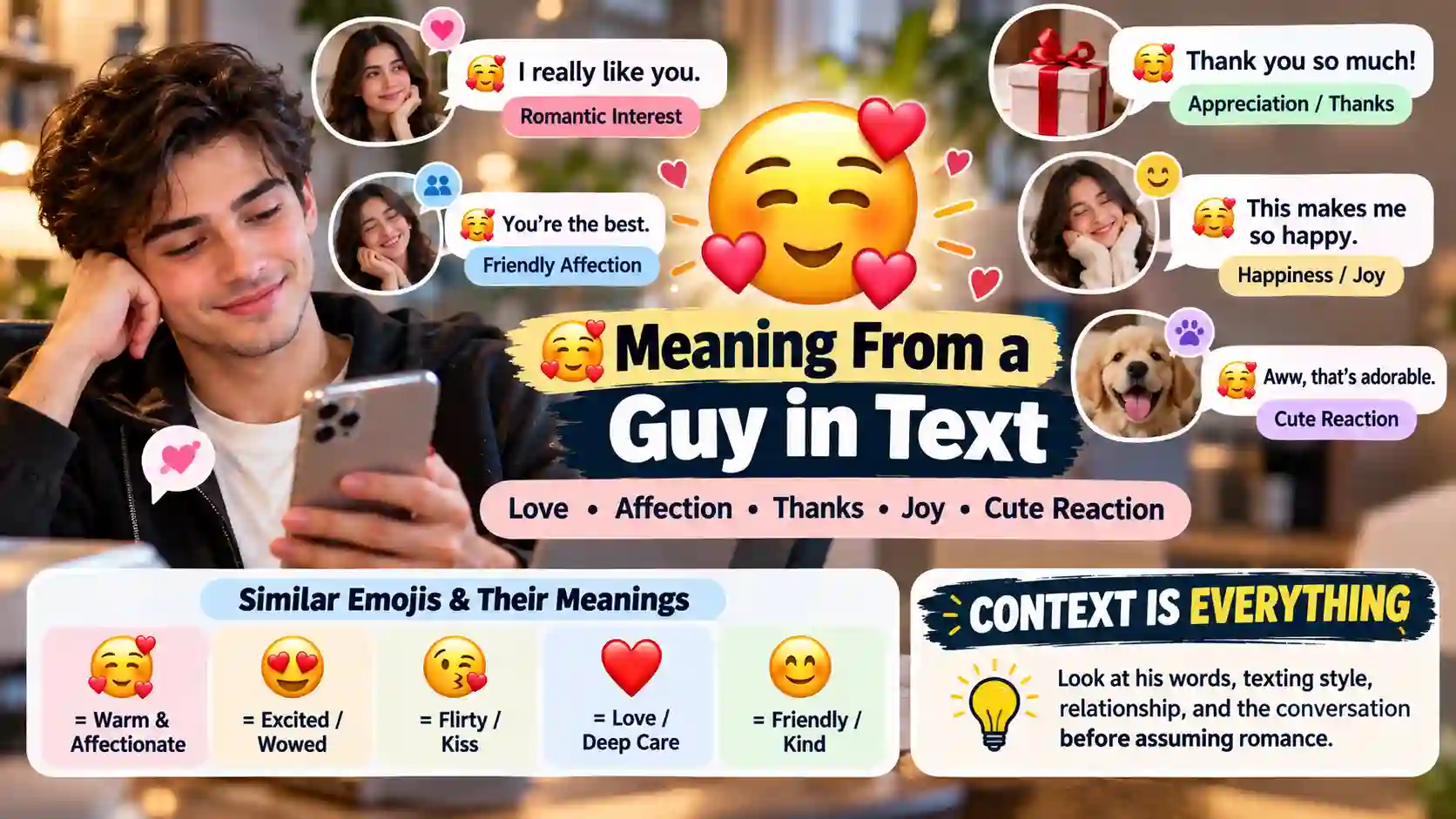
He sends you a 🥰. Just the emoji. No words.
Your heart skips. Or your brain starts to spin. Does he like you? Is he just being nice? Did he send it to everyone?
You are not alone. The 🥰 emoji is one of the most mixed-up emojis in texting. It shows up in chats with crushes, friends, family, and even coworkers. You will also see it on social media and in gaming chats.
Why does it matter? Because one small picture can change how you feel about a whole chat. If you read it wrong, you might get your hopes up. Or you might miss a sweet sign.
In this post, you will learn what 🥰 means. You will see how guys use it in different places. You will also learn how to reply, so you can feel calm and clear the next time it pops up on your screen.
Definition & Meaning
The Short Answer
🥰 is called “Smiling Face with Hearts.”
The feeling is warmth, affection, and joy. That is the heart of it.
What It Can Mean
When a guy sends 🥰, it usually means one of these:
- Love or romantic interest: “I really like you.”
- Friendly affection: “You’re sweet. I care about you.”
- Thanks: “That was kind. I appreciate it.”
- Happiness: “This makes me so happy.”
- Cute reaction: “Aww, that is adorable.”
It Is About the Person, Not Just Gender
Here is the key point. There is no secret “guy code” for 🥰. Men, women, and everyone else use it in many ways. What matters is who he is, how he normally texts, and what you just said.
Some guys use lots of emojis. For them, 🥰 is just a normal smile. Others rarely use emojis. For them, 🥰 may mean a lot more.
Real-Life Examples
Romantic:
You: I made you a card.
Him: 🥰 I love it. Can’t wait to see you.
Friendly:
You: I brought you coffee!
Him: 🥰 You’re the best.
Thanks:
You: I picked up your package for you.
Him: 🥰 Thank you so much!
Cute reaction:
You: Here is a photo of my puppy.
Him: 🥰🥰🥰
Quick Clues
- One 🥰 alone can be sweet but unclear.
- Many 🥰🥰🥰 usually show strong feeling.
- Words with it (“miss you 🥰”) give you the real meaning.
- A late-night reply can feel more personal.
- How he texts others shows if it is just his style.
Background & History
Where Did 🥰 Come From?
The 🥰 emoji is fairly new. It was added to the Unicode emoji set in 2018 as part of a big update. Unicode is the group that decides which emojis all phones can share.
Before that, people used other emojis to show love, like 😍, 😘, and ❤️. But there was no emoji that showed soft, warm love. 😍 felt too wild, with its heart eyes. 😘 felt too much like a kiss. People wanted something gentler.
🥰 filled that gap.
How It Changed Over Time
Here is the rough path:
- Before 2018: People used 😊, 😍, or ❤️ to show affection.
- 2018: 🥰 arrived on phones and apps.
- Early days: It was mostly used for love and cute moments.
- Today: It is used for love, thanks, joy, and friendly warmth.
Why It Became Popular
It looks soft and sweet. The hearts around the face make the feeling very clear. It also feels safe. It is more gentle than 😘 and less intense than 😍.
That is why people use it with a wide range of people: partners, friends, parents, and kids.
Where It Is Common Today
You will see 🥰 in:
- Text messages
- Instagram and Snapchat
- TikTok comments
- Dating apps
- Family group chats
- Gaming chats
- Some work chats (less often)
No single person owns it. That is why the meaning depends so much on context.
Usage in Various Contexts
Texting a Crush or Partner
This is where 🥰 matters most.
You: Good morning! Hope you slept well.
Him: 🥰 Morning. You made my day already.
Here, it is clearly romantic.
You: Thanks for helping me today.
Him: 🥰 Anytime.
This could be romantic or just kind. Look at the other signs.
Texting Friends
Between friends, 🥰 is usually warm but not romantic.
Friend: I got the job!
Him: 🥰 So proud of you, man!
Family Chats
Many guys use it with moms, sisters, and grandparents.
Mom: Dinner is at six.
Him: 🥰 See you then, Mom.
Social Media
On social media, 🥰 is a common comment.
Post: Our wedding day!
Comment: 🥰🥰🥰 Congrats!
It is also a quick way to react to cute pets, babies, or photos.
Gaming
In gaming chats, 🥰 can be a friendly thank-you.
Player 1: I’ll heal you!
Player 2: 🥰 You’re a lifesaver.
Work Chats
At work, some people use it as a warm thank-you in casual team chats.
Coworker: I covered your shift.
Him: 🥰 Thank you!
Quick Guide
| Place | Likely Meaning |
| Crush or partner | Affection or romance |
| Friends | Warm thanks or joy |
| Family | Love and care |
| Social media | Cute reaction |
| Gaming | Friendly thanks |
| Work | Warm thanks (be careful) |
Common Misconceptions & Clarifications
“🥰 Always Means He Likes Me”
This is the biggest myth. A 🥰 does not always mean romance. Many guys use it as a warm “thank you” or a kind reaction. It may be just his normal style.
Ask yourself: Does he use it with everyone? If yes, it may not be special.
“🥰 Means He Is Not Serious”
Also not true. Some guys use emojis in a light way, but still mean what they say. If he sends it with kind words and kind actions, it can be a real sign.
“One 🥰 Is Weak, Many Are Strong”
Often true, but not a rule. A single 🥰 from a shy guy may mean more than ten from a talkative one. Compare it to how he usually texts.
“🥰 and 😍 Mean the Same Thing”
They are close, but not equal. 😍 shows excitement or being wowed. 🥰 shows warmth and affection. Think of 😍 as “wow!” and 🥰 as “aww.”
“He Is Flirting If He Sends 🥰”
Maybe. But flirting needs more than one emoji. Look for other clues, such as:
- He asks about your day.
- He wants to plan time together.
- He remembers small things you said.
- He texts you often.
Is It Inappropriate?
No. 🥰 is not rude. The only issue is tone and place. In a very formal setting, it may feel too personal.
The Best Rule
When unsure, ask in a kind way.
You: Your 🥰 made me smile. Are you feeling the same way I do?
Him: Yeah, I think I am 😊
Being honest can save you a lot of worry.
Similar Terms & Alternatives
Guys use many emojis and phrases to show warmth. Each one feels a little different.
Common Emoji Alternatives
- 😍 (Heart Eyes): Wow, excited, very impressed.
- 😘 (Blowing a Kiss): Affection, flirty, or a friendly goodbye.
- ❤️ (Red Heart): Love, strong care.
- 😊 (Smiling Face): Warm, friendly, softer than 🥰.
- 🥹 (Face Holding Back Tears): Touched, moved, grateful.
- 💕 (Two Hearts): Romantic or sweet feelings.
- ☺️ (Smiling Face): Gentle, shy happiness.
Word Alternatives
- “Aww”: A sweet reaction.
- “You’re the best”: Warm thanks.
- “I like you”: Direct and clear.
- “Miss you”: Shows he thinks of you.
- “Thinking of you”: Soft and caring.
Comparison Table
| Emoji | Usual Feeling | Warmth Level |
| 🥰 | Soft love, joy | High |
| 😍 | Excited, wowed | High |
| 😘 | Flirty, affectionate | High |
| ❤️ | Love, deep care | Very high |
| 😊 | Friendly, kind | Medium |
| 🥹 | Touched, grateful | Medium to high |
| 😂 | Funny | Low (different mood) |
Why Guys Pick One Over Another
Some guys feel shy about ❤️, so they choose 🥰. It feels safer. It shows warmth without making a big promise.
Tip: If you want to be clear, use words. “I really like you” cannot be misread.
How to Respond to This Term
Your reply should match the mood. Here are four styles.
1. Casual
Use this with friends or someone you know well.
Him: 🥰
You: Aww, thanks! 😊
Or:
Him: 🥰 Thanks for today.
You: Anytime! I had fun too.
2. Funny
Use humor if the mood is light.
Him: 🥰
You: Careful. You’ll make me blush.
Him: 🥰🥰🥰
You: That is a lot of hearts. Are you okay?
3. Professional
Use this if he is a coworker or client.
Coworker: 🥰 Thanks for the help!
You: You’re welcome. Happy to help.
Client: 🥰 Great work!
You: Thank you. I appreciate the kind words.
4. Privacy-Conscious
Sometimes you do not want to share your feelings yet. That is okay.
Him: 🥰 I really like talking to you.
You: Thanks, I enjoy chatting too. Let’s keep getting to know each other.
If someone you do not know well pushes too fast:
Stranger: 🥰 You’re so pretty. Where do you live?
You: Thanks, but I don’t share that. Let’s talk about something else.
If You Like Him Too
Him: 🥰
You: You always make me smile 🥰
Be honest and warm. It does not have to be fancy.
What to Avoid
- Do not overthink. One emoji is not a promise.
- Do not send ten texts in a row. That can feel pushy.
- Do not assume love. Check the other clues first.
- Do not ignore it. A kind reply keeps the chat warm.
Reply Cheat Sheet
| Style | Best For | Example |
| Casual | Friends | “Aww, thanks!” |
| Funny | Light chats | “You’ll make me blush.” |
| Professional | Work | “Thank you. Happy to help.” |
| Privacy | New contacts | “Let’s keep getting to know each other.” |
Regional or Cultural Differences
Is 🥰 Used Everywhere?
Mostly yes. Emojis are a global language. 🥰 shows up on phones around the world. The picture is the same. But the meaning can shift a little from place to place.
How It Can Vary
- In the US and UK: 🥰 is common among friends, family, and partners. It is usually warm and casual.
- In Latin America and Spain: People often use affectionate emojis freely, even with friends and family.
- In South Asia: It is common in chats with friends and family.
- In East Asia: Emoji use is also common, but the style of warmth can be more reserved in some chats.
- In some more formal cultures: A 🥰 from a coworker may feel too personal.
These are general patterns, not strict rules. Every person is different.
Texting Style Differences
Some groups text in a very warm style. They use lots of hearts, even for small things. Others use emojis only for special feelings. If you chat with people from other places, do not judge too fast. What feels big to you may be normal to them.
Tip for Global Chats
When you chat with someone from another country:
- Ask kindly if you are unsure.
- Use clear words along with emojis.
- Notice his style over time.
A 🥰 can be a tiny sign of kindness, or a big sign of love. Culture and personality both matter.
Comparison with Similar Terms
Let’s put 🥰 next to a few look-alikes.
| Emoji | Meaning | Tone | Key Difference |
| 🥰 | Soft love, warm joy | Sweet | Gentle and flexible |
| 😍 | Wowed, excited | Strong | More about excitement than warmth |
| 😘 | Kiss, flirty | Flirty | More romantic or playful |
| ❤️ | Love | Deep | Strongest and most serious |
| 😊 | Happy, friendly | Light | Warm but less affectionate |
| 🥹 | Touched, grateful | Emotional | Shows being moved |
| 💕 | Sweet romance | Romantic | Often used for crushes |
How They Differ
🥰 vs. 😍: 😍 says “Wow, you look amazing!” 🥰 says “You make me feel warm and happy.”
You: Here is my new outfit.
Him: 😍 (He is wowed.)
You: I made you cookies.
Him: 🥰 (He feels warm and thankful.)
🥰 vs. 😘: 😘 is more flirty. It can also be a friendly goodbye. 🥰 is softer and less physical.
🥰 vs. ❤️: ❤️ is a clear, strong feeling. 🥰 is gentler and more flexible. Many guys use 🥰 when they are not ready for ❤️.
🥰 vs. 😊: 😊 is friendly. 🥰 is warmer and more personal.
Quick Tip
When two emojis look close, look at the context. The words around the emoji and his past texts will tell you much more.
Usage in Online Communities & Dating Apps
Dating Apps (Tinder, Bumble, Hinge)
On dating apps, 🥰 is a positive sign. It often shows he is enjoying the chat.
Match: Your dog is so cute 🥰
You: Thanks! His name is Max.
Match: I had a great time on our date 🥰
You: Me too. Let’s do it again.
Here are some clues:
- 🥰 with a compliment is usually flirty.
- 🥰 after a date shows he likes you.
- 🥰 as the only reply may be friendly but unclear.
- 🥰 early in the chat may just be polite.
Twitter and X
On Twitter or X, 🥰 is a common reply to cute posts, good news, or fans.
Post: Just adopted a kitten!
Reply: 🥰🥰🥰
Instagram and TikTok
In comments and DMs, it is a quick sign of support.
Post: Birthday celebration!
Comment: Happy birthday 🥰
Gaming Communities
On Discord and Twitch, guys use 🥰 to thank teammates or support streamers.
Streamer: Thanks for the sub!
Viewer: 🥰 Love your stream.
Tips for Responding
- Match his energy. If he is warm, be warm.
- Be honest. Do not pretend if you are not interested.
- Ask a question. It keeps the chat going.
- Do not rush. Let feelings grow.
- Watch the pattern. One 🥰 is a hint. Many are a trend.
Safety Tips
On dating apps, never share your address, workplace, or money details with a new match. If someone uses sweet emojis to push you for private info, be careful. Real affection does not need your bank details or home address.
Hidden or Offensive Meanings
Does 🥰 Have a Rude Meaning?
No. 🥰 is not an offensive emoji. It has no hidden rude meaning. It is a soft, warm picture.
The Real Risk: Mixed Signals
The real problem is not the emoji. It is confusion. A guy might send 🥰 to be kind, but you might read it as love. Or he might mean love, but you read it as friendly.
You: I thought you liked me.
Him: I do like you. As a friend 🥰.
(A common mix-up.)
When 🥰 Can Feel Fake or Sarcastic
Sometimes people use 🥰 in a sarcastic way. They may be joking, or even mocking.
You: I forgot to call you back.
Him: Oh no. That’s fine 🥰
(This might be sarcastic.)
Look at the words and tone. If the words feel cold but the emoji is sweet, he may be upset.
When It Can Be Used to Manipulate
Sometimes a person may use lots of sweet emojis to get something. This could be attention, favors, or private details. This is not common, but it can happen. Trust your gut. If sweet words come with pressure, step back.
Why Tone and Context Matter
Ask yourself:
- What did I just say?
- How does he usually text?
- Do his actions match his words?
- Does he use 🥰 with everyone?
If words and actions match, you can trust the signal. If they do not, ask.
Cultural Meanings
In some places, an affectionate emoji from a man to a woman may feel very personal. In others, it is normal. If you are chatting across cultures, check before you assume.
A Kind Reminder
Do not read too much into one tiny picture. Many 🥰 emojis are just kind, sweet, and harmless. And if you are the one sending it, think about how it may feel to the other person.
Suitability for Professional Communication
Is 🥰 Okay at Work?
Usually no, or only in very casual chats. The 🥰 emoji shows warmth and affection. At work, that can feel too personal. Some people may feel uncomfortable.
Where It Might Be Okay
- A friendly chat with a close coworker you know well
- A casual team chat that already uses lots of emojis
- A thank-you after a big favor, if your workplace is relaxed
Where It Is Not Okay
- Emails to clients
- Messages to your boss, unless you know the style
- Messages to someone you barely know
- Job applications and interviews
- Formal reports and letters
- Messages to someone of a higher rank
Why It Can Be a Problem
At work, 🥰 may sound:
- Too romantic. It could cause awkward feelings.
- Too casual. It may reduce the respect of the message.
- Unclear. The reader may not know what you mean.
None of these may be your goal. But the reader cannot see your face.
Professional Alternatives
| Casual | Professional Option |
| 🥰 | “Thank you. I really appreciate it.” |
| 🥰 Great job! | “Great work. Thank you for your effort.” |
| 🥰 You’re the best | “I’m grateful for your help.” |
| 🥰 Love this idea | “This is an excellent idea.” |
| 🥰 See you soon | “Looking forward to seeing you.” |
Safer Emoji Options
If you want to add a bit of warmth, try:
- 😊 (Smiling Face)
- 👍 (Thumbs Up)
- 🙏 (Thank You)
These feel kind without being too personal.
Example at Work
Employee: Thanks for the help 🥰
(This could feel too personal.)
Better:
Employee: Thanks so much for the help. I really appreciate it.
(Clear, warm, and professional.)
Simple Rule
If it is work, keep it clear and respectful. Words are safer than hearts.
FAQs
1. What does 🥰 mean from a guy in a text?
It means warmth, affection, or joy. It can show love, friendship, or thanks. The words around it and his texting style show which one.
2. Does 🥰 mean he likes me?
Not always. It can be a sign of romance, but many guys use it as a friendly “thank you” or kind reaction. Look for other clues like effort, attention, and honest words.
3. Is 🥰 flirty?
It can be, especially with compliments or late-night chats. But it is also common among friends and family. Flirting needs more than one emoji.
4. What is the difference between 🥰 and 😍?
😍 shows excitement or being wowed. 🥰 shows warmth and affection. Think “wow” versus “aww.”
5. How should I reply to 🥰?
Match his tone. A smile, a thank-you, or a warm message works well. If you like him, be honest. If you do not, stay kind and clear.
6. Can I send 🥰 to a coworker?
It is best to avoid it, unless you know the person well and your workplace is casual. Use words or a simple 😊 instead.
7. Is 🥰 ever rude or offensive?
No. It is not a rude emoji. The only risk is mixed signals or sarcasm. If you are unsure, ask kindly.
Conclusion
🥰 is a tiny emoji with a big feeling. It can show love, thanks, joy, or simple kindness. It does not belong to one type of person, and there is no secret code behind it.
Here are the key points to remember:
- Context is everything. Look at who is texting, how he usually writes, and what you just said.
- Do not panic or overthink. One emoji is not a promise.
- Look for patterns. Words, actions, and effort say more than any emoji.
- Ask kindly if you are unsure. Honest talk clears up most mix-ups.
- Use full words in formal settings. They are clearer and more respectful.
Next time you see 🥰, take a breath. Read the mood. Then reply with kindness, and be true to your own feelings.
Discover More Article

Hello, I’m Insha, a passionate content writer with 2 years of experience creating clear, engaging, and helpful content. I specialize in the meaning niche, explaining words, slang, phrases, and online terms in simple language that readers can easily understand and use.