You get a text. It says, “It’s fine, dws.” You stop. What does that mean?
Short slang like this shows up in texts, DMs, comments, and game chats. People type fast. They cut words. Sometimes you are left guessing.
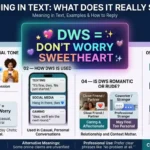
The most common answer online is “Don’t Worry Sweetheart.” It is a way to calm someone down. But the web does not agree on one meaning. That is why context matters so much.
In this guide, you will learn what DWS most likely means. You will see how people use it, how to reply, and when to avoid it. You will also see why you should not trust every slang site you find.
Knowing the meaning helps you avoid awkward moments. You will not reply to a kind note with a joke. You will not send a warm word to your boss by mistake.
Definition & Meaning
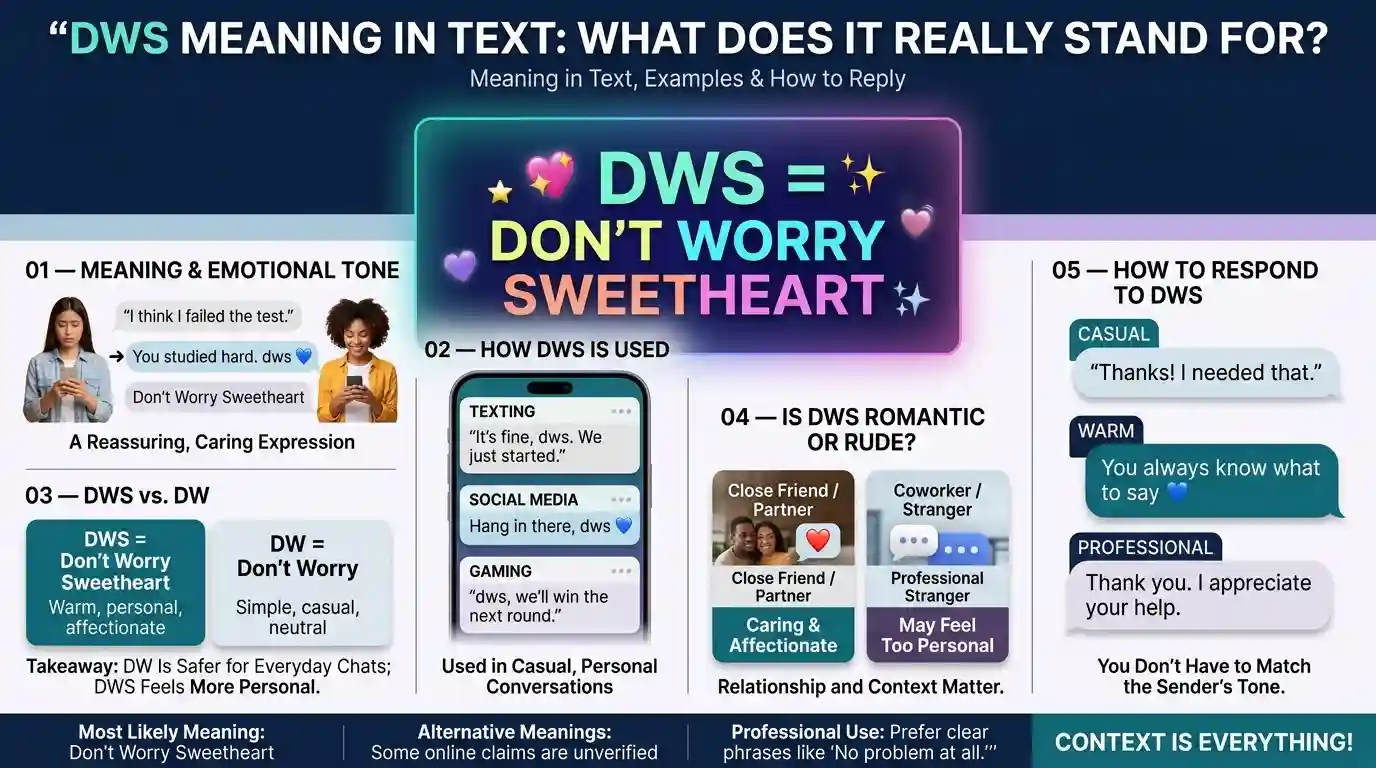
DWS most likely stands for “Don’t Worry Sweetheart.” Sources describe it as a reassurance, a way to offer comfort or say a worry is unfounded. Another page gives the same example of a sender texting “Everything will be fine, dws” to comfort someone facing a challenge.
So the message is simple: “Relax. It’s okay.”
Here is how it looks in a chat:
Mia: I think I failed the test.
Sam: You studied hard. dws.
Lena: I’m sorry I’m late!
Jo: It’s fine, dws. We just started.
Other meanings exist, but they are weak. One site says DWS means “does not seem” or “doesn’t seem.” Another says “Dog Watching Someone,” meaning someone who watches another person online. I could not confirm either one from a trusted source. Both come from pages that look auto-written. Treat them with care.
Key point: If the text is about worry, stress, or sorrow, DWS probably means “Don’t Worry Sweetheart.”
There is also a real company called DWS Group, an investment firm. That has nothing to do with texting. It matters only if you see DWS in a work email.
Background & History
Here is the honest answer: no one has documented where DWS began. I found no first use, no date, and no trusted source on its history.
We can still say a few safe things.
People have shortened phrases in texts for a long time. Typing on small phone keys is slow. So people shrink long phrases into letters. “Don’t worry” is often cut to “DW.” Adding S for “sweetheart” fits that habit. This is a reasonable guess about how it formed. It is not a proven fact.
Slang also changes with the group using it. A phrase may start with one friend group. Then it spreads on social apps. After a while, many people use it. Each group can add its own spin.
That may explain why DWS has more than one meaning. Different groups may use the same letters for different things.
Where it appears today:
- Text messages
- Instagram and other DMs
- Comments on posts
- Casual chats between close people
Key point: Treat any site that gives a clear “origin story” for DWS with doubt. If it names a year or a person, ask for proof.
If you need to know what one sender means, ask them. It is the only sure way.
Usage in Various Contexts
Texting
Used to comfort someone. It is short and soft.
Ben: I forgot your birthday gift.
Ana: dws, I’m just glad you came.
Social media
Used in replies and DMs. It may show up under a sad post.
Post: Rough week. Feeling down.
Reply: Hang in there, dws.
Gaming
Less common here. Gamers often use “np” for “no problem” or “gg” for “good game.” If someone types DWS in a game, it may be comfort. It may also be something else, so read the mood.
Player 1: Sorry, I messed up that round.
Player 2: dws, we’ll win the next one.
Casual talk with close people
Best when you know the person well.
Dad: Did I lock the door?
Mom: Yes, dws.
Key point: DWS fits warm, personal chats. It does not fit cold or formal ones.
If you are unsure, you can look at the rest of the message. Is the person upset? Is the other person trying to help? The mood will tell you.
Common Misconceptions & Clarifications
Myth 1: DWS has one clear meaning.
It does not. No major dictionary lists it. The web gives several meanings, and some look made up.
Myth 2: It is always romantic.
Not always. “Sweetheart” can be romantic. But some people use pet names with friends, kids, or family. The word does not always mean love.
Myth 3: It is the same as “DW.”
Close, but not the same. “DW” means “don’t worry.” DWS adds the pet name. So DWS sounds softer and more personal.
Myth 4: Every site that explains it is right.
Many pages that rank for this term repeat the same text. Some even contradict each other. Check more than one source. Better yet, check with the sender.
Can it be misread?
Yes. Say a coworker or a stranger sends “dws.” That can feel too personal. Some people may find it creepy. Others may see it as talking down to them. Pet names can bother people who do not want them.
Key point: The meaning is not the only issue. The relationship between you and the sender matters too.
Similar Terms & Alternatives
Here are other ways to say “don’t worry” in a text:
| Term | Meaning | Tone |
| DW | Don’t worry | Casual, neutral |
| NP | No problem | Casual, friendly |
| NW | No worries | Casual, friendly |
| NBD | No big deal | Relaxed |
| IDC | I don’t care | Can sound cold |
| It’s all good | Everything is fine | Warm, casual |
| No stress | Don’t be stressed | Relaxed |
Some of these are not sweet. IDC can sound rude. NP and NW are safe.
Here is how they sound in a chat:
Kai: Sorry I missed your call.
Zoe: NP. Call me later.
Kai: I broke your mug.
Zoe: NBD. I have ten more.
Key point: If you want a safe, clear option, use NP, NW, or DW. Use DWS only when a soft tone fits.
How to Respond to This Term
How you reply depends on who sent it and what you want.
Casual
Them: It’s okay, dws.
You: Thanks. I needed that.
Funny
Them: dws, it happens.
You: Don’t worry, I’m already worrying enough for both of us.
Warm
Them: dws, we’ll figure it out.
You: You always know what to say. Thank you.
Professional
Say a coworker uses it with you. Keep it kind but neutral.
Coworker: dws, I’ll fix it.
You: Thank you. I appreciate your help.
Privacy-conscious
Maybe the pet name feels too close. You can stay polite and set a line.
Them: dws, sweetheart.
You: Thanks for the kind words. I prefer to use my name, though.
Not sure what it means?
Just ask. It is better than guessing.
You: Quick question. What does dws mean?
Them: Don’t worry sweetheart. Sorry, bad habit!
Key point: You never have to match the tone. You can reply in your own style.
Regional or Cultural Differences
I found no reliable data on how DWS is used across regions or languages. I will not make up a list of local slang. That would not be honest.
Here is what we can say safely.
Pet names change by culture. In some places, calling a friend “sweetheart” is normal. In other places, it sounds too personal. So the same text can feel kind in one place and strange in another.
Slang does not always travel. Many abbreviations come from English. Not every English speaker uses them. People who speak English as a second language may not know them.
Age may play a role. Younger users often invent or adopt new slang first. Older users may not know it. This is a common pattern with slang in general. It is not a proven fact about DWS.
Key point: If you text someone from another culture, use plain words. “Don’t worry” works everywhere. It never confuses anyone.
If you see DWS from someone who speaks another language, do not assume. Their meaning may differ from yours.
Comparison with Similar Terms
| Term | Full form | Warmth | Best used with |
| DWS | Don’t Worry Sweetheart | High | Partners, close friends, family |
| DW | Don’t worry | Medium | Almost anyone |
| NW | No worries | Medium | Friends, coworkers |
| NP | No problem | Medium | Friends, coworkers |
| NBD | No big deal | Low to medium | Friends |
| IDC | I don’t care | Low | Rarely a good choice |
The main difference is the pet name. DWS feels personal. DW feels plain. That is why DWS can be sweet in one chat and awkward in another.
Tone check:
“dws” to your partner → sweet
“dws” to a new coworker → too much
“dw” to a new coworker → just fine
Key point: Pick the term that matches your closeness with the other person.
If you only remember one thing, remember this: DW is safe, DWS is warm.
Usage in Online Communities & Dating Apps
I found no trusted data on how DWS is used on Tinder, Twitter, or in gaming groups. So here is general advice, not claims about those sites.
Dating apps
Pet names can feel flirty early on. If someone you just matched with sends “dws,” think about the mood. Is the chat warm and fun? Or does it feel too fast?
Match: Sorry, I took a day to reply.
You: No worries. Glad you’re here.
You can answer in a friendly way. You do not have to use pet names back.
Twitter / X and other public feeds
Public replies reach many people. A pet name from a stranger may feel odd. Some users may mute or block it.
Gaming communities
Games move fast. People often use short words like “np” and “gg.” DWS is not a known gaming term in the sources I found. If you see it, treat it as comfort, but check the mood.
Tips for responding
- Read the mood before you reply.
- Stay polite even if you do not like the pet name.
- Set limits if you feel uneasy.
- Do not click links or share private info with strangers.
Key point: Online, you owe no one a warm reply. Be kind, but stay safe.
Hidden or Offensive Meanings
Is DWS offensive? In the most common meaning, no. “Don’t Worry Sweetheart” is meant to comfort.
But tone and context can change how it lands.
When it can bother people:
- A stranger uses it.
- A boss or coworker uses it.
- Someone uses it when you are upset and do not want a pet name.
- Someone uses it to talk down to you. Calling an adult “sweetheart” can sound as if you do not take them seriously.
Coworker: dws, I’ll handle the report.
You (thinking): Hmm. That felt a little personal.
Other meanings: Some sites claim “Dog Watching Someone” or “doesn’t seem.” I could not verify them. I found no sign that DWS has a hidden rude meaning. But slang changes fast. Some small group may use it in a way I could not find.
Why tone matters: Words are only part of the message. The who and the when matter too. The same three letters can feel kind from a loved one and cold from a stranger.
Key point: If DWS makes you uncomfortable, you can say so. You do not need to put up with pet names you dislike.
Suitability for Professional Communication
Short answer: no. DWS is not a good choice for work.
Here is why:
- It is slang. Many people will not know it.
- It uses a pet name. That can sound too close.
- It can look unprofessional in emails or reports.
A slang site gives the same advice: when talking with people who may not know the slang, spell out the whole phrase, and slang acronyms are often wrong for business settings.
Better choices for work:
| Instead of | Try |
| dws | “No problem at all.” |
| dws | “Please don’t worry about it.” |
| dws | “That’s fine. Thanks for letting me know.” |
| dws | “No need to apologize.” |
In a work chat:
Coworker: Sorry, I missed the meeting.
You: No problem at all. I’ll send you the notes.
Key point: At work, use plain words. They are clear, kind, and safe.
FAQs
1. What does DWS mean in text?
It most likely means “Don’t Worry Sweetheart.” People use it to calm or comfort someone. Other meanings exist online, but I could not verify them.
2. Is DWS the same as DW?
Not quite. DW means “don’t worry.” DWS adds a pet name, so it feels warmer and more personal.
3. Is DWS romantic?
It can be. But close friends and family may use it too. Check the relationship and the mood.
4. Is DWS rude?
Usually not. But a pet name from a stranger or a boss can feel too personal. Some people do not like being called “sweetheart.”
5. Can I use DWS at work?
It is better not to. Use “no problem at all” or “please don’t worry about it.”
6. Does DWS mean something else?
Some sites say “Dog Watching Someone” or “doesn’t seem.” I found no trusted source to back these up. DWS is also the name of an investment company, which has nothing to do with texting.
7. What if I don’t know what someone means?
Just ask. A quick “What does that mean?” works every time.
Conclusion
DWS most likely means “Don’t Worry Sweetheart.” People send it to comfort someone. It sounds warm, soft, and close.
But the web does not agree on one meaning. Many pages that explain it look auto-written and contradict each other. I found no trusted dictionary entry, no known origin, and no solid data on regional use.
Context is your best guide. Look at who sent it. Look at the mood.A pet name can be sweet from a loved one. It can feel odd from a stranger.
When in doubt, ask the sender. At work, use plain words like “no problem at all.” With friends and family, pick the term that fits your bond: DW is safe, DWS is warm.
Discover More Article

Hi, I’m Mahgull, a dedicated content writer with 2 years of experience in the meaning niche. I enjoy turning complex words, slang, abbreviations, and phrases into simple, informative content that helps readers understand their meanings clearly and quickly.