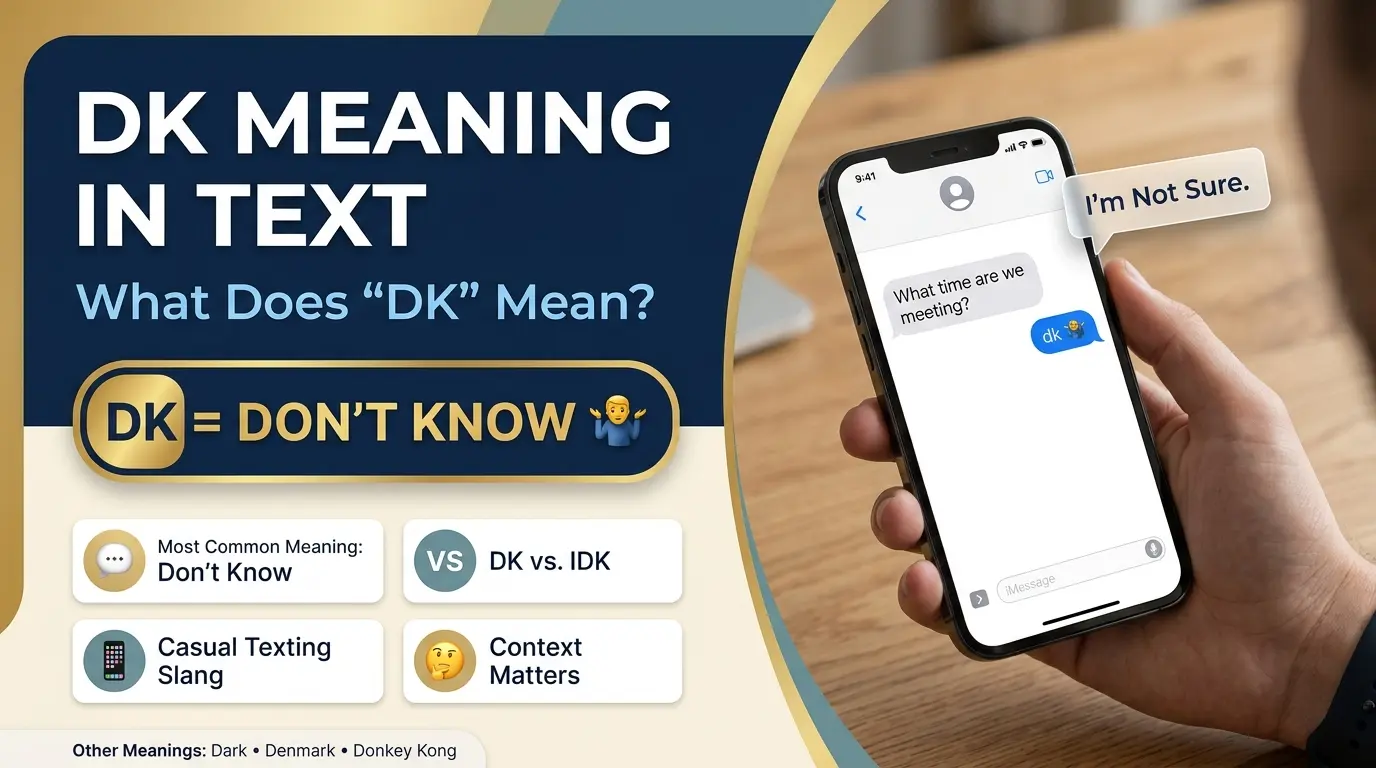
You get a message. It says “DK.”
Is it a name? A code? A short answer? Did your friend forget to finish the word?
You are not alone. “DK” is a tiny acronym that shows up in texts, on Snapchat, in game chats, and even in work messages. Most of the time, it is easy to read. But sometimes it can mean something else, and that is where the mix-ups start.
Why does it matter? Because a short reply can hide a big clue. If someone says “DK,” they may be unsure, busy, or not ready to talk. If you read it wrong, you may push too hard or miss the point.
In this post, you will learn what “DK” means, where it came from, and how to reply. You will also learn about its other meanings and when to avoid it.
Let’s start.
Definition & Meaning
The Short Answer
“DK” most often means “Don’t Know.” Sources agree on this. One Snapchat guide calls it the most common and widely accepted meaning across most of the internet. Wiktionary also lists it as internet and texting slang for “don’t know.”
It is a quick way to say: “I’m not sure,” or “I have no idea.”
Why People Use It
People use “DK” because it is fast.
- Do not have the answer
- Do not want to think hard
- Are busy
- Want to keep a chat light
Real-Life Examples
A simple “I don’t know”:
Friend: What time does the movie start?
You: dk, I’ll check
Unsure about plans:
You: Are you coming to the party?
Friend: dk yet, depends on work
Unsure about an answer:
Teacher: Who knows the capital of Australia?
Student (in chat): dk
Not ready to talk:
You: What’s wrong?
Friend: dk. Just tired.
Other Meanings You May See
Some other meanings exist, but they are less common in texting:
- Dark: In some word lists, “dk” is a short form of “dark,” often in color names like “dk blue.”
- Dankon: In Esperanto, “dk” can be short for “thank you.”
- Denmark: “.dk” is Denmark’s web domain, and “DK” is its country code.
- Donkey Kong: In gaming, “DK” is a popular nickname for the classic Nintendo character.
Quick Clues
- A question and a short reply? Probably “don’t know.”
- Talking about colors? Probably “dark.”
- Talking about games? Maybe Donkey Kong.
- Talking about Denmark? Probably the country code.
Background & History
Where Did “DK” Come From?
“DK” is a shortened form of “don’t know.” People have long shortened common phrases when they write fast. The practice is older than texting. People used short forms in telegrams, notes, and letters.
The exact first use of “DK” is hard to pin down. Slang usually starts in speech and short writing. Then it spreads when many people use it.
How It Spread
Here is the rough path:
- Short notes and early chat: People dropped letters to save time.
- Text messages: Character limits made short forms popular.
- Instant messaging and social apps: Snapchat, WhatsApp, and Instagram helped “DK” spread.
- Today: It is a normal, casual way to say “I don’t know.”
Odd Claims Online
Some websites make strange claims about “DK.” One page says it is an “unspoken, secretive” term from “obscure digital forums.” That page is full of hype and has no real proof. Do not trust claims like that. Most reliable sources say “DK” simply means “don’t know.”
How the Meaning Has Stayed the Same
Many slang words change over time. “DK” has stayed fairly steady. The core meaning is still “don’t know.” The main difference is the mood. It can sound relaxed, tired, or even a bit short, depending on the chat.
Where It Is Common Today
You will see “DK” in:
- Text messages
- Snapchat chats
- Instagram and WhatsApp
- Gaming chats
- Group chats
Usage in Various Contexts
Texting Friends
In texts, “DK” is a quick “I don’t know.”
Friend: Where should we eat?
You: dk, you pick
Snapchat and Social Media
On Snapchat, it is a standard short answer.
Friend: Did you see his story?
You: dk, haven’t checked
Friend: Who’s going to the game?
You: dk, still waiting for replies
Gaming
In gaming, “DK” can mean “don’t know,” or it can point to Donkey Kong.
Look at the topic. If it is a Nintendo game, it may be the character.
Casual Conversations
Face to face, people say “dunno” or “don’t know.” Typed “DK” is mostly for texts.
Friend: What do you want to do tonight?
You: dk, anything is fine
Family Chats
Many parents use “idk” more than “dk.” But some do use “DK.”
Mom: Where did you put the keys?
You: dk, I’ll look
Work Chats
At work, “DK” is rare. Some casual teams use it.
Coworker: Do you know when the meeting is?
You: dk, I’ll check the calendar
Quick Guide
| Place | Likely Meaning |
| Texting friends | Don’t know |
| Snapchat | Don’t know |
| Gaming chats | Don’t know, or Donkey Kong |
| Design talk | Dark |
| Talking about Denmark | Country code |
| Work | Don’t know (casual only) |
Common Misconceptions & Clarifications
“DK Has a Secret Meaning”
No. Some clickbait sites say it is mysterious. It is not. The usual meaning is simple: “don’t know.”
“DK Is the Same as IDK”
Close, but not the same. “IDK” means “I don’t know.” “DK” drops the “I.” Most people read them the same way. “DK” feels a bit shorter and more casual.
“DK Is Rude”
No. “DK” is not a rude word. But a very short answer can feel cold if the other person wanted more.
You: Do you want to talk about what happened?
Friend: dk
This may mean “I’m not sure.” Or it may mean “I don’t want to talk.” Look at the mood.
“DK Only Means Don’t Know”
Mostly, but not always. It can also mean “dark,” “Denmark,” or “Donkey Kong,” depending on the topic.
“DK Is Always Negative”
No. Many people say “DK” because they are just unsure. It can be neutral.
“DK Is a Typo”
Sometimes people mistype “OK” as “DK” because the letters sit close on the keyboard. Look at the chat. If “DK” answers a question like “Are you coming?” it might actually mean “OK.”
You: Pick you up at six?
Friend: dk
You: Did you mean “ok” or “don’t know”?
Friend: Oops, “ok”!
Is It Inappropriate?
Not really. Some slang dictionaries list rude meanings for the letters “DK” in niche groups. But in normal texting, it is not an offensive word. Context rules.
The Best Rule
When unsure, ask. A quick question clears up most confusion.
Similar Terms & Alternatives
Many words say “I don’t know.”
Common Alternatives
- IDK: “I don’t know,” the most popular form.
- IDKY: “I don’t know why.”
- IDRK: “I don’t really know.”
- Dunno: A casual spoken form.
- No clue: Plain and clear.
- Not sure: A softer version.
- Beats me: A casual, playful reply.
- Who knows?: Open-ended.
- TBD: “To be decided.”
- IDC: “I don’t care,” which is different.
Comparison Table
| Term | Meaning | Tone | Formality |
| dk | Don’t know | Casual | Low |
| idk | I don’t know | Casual | Low |
| idrk | I don’t really know | Casual | Low |
| dunno | Don’t know | Relaxed | Low |
| not sure | Uncertain | Polite | Medium |
| no clue | No idea | Direct | Low |
| TBD | To be decided | Neutral | Medium |
Why People Pick One Over Another
Some pick “dk” because it is shorter. Others like “idk” because it is the most common. Some prefer “not sure” because it sounds softer and more polite.
Tip: If you want to be clear with everyone, use “I’m not sure” or “I don’t know.”
How to Respond to This Term
Your reply depends on the mood. Here are four styles.
1. Casual
Use this with friends.
Friend: dk
You: No worries. Let me know when you figure it out.
Friend: dk what to wear
You: Wear the blue one. It looks great.
2. Funny
Use humor if the mood is light.
Friend: dk
You: Wow, deep answer. Let me write that down.
Friend: dk where my phone is
You: Check your hand. I’m kidding. Try your pocket.
3. Professional
Use this at work or school.
Coworker: dk
You: No problem. Could you find out and let me know by noon?
Student: dk
Teacher: That’s okay. Let’s work through it together.
4. Privacy-Conscious
Sometimes you do not want to share more. That is okay.
Stranger: Where do you live?
You: dk what you mean, but I don’t share that.
Or more directly:
Stranger: Do you know my friend?
You: Not sure. I’d rather not share details.
If the Mood Seems Heavy
If “dk” feels sad or stressed, check in kindly.
Friend: dk. I feel off today.
You: I’m sorry. Want to talk about it?
What to Avoid
- Do not assume the worst. It is usually just “I’m not sure.”
- Do not push too hard. Give people room.
- Do not reply with sarcasm if they seem upset.
- Do not ignore it. A short reply keeps the chat warm.
Reply Cheat Sheet
| Style | Best For | Example |
| Casual | Friends | “No worries. Let me know.” |
| Funny | Light chats | “Deep answer. Let me write that down.” |
| Professional | Work, school | “Could you find out by noon?” |
| Privacy | Strangers | “I’d rather not share details.” |
Regional or Cultural Differences
Is “DK” Used Everywhere?
It is mostly English-language slang. You will see it in places where English is common online, such as the US, UK, Canada, and Australia.
Other Languages
In other languages, people often use their own short forms. For example, in Esperanto, “dk” can be short for “dankon,” meaning “thank you.” That shows how the same two letters can mean different things in different languages.
Regional Notes
- Denmark: “DK” is the country code. Danes see it on websites (.dk) and on car stickers. So in Denmark or Danish groups, “DK” may mean “Denmark.”
- UK and Ireland: “DK” is sometimes used in casual chats for “don’t know,” but “dunno” is also very common.
- United States: “DK” and “IDK” are both widely used, with “IDK” more common.
- Gaming communities worldwide: “DK” often means Donkey Kong.
These are general patterns, not strict rules.
Regional Ways to Say “I Don’t Know”
- “Dunno” is common across many English-speaking places.
- “No idea” is widely used.
- “Haven’t a clue” is more common in the UK.
- “Beats me” is a US phrase.
- “Couldn’t tell you” is a casual UK and Irish phrase.
Tip for Global Chats
When you chat with people from other countries:
- Do not assume they know the term.
- Spell it out if clarity matters.
- Ask kindly if you are unsure.
A small acronym can mean different things in different places.
Comparison with Similar Terms
Let’s put “DK” next to a few look-alikes.
| Term | Meaning | Tone | Key Difference |
| DK | Don’t know | Casual | Short and quick |
| IDK | I don’t know | Casual | Most common form |
| OK | Okay | Neutral | Agreement, not doubt |
| IDC | I don’t care | Dismissive | About interest, not knowledge |
| TBD | To be decided | Neutral | Used for plans |
| DKY | Don’t know yet | Casual | Adds “yet” |
| DM | Direct message | Neutral | A message type |
How They Differ
DK vs. IDK: They mean almost the same thing. “IDK” is much more common. “DK” is shorter.
DK vs. OK: One letter apart on the keyboard. “OK” says yes. “DK” says “I’m not sure.”
You: Want to go?
Friend: ok (Yes.)
You: Want to go?
Friend: dk (Not sure.)
DK vs. IDC: “IDC” says “I don’t care.” “DK” says “I don’t know.” Very different.
DK vs. TBD: “TBD” means a decision is still coming. “DK” means the person does not have the answer.
Quick Tip
When two acronyms look close, check the question. The question tells you which answer fits.
Usage in Online Communities & Dating Apps
Snapchat and Instagram
This is where “DK” is most common. It is a short, casual reply.
Friend: Are you going to the party?
You: dk yet
Twitter and X
On Twitter or X, “DK” shows up in replies and quick answers.
Post: Who knows a good pizza place?
Reply: dk but I’m hungry too
Gaming Communities
On Discord, Twitch, and in-game chat, “DK” can mean “don’t know,” or the character Donkey Kong.
Dating Apps (Tinder, Bumble, Hinge)
On dating apps, “DK” is a casual “not sure.” It can feel low-effort.
Match: What do you want to do this weekend?
You: dk, what about you?
Some clues:
- “dk” alone may feel flat.
- “dk, you?” keeps the chat going.
- Many “dk” replies in a row may mean the chat needs more depth.
Tips for Responding
- Add a follow-up question. It keeps the chat alive.
- Do not take it personally. It often means “I’m unsure.”
- Offer an easy choice. “Pizza or tacos?” is easy to answer.
- Be patient. Some people text in short bursts.
Safety Tips
On dating apps, never share your address, workplace, or money details with a new match. If someone uses short, vague replies to dodge questions about safety, trust your gut.
Hidden or Offensive Meanings
Does “DK” Have a Rude Meaning?
Not in normal texting. “DK” is not an offensive word. The common meaning is “don’t know.”
Odd Entries Online
Some slang lists include rude meanings for the letters “DK” in rare, niche groups. These are not common, and most people would not read it that way. If a message does not fit that meaning, do not assume the worst.
The Real Risk: Mix-Ups
The real problem is confusion, not rudeness. A few possible mix-ups:
- DK vs. OK: One wrong letter changes yes to “not sure.”
- DK vs. IDK: Slight, but usually the same meaning.
- DK as a name or country: Context matters.
When It Can Feel Cold
A plain “dk” can feel flat, especially after something important.
You: I’m nervous about the results.
Friend: dk
(This may feel short, but it may only mean they are unsure how to respond.)
Sarcasm
Some people use “dk” with a shrug or an eye-roll.
You: Did you finish your homework?
Friend: dk lol
(This may mean “maybe not.”)
Why Tone and Context Matter
Ask yourself:
- What was the question?
- How does this person usually text?
- Is the topic serious or light?
- Are there emojis or other clues?
If you still do not know, ask. A kind question helps.
A Kind Reminder
Do not read too much into one short reply. Most “dk” messages simply mean “I’m not sure.” And if you send it, extra words can add warmth.
Suitability for Professional Communication
Is “DK” Okay at Work?
Usually no, or only in casual chats. “DK” is slang. In professional settings, it can look careless or unclear. Some readers may not know it, or may think it is a typo.
Where It Might Be Okay
- A quick chat with a close coworker
- A casual team chat that already uses short forms
- A fast internal message that will not be shared
Where It Is Not Okay
- Emails to clients
- Messages to your boss, unless you know the style
- Job applications and interviews
- Formal letters and reports
- School assignments
Why It Can Be a Problem
At work, “DK” may sound:
- Too casual. It may lower the tone of a message.
- Unhelpful. It gives no extra information.
- Confusing. Some readers may not know what it means.
Professional Alternatives
| Casual | Professional Option |
| “dk” | “I’m not sure.” |
| “dk, will check” | “I don’t have that information. I’ll find out.” |
| “dk yet” | “I’ll let you know once I have an answer.” |
| “dk, ask Sam” | “Sam may have that information.” |
| “dk when” | “The timing is still to be confirmed.” |
Example at Work
Manager: When will the report be done?
Employee: dk
(This may seem too casual and unhelpful.)
Better:
Manager: When will the report be done?
Employee: I’m not sure yet. I’ll confirm by noon.
(Clear, helpful, and polite.)
Simple Rule
If it is work, give a clear answer. Even “I’m not sure, but I’ll find out” is better than “dk.”
FAQs
1. What does “DK” mean in text?
It most often means “don’t know.” It is a quick, casual way to say you are not sure.
2. Is “DK” the same as “IDK”?
They mean nearly the same thing. “IDK” means “I don’t know.” “DK” drops the “I.” “IDK” is more common.
3. Does “DK” have other meanings?
Yes, sometimes. It can mean “dark,” “Denmark,” or “Donkey Kong” in gaming. In Esperanto, “dk” can be short for “thank you.” Context tells you which one fits.
4. Is “DK” rude?
No. It is casual, not rude. A very short reply can feel cold, but it usually just means the person is unsure.
5. How do I reply to “DK”?
Match the mood. You can say “No worries,” offer help, or ask a simple follow-up question. In serious chats, check in kindly.
6. Can I use “DK” at work?
Only in very casual chats. In emails and formal messages, use “I’m not sure” or “I don’t have that information.”
7. Could “DK” be a typo for “OK”?
Yes. The “D” and “O” are not neighbors on most keyboards, but people do mix them up. If the answer does not fit “don’t know,” ask what the person meant.
Conclusion
“DK” is a small acronym with a simple core. It most often means “don’t know.” It is a quick, casual way to say “I’m not sure.” In other settings, it can mean “dark,” “Denmark,” or even “Donkey Kong.”
Here are the key points to remember:
- Start with “don’t know.” It is the best fit.
- Context decides the rest. Look at the topic and the chat.
- Be careful with hype sites. Some make up strange meanings.
- It is not rude. It is just casual.
- Use clear words at work. “I’m not sure” always works.
Next time you see “DK,” you will know what to do. Read the mood, reply with care, and ask if you are unsure.
Discover More Article

Hello, I’m Insha, a passionate content writer with 2 years of experience creating clear, engaging, and helpful content. I specialize in the meaning niche, explaining words, slang, phrases, and online terms in simple language that readers can easily understand and use.




1 thought on “DK Meaning in Text: What Does “DK” Really Stand For? (2026)<p class="post-updated-date">🕓 <span class="updated-label">Last updated on</span> <time datetime="2026-10-22T10:51:14+00:00">October 22, 2026</time></p><script type="application/ld+json"> { "@context": "https://schema.org", "@type": "BlogPosting", "mainEntityOfPage": { "@type": "WebPage", "@id": "https://outreachnexa.com/dk-meaning-in-text/" }, "datePublished": "2026-10-22T10:51:06+00:00", "dateModified": "2026-10-22T10:51:14+00:00" } </script>”