You get a text. It says “yuh.”
Is it a yes? Is it a cheer? Or did your friend just mean “you”?
You are not alone. “Yuh” is a small word with big range. It shows up in texts, on TikTok, in gaming chats, and in song lyrics. It can mean “yes,” “yeah,” “right on,” or even “you.” The meaning depends on who says it and how.
Why does it matter? Because one tiny word can change how a chat feels. If you guess wrong, you may reply in a way that does not fit. You might also miss the fun.
In this post, you will learn what “yuh” means. You will see where it came from and how people use it. You will also learn how to reply, when to avoid it, and what to say instead.
Let’s dive in.
Definition & Meaning
The Short Answer
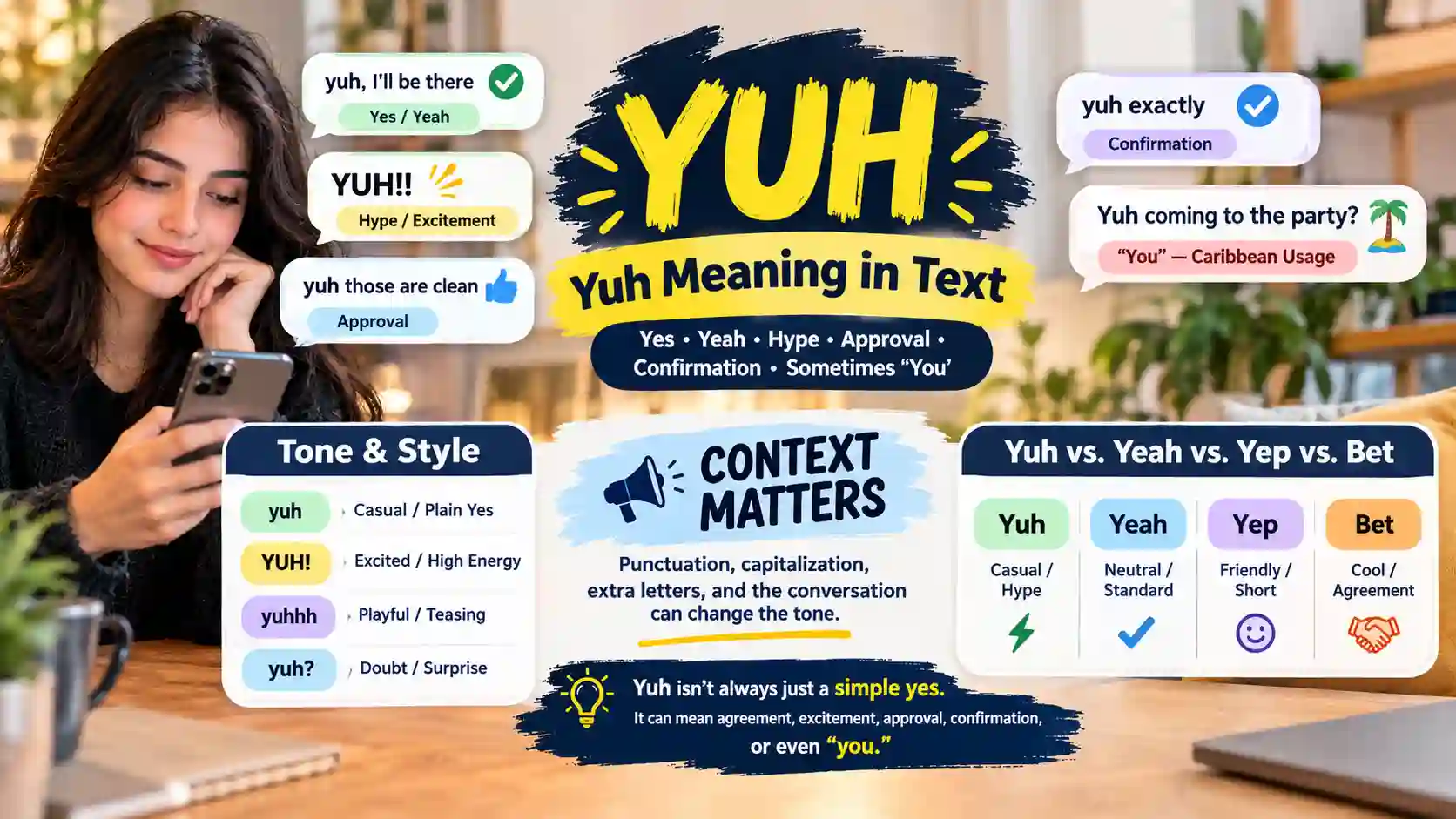
“Yuh” is a casual way to say “yes” or “yeah.” Think of someone shouting “Yeah!” when something goes right. That is “yuh!” too.
The Main Meanings
- Yes or yeah: “I agree.” / “Sure.”
- Hype or excitement: “Let’s go!” / “That’s awesome!”
- Approval: “Nice!” / “I like that.”
- Confirmation: “That’s right.” / “Exactly.”
- “You” (in some dialects): In Caribbean English and Jamaican Patois, “yuh” often means “you.”
Real-Life Examples
Simple yes:
You: Are you coming tonight?
Friend: yuh, I’ll be there
Hype:
Friend: I got the tickets!
You: YUH!!
Approval:
You: Check out my new shoes.
Friend: yuh those are clean
Confirming:
You: So we meet at six?
Friend: yuh exactly
As “you” (Caribbean usage):
Friend: Yuh coming to the party?
You: Yes, I’ll be there.
Quick Clues
- All caps (“YUH!”) usually means excitement.
- Lowercase (“yuh”) is usually a plain yes.
- Extra letters (“yuhhh”) can be playful or teasing.
- An exclamation mark adds energy.
- A question (“yuh?”) can mean “really?” or “right?”
Background & History
Where Did “Yuh” Come From?
“Yuh” is a spelling of how people say “yeah.” In speech, “yeah” can sound like “yuh,” “yah,” or “yeh.” People started typing it the way it sounds.
That is the simple part. The exact first use is hard to trace. Slang usually grows in speech first, then shows up in writing. No one can point to a single first text or first speaker. So it is best to say that “yuh” grew out of casual speech.
Roots in Different Communities
Several communities helped shape how “yuh” is used today:
- Caribbean English and Jamaican Patois: “Yuh” has long been used to mean “you” or “your.”
- African American English and hip-hop: “Yuh” is often an ad-lib, a short sound added in songs for energy.
- Southern US speech: “Yuh” and “yeah” blend naturally in many accents.
- Internet and gaming culture: Fast typing made short spellings popular.
How It Changed Over Time
Here is the rough path:
- Spoken first: People said “yuh” as a casual yes.
- Music: Rappers and singers used it as a shout of energy.
- Texting and chat: People typed it to match how they speak.
- Social media: TikTok and Instagram spread it more widely.
Where It Is Common Today
You will see “yuh” in:
- Text messages
- TikTok and Instagram
- Snapchat chats
- Gaming voice and text chat
- Music and rap lyrics
- Group chats
No single group owns it. It has grown beyond where it started.
Usage in Various Contexts
Texting Friends
This is the most common place. “Yuh” is a quick yes.
Friend: Want to grab food?
You: yuh, where?
Texting Family
Some people use it with family, but it is less common.
Sister: Did you finish your chores?
You: yuh, all done
Social Media
On social media, “yuh” shows support or hype.
Post: Just finished my first 5K!
Comment: YUH congrats!!
Post: New song out tonight.
Comment: yuh can’t wait
Gaming
In gaming, “yuh” can mean “yes,” “nice play,” or “let’s go.
Casual Conversations
Out loud, “yuh” is a relaxed “yeah.”
Friend: You good?
You: Yuh, I’m good.
In Music
In songs, “yuh” is a beat-driven shout. It adds rhythm and attitude. Fans often repeat it in comments.
Work Chats
At work, “yuh” is rare. Some casual teams may use it.
Coworker: Can you send the file?
You: yuh sending it now
Quick Guide
| Place | Likely Meaning |
| Texting friends | Yes or yeah |
| Social media | Hype or support |
| Gaming | Yes, nice, or let’s go |
| Caribbean chats | Sometimes “you” |
| Music | Energy shout |
| Work | Rare, casual yes |
Common Misconceptions & Clarifications
“Yuh Only Means Yes”
Not true. It also means excitement, approval, or “you” depending on the speaker. Context matters.
“Yuh Is Just a Typo”
Some people think it is a mistake for “yeah.” It is not. It is a chosen spelling to match a casual speaking style. Many people type it on purpose.
“Yuh Is Rude”
No. It is a casual word, not a rude one. The only issue is formality. It may feel too relaxed in formal places.
“Yuh Is Only for One Group”
Not true. People of many backgrounds use “yuh” today. It has roots in certain communities, so it is polite to be aware of that. But it has spread widely.
“Yuh” Versus “Yeah” Versus “Yah”
These are close. “Yeah” is the standard casual spelling. “Yah” is a similar sound, often playful. “Yuh” feels more relaxed and sometimes more rhythmic. The difference is small, and mostly about style.
“Yuh” Always Means Agreement
Not always. “Yuh?” with a question mark can mean doubt.
Friend: I’m going to run a marathon next week.
You: yuh? you’ve never run before
Here, “yuh?” means “Really?”
Is It Inappropriate?
No. It is not offensive. But if you copy a style that is not yours, be sure it feels natural. Forced slang can sound fake.
The Best Rule
When unsure, look at the mood. Is it playful or serious? Excited or calm? Use that to guide you. If it is still unclear, just ask.
Similar Terms & Alternatives
There are many ways to say the same thing.
Alternatives for “Yes”
- Yeah: The standard casual yes.
- Yep / Yup: Short and friendly.
- Yah: Playful yes.
- Sure: Easygoing yes.
- For sure: Strong yes.
- Fr (for real): Agreement with emphasis.
- Bet: Casual yes, like “okay, let’s do it.”
- Aight / Alright: Calm agreement.
Alternatives for Hype
- Let’s go!
- Yessir!
- Facts!
- W (win)
- Hype!
Comparison Table
| Term | Meaning | Tone | Energy |
| yuh | Yes, hype | Casual | Medium to high |
| yeah | Yes | Neutral | Low |
| yep | Yes | Friendly | Low |
| bet | Okay, deal | Cool | Medium |
| fr | For real | Casual | Medium |
| yessir | Yes, enthusiastic | Strong | High |
| sure | Okay | Easygoing | Low |
Why People Pick One Over Another
Some pick “yuh” for its relaxed feel. Others like “bet” for a cooler tone. Some use “yeah” because it works everywhere.
Tip: If you want to be clear with everyone, use “yes” or “yeah.” They are never wrong.
How to Respond to This Term
Your reply depends on the meaning. Here are four styles.
1. Casual
Use this with friends.
Friend: yuh
You: Cool, see you there!
Friend: YUH!!
You: Right?! So hyped.
2. Funny
Use humor when the mood is light.
Friend: yuh
You: Wow, such a strong answer. Very detailed.
Friend: YUHHH
You: That was the loudest text I’ve ever read.
3. Professional
Use this at work or school.
Coworker: yuh I can do that
You: Great, thank you. I’ll send the details.
If you want to nudge toward formal words:
Coworker: yuh
You: Just to confirm, you can complete this by Friday?
4. Privacy-Conscious
Sometimes you do not want to share more. That is okay.
Stranger: yuh, where do you live?
You: I’d rather not share that. Let’s talk about something else.
New contact: yuh, what’s your number?
You: I’ll keep chatting here for now.
When “Yuh” Means “You”
If someone uses it as “you,” just answer the question.
Friend: Yuh coming tomorrow?
You: Yes, I’ll be there.
What to Avoid
- Do not overthink. “Yuh” is usually simple.
- Do not mock how someone types. Slang is personal.
- Do not force slang. Be yourself.
- Do not skip a reply. A short answer keeps the chat warm.
Reply Cheat Sheet
| Style | Best For | Example |
| Casual | Friends | “Cool, see you there!” |
| Funny | Light chats | “Such a detailed answer.” |
| Professional | Work | “Great, thank you.” |
| Privacy | New contacts | “I’d rather not share that.” |
Regional or Cultural Differences
Is “Yuh” Used Everywhere?
It is common in many English-speaking places, but the meaning shifts a little.
Regional Notes
- United States: Common in casual texting, music, and gaming as “yeah” or a hype shout.
- Caribbean (such as Jamaica): Often used to mean “you” or “your,” as part of Patois and local speech.
- United Kingdom: Heard in some communities, especially those with Caribbean ties.
- Canada and Australia: Used mostly through online and music culture.
- Non-English countries: Used mainly when people chat in English online.
Regional Slang Twists
Small groups may use “yuh” in their own way. A school group might use it as a joke. A gaming server might use it as a cheer. These are local habits.
Similar casual “yes” words in English include:
- “Yeah” and “yep” across most regions.
- “Aye” in parts of Scotland and northern England.
- “Yah” in some Southern or surfer-style speech.
- “Ya” in various casual dialects.
A Note on Respect
Because “yuh” has roots in communities with rich language traditions, it is kind to use it naturally and respectfully. Avoid imitating accents or making fun of dialects.
Tip for Global Chats
When you chat with people from different places:
- Ask kindly if you are unsure.
- Use clear words when it matters.
- Notice their style and respond in a natural way.
A small word can carry a lot of culture.
Comparison with Similar Terms
Let’s put “yuh” next to a few look-alikes.
| Term | Meaning | Tone | Key Difference |
| yuh | Yes, hype, sometimes “you” | Casual | Flexible and rhythmic |
| yeah | Yes | Neutral | Standard casual yes |
| yep | Yes | Light | Short and friendly |
| yah | Yes | Playful | Often more upbeat or breezy |
| bet | Okay, deal | Cool | Shows commitment |
| fr | For real | Casual | Stresses truth |
| aye | Yes | Warm | Regional, sometimes old-fashioned |
How They Differ
“Yuh” vs. “Yeah”: “Yeah” is the all-purpose choice. “Yuh” has a more relaxed, rhythmic feel and can show hype.
You: Did you like the movie?
Friend: yeah (plain answer)
You: Did you like the movie?
Friend: YUH it was so good (excited answer)
Quick Tip
When two words look close, check the mood. The tone and the topic tell you which one fits.
Usage in Online Communities & Dating Apps
Dating Apps (Tinder, Bumble, Hinge)
On dating apps, “yuh” is a casual yes. It often signals a relaxed vibe.
Match: Do you like hiking?
You: yuh, love it
Match: Want to meet this weekend?
You: yuh, Saturday works
Here are some clues:
- “yuh!” shows enthusiasm.
- “yuh” alone may be a casual, low-effort yes.
- “yuh?” may show doubt or surprise.
- Many “yuh” replies in a row may mean the chat feels shallow. Add a question to deepen it.
Twitter and X
On Twitter or X, “yuh” is a quick reaction or hype.
Post: New album drops Friday!
Reply: YUH
TikTok and Instagram
In comments and captions, it shows excitement.
Video: Finally finished my project!
Comment: yuh congrats
Gaming Communities
On Discord, Twitch, and in voice chat, “yuh” can be a quick team response.
Captain: Push now?
Teammate: yuh go
Tips for Responding
- Match the energy. Be playful if they are playful.
- Keep it going. Ask a simple follow-up question.
- Be honest. Do not agree just to be polite.
- Do not rush. Let the chat grow.
- Use full words when it matters. Plans and details need clarity.
Safety Tips
On dating apps, never share your address, workplace, or money details with a new match. If a stranger pushes for private info, it is okay to stop replying.
Hidden or Offensive Meanings
Does “Yuh” Have a Rude Meaning?
No. “Yuh” is not an offensive word. It is a casual way to say “yes” or to cheer. It has no hidden rude meaning that I know of.
The Real Risk: Mix-Ups
The trouble is not rudeness. It is confusion. Because “yuh” has several meanings, people can misread it.
Friend: Yuh coming?
You: Yeah, I’m coming. (You understood “you.”)
Friend: Yuh!
You: Wait, was that a yes or a cheer? (You were unsure.)
When It Can Feel Dismissive
A plain “yuh” with no energy can feel like a low-effort reply. It may seem like the person does not care.
You: I need to tell you something important.
Friend: yuh
That may feel cold. It does not always mean the person does not care, but it can feel that way.
Sarcasm
Some people say “yuh” sarcastically. They may mean “yeah, right.”
You: I’m going to clean my room today.
Friend: yuhhh sure
The extra letters and “sure” hint at sarcasm.
Why Tone and Context Matter
Ask yourself:
- What did I just say?
- How does this person normally text?
- Are there emojis or other clues?
- Is it a question or a statement?
If it is still unclear, ask. A kind question solves most confusion.
Cultural Sensitivity
Since “yuh” has roots in certain dialects and communities, use it naturally. Do not use it to mock or copy an accent. Respect goes a long way.
A Kind Reminder
Do not read too much into one tiny word. Most “yuh” replies are friendly and simple. And if you send it, remember that extra words can add warmth.
Suitability for Professional Communication
Is “Yuh” Okay at Work?
Usually no. “Yuh” is casual slang. In professional settings, it can look careless or too relaxed.
Where It Might Be Okay
- A quick chat with a close coworker
- A casual team chat that already uses slang
- A friendly voice call
Where It Is Not Okay
- Emails to clients
- Messages to your boss, unless you know the style
- Job applications and interviews
- Reports and formal letters
- School essays
Why It Can Be a Problem
At work, “yuh” may sound:
- Too casual. It may lower the respect of the message.
- Unclear. The reader may not know if it means yes or hype.
- Unprofessional. It may not match the workplace style.
Professional Alternatives
| Casual | Professional Option |
| “yuh” | “Yes, absolutely.” |
| “yuh, sounds good” | “That works for me.” |
| “yuh I can do it” | “I can take care of that.” |
| “YUH!” | “That’s great news!” |
| “yuh, on it” | “I’m working on it now.” |
Example at Work
Manager: Can you send the report by noon?
Employee: yuh
(This may seem too casual.)
Better:
Manager: Can you send the report by noon?
Employee: Yes, I’ll send it by noon.
(Clear and polite.)
Simple Rule
If it is work, use clear words. “Yes” is always safe, and it always sounds professional.
FAQs
1. What does “yuh” mean in text?
It usually means “yes” or “yeah.” It can also be an excited cheer. In Caribbean English, it can also mean “you.”
2. Is “yuh” the same as “yeah”?
Close, but not exactly. “Yeah” is the standard casual spelling. “Yuh” feels more relaxed and can show hype.
3. Is “yuh” rude?
No. It is not a rude word. It is just casual, so it may not fit formal settings.
4. How do I reply to “yuh”?
Match the mood. A friendly answer works for most chats. If it is a cheer, cheer back. If it is a question, answer it.
5. Can I use “yuh” at work?
In a casual chat with close coworkers, maybe. In emails or formal messages, use “yes” instead.
6. Where did “yuh” come from?
It started as a spoken version of “yeah,” then grew through texting, music, and social media. It is also tied to Caribbean speech, where it can mean “you.”
7. What does “yuh?” with a question mark mean?
It usually shows doubt or surprise, like “Really?” or “Is that right?” Look at the topic of the chat for clues.
Conclusion
“Yuh” is a small word with a big feel. It can mean yes, hype, approval, or “you.” It grew out of casual speech and spread through texting, music, and social media.
Here are the key points to remember:
- Context is everything. Look at who is talking, how they text, and what the topic is.
- Tone matters. Caps, extra letters, and punctuation change the meaning.
- It is not rude. It is just casual.
- Ask if unsure. A quick question clears up most mix-ups.
- Use clear words at work. “Yes” is always safe.
Next time you see “yuh,” you will know what to do. Read the mood, match the energy, and reply with confidence.
Discover More Article

Hi, I’m Mahgull, a dedicated content writer with 2 years of experience in the meaning niche. I enjoy turning complex words, slang, abbreviations, and phrases into simple, informative content that helps readers understand their meanings clearly and quickly.