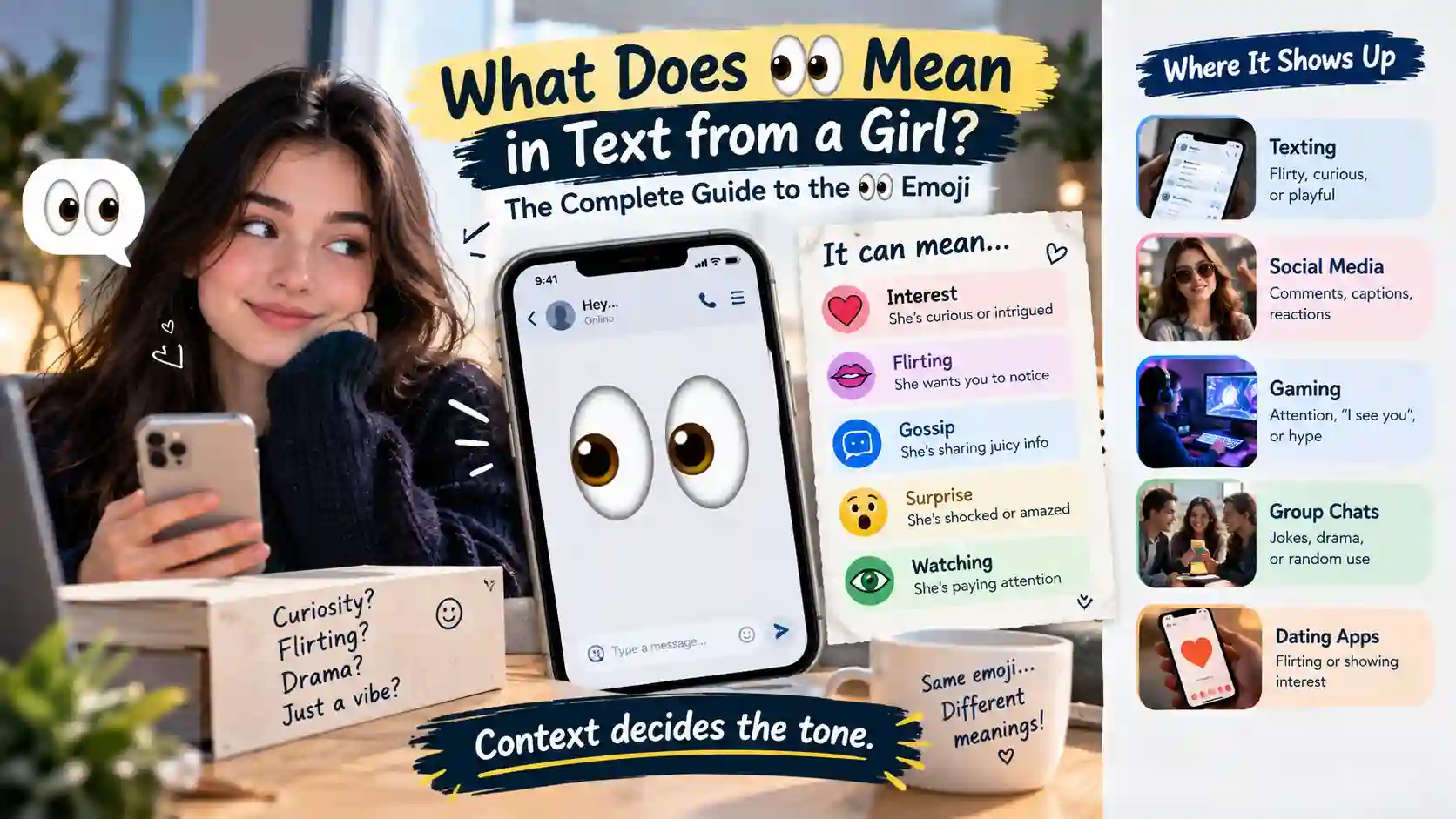
You’re texting a girl, things are going well, and suddenly she sends just one thing: 👀. No words. No explanation. Just two eyes staring back at you from your screen.
What is she trying to say?
The 👀 emoji has become one of the most versatile symbols in modern texting. It shows up in flirty conversations, group chats, social media comments, gaming lobbies, and even the occasional office Slack channel. Because it has no fixed meaning, it relies entirely on context, tone, and timing.
Understanding what 👀 means isn’t just about decoding an emoji. It’s about understanding modern digital communication, where a single symbol can carry curiosity, flirtation, suspicion, excitement, or even a warning. This guide breaks down everything you need to know about the 👀 emoji, especially when a girl sends it to you.
Definition & Meaning
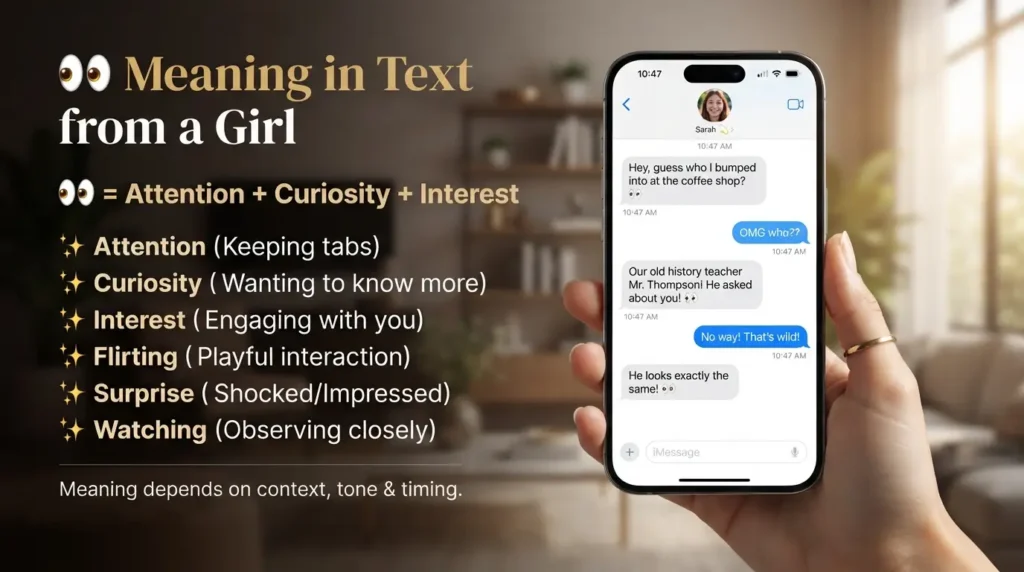
The 👀 emoji, officially called “Eyes,” depicts two eyeballs looking to the side. Unlike a text word, its meaning shifts based on the conversation it appears in. In general, it signals attention, interest, or awareness. It’s the digital version of someone raising an eyebrow or glancing over meaningfully.
When a girl sends 👀 in a text, it typically means one of the following:
- She’s interested or intrigued by something you said
- She’s flirting and wants you to notice
- She’s calling attention to gossip or a juicy detail
- She’s surprised by news you shared
- She’s watching a situation unfold, often in a group chat
Example in dialogue:
You: I might have a date this weekend 👀
Her: 👀👀👀 wait who??
Here, 👀 works as an expression of excited curiosity she wants details immediately.
Another common use is flirtatious teasing:
Her: I saw you at the gym today
You: oh yeah? did you like the view
Her: 👀
In this case, the emoji replaces a wink or a coy smile, implying “I noticed, and I’m not going to say more than that.”
Because 👀 is non-verbal, its true meaning almost always depends on the message before it, the relationship between the two people, and the emotional tone of the conversation.
Background & History
The eyes emoji, 👀, was added to the Unicode Standard in 2010 as part of the original emoji set and became widely available across platforms by the mid-2010s. Originally, it was used literally to say “I’m watching” or “I see this.”
As texting culture evolved, especially with the rise of Twitter, group texts, and meme culture in the late 2010s, 👀 took on a more playful, exaggerated role. People began using it to represent suspicion, gossip, or “spilling tea” without needing to type anything at all.
By the early 2020s, 👀 had become a staple of internet shorthand. It appeared constantly in:
- Twitter replies hinting at scandal or drama
- Instagram comments reacting to attractive photos
- Group chats reacting to bold or juicy statements
- Dating app messages as a flirtatious nudge
Today, 👀 is one of the most recognizable “reaction emojis” used less to describe literal eyes and more to represent a feeling: curiosity, attraction, suspicion, or amusement. Its meaning has broadened so much that it now functions almost like a punctuation mark for implication.
Usage in Various Contexts
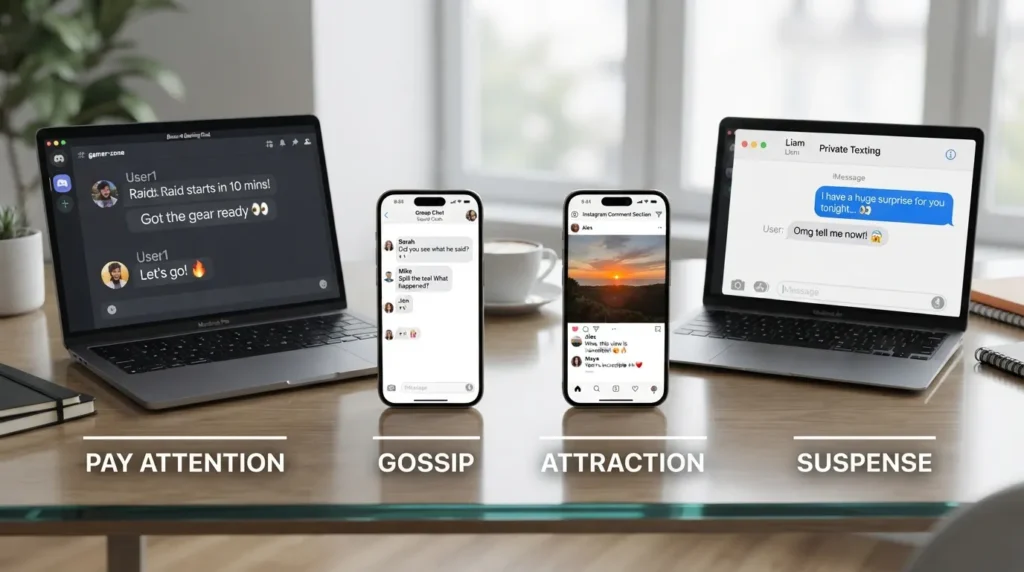
The 👀 emoji adapts to whatever platform or conversation it’s dropped into. Here’s how it typically shows up:
In Texting
Her: guess who just matched with me on the app
You: who??
Her: 👀 you’ll never guess
Here, 👀 builds suspense before revealing information.
In Social Media Comments
Under a photo, someone might comment just “👀” signaling admiration or attraction without spelling it out.
In Gaming Communities
In multiplayer games or Discord servers, 👀 often means “I see something” or “pay attention here”:
Player 1: enemy spotted top lane
Player 2: 👀 got it, rotating now
In Casual Group Chats
Friend: so I heard someone in this chat has a crush 👀
You: don’t look at me 😅
In each case, the emoji conveys implied meaning without explicit words, which is exactly why it’s so popular it lets the sender hint at something without fully committing to saying it outright.
Common Misconceptions & Clarifications
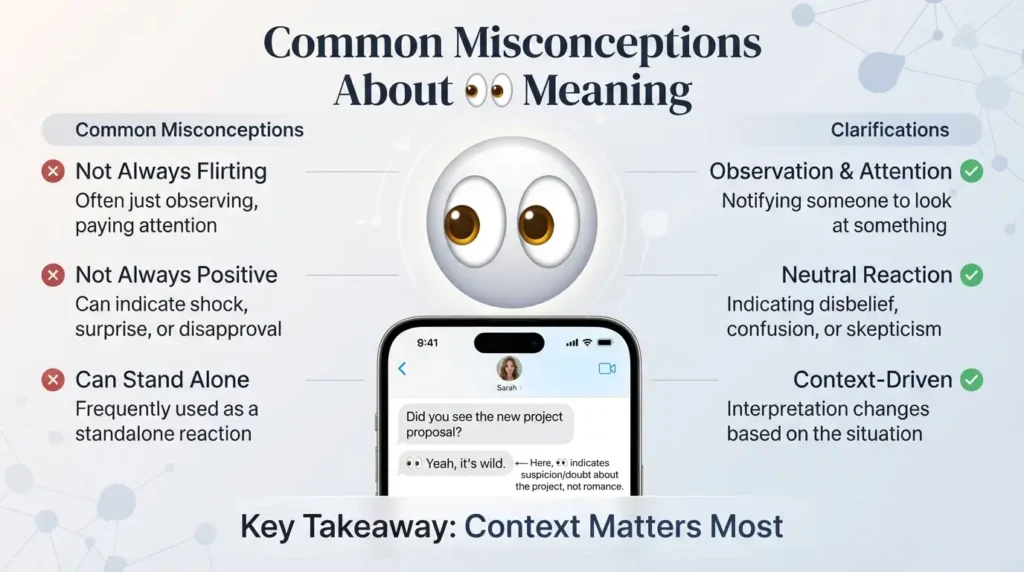
One of the biggest misconceptions is that 👀 always means flirting. In reality, it’s a general-purpose “attention” emoji, and its emotional tone depends entirely on context.
Misconception 1: It always means romantic interest.
Not true. It can just as easily mean “I’m intrigued by this gossip” or “I’m watching this situation,” with zero romantic undertone.
Misconception 2: It’s always positive.
Sometimes 👀 can signal mild suspicion or side-eye, such as:
Her: you said you were busy but I saw you online all night 👀
Here, it functions almost like calling someone out a digital raised eyebrow.
Misconception 3: It needs a caption to make sense.
Actually, part of its charm is that it works alone. A solo 👀 in response to a bold statement is a complete sentence in emoji form.
Clarification: Context clues matter more than the emoji itself. Look at:
- What was said right before it
- The emotional tone of the conversation
- Whether there’s history of flirting between you two
Without those clues, 👀 is intentionally ambiguous which is often the point.
Similar Terms & Alternatives
Several other emojis and phrases carry similar or overlapping meanings to 👀. Here’s how they compare:
| Term/Emoji | Meaning | Tone |
| 👀 | Attention, curiosity, subtle flirtation | Playful, ambiguous |
| 😏 | Smug or flirtatious hint | Confident, teasing |
| 👁️👄👁️ | Shocked or intrigued reaction | Comedic, dramatic |
| “Interesting…” | Verbal version of 👀 | Curious, suggestive |
| “Tell me more” | Direct request for details | Genuine curiosity |
| 🍵 (tea emoji) | Requesting gossip | Playful, nosy |
While these terms overlap, 👀 stands out because it can be used alone, replacing an entire sentence, whereas most alternatives need supporting text to land properly.
How to Respond to This Term
If a girl sends you 👀, your response should match the tone of the conversation. Here are some approaches:
Casual Response
“haha why the eyes 👀”
Playful/Flirty Response
“oh you know exactly what I mean 😏”
Funny Response
“the 👀 is doing a lot of talking right now lol”
Privacy-Conscious Response (if you’d rather not share details)
“I’ll tell you later, not over text 👀”
Professional Context (rare, but possible in casual work chats)
“Ha, I see you noticed let’s chat about it later.”
The key is to read the emotional temperature of the conversation. If she’s clearly flirting, lean into playful energy. If it seems like she’s just curious about gossip, respond with more detail or tease her back.
Regional or Cultural Differences
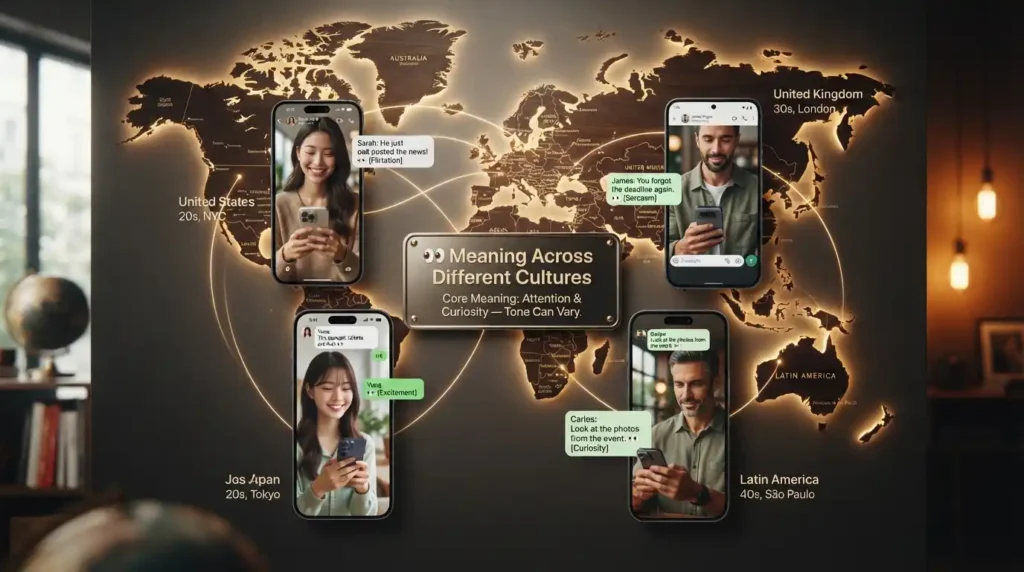
The 👀 emoji is used globally, but interpretation can shift slightly by region and culture:
- United States: Commonly used for flirtation, gossip, or reacting to bold statements.
- United Kingdom: Often used similarly, though sometimes with a more sarcastic or dry tone.
- Asian markets (e.g., Japan, South Korea): Frequently used in fandom culture and messaging apps like LINE or KakaoTalk to express excitement or anticipation, especially around celebrity content.
- Latin America: Popular in casual texting to imply curiosity or subtle flirtation, often paired with laughing emojis.
While the core meaning attention or curiosity stays consistent worldwide, the intensity of flirtation implied can vary. In some cultures, texting norms are more reserved, so 👀 might carry a stronger flirtatious undertone than in cultures where bold, direct texting is the norm.
Comparison with Similar Terms
To further clarify how 👀 differs from related expressions:
| Expression | Primary Use | Implies Flirting? | Can Stand Alone? |
| 👀 | General attention/curiosity | Sometimes | Yes |
| 😏 | Smug/flirty hint | Often | Yes |
| “lol really?” | Surprise, disbelief | Rarely | No |
| 🔥 | Attraction, approval | Often | Yes |
| “omg tell me” | Direct curiosity | Rarely | No |
The main distinction is that 👀 is more subtle and ambiguous, while emojis like 😏 or 🔥 are more overtly flirtatious. This subtlety is exactly why 👀 works so well it lets the sender gauge interest without fully exposing their intentions.
Usage in Online Communities & Dating Apps
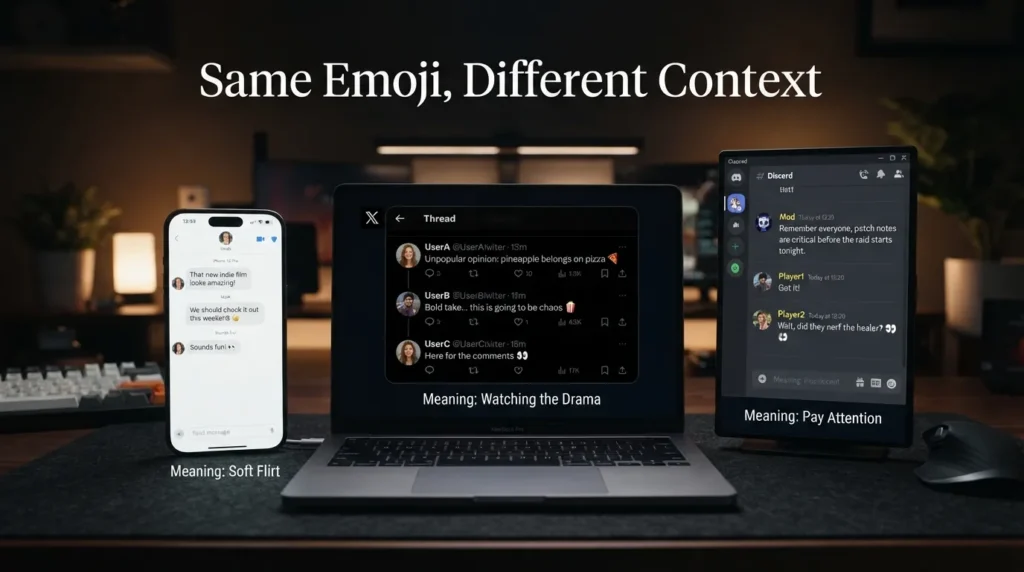
On dating apps like Tinder, Bumble, or Hinge, 👀 is a common icebreaker reaction. If a girl sends 👀 after your bio or a photo, it usually signals mild attraction or amusement a lighter version of a compliment.
Example:
Her: your dog is cuter than you 👀
You: rude but fair, wait till you meet him in person
On Twitter/X, 👀 often appears under posts hinting at drama, announcements, or attractive content, functioning as a way to say “I’m watching this unfold” without commenting directly.
In gaming communities (Discord, Twitch chat), 👀 usually flags something worth noticing an enemy sighting, a funny moment, or reaction to a clutch play.
Tips for responding appropriately:
- On dating apps, treat 👀 as a soft flirt respond with light humor or a follow-up question.
- In group chats, use it to acknowledge something interesting without fully committing to a reaction.
- Avoid overanalyzing a single 👀 it’s often light and meant to spark a fun exchange, not a serious declaration.
Hidden or Offensive Meanings
For the most part, 👀 is harmless and playful. However, tone and context can shift its meaning:
- Passive-aggressive undertone: When used after catching someone in a lie or inconsistency, 👀 can imply suspicion or side-eye judgment.
Her: you said you were asleep but you liked my photo at 2am 👀
- Voyeuristic connotation: In rare cases, especially paired with certain suggestive captions, 👀 might imply overly watchful or intrusive behavior. This is uncommon but worth noting in unfamiliar conversations.
- Sarcastic call-out: Sometimes used to expose contradictions or catch someone off guard, functioning almost like “caught you.”
Why tone and context matter: Because 👀 has no inherent negative meaning, misinterpreting it can lead to unnecessary awkwardness. Always consider the full conversation, not just the emoji in isolation, before assuming a hidden or negative meaning.
Suitability for Professional Communication
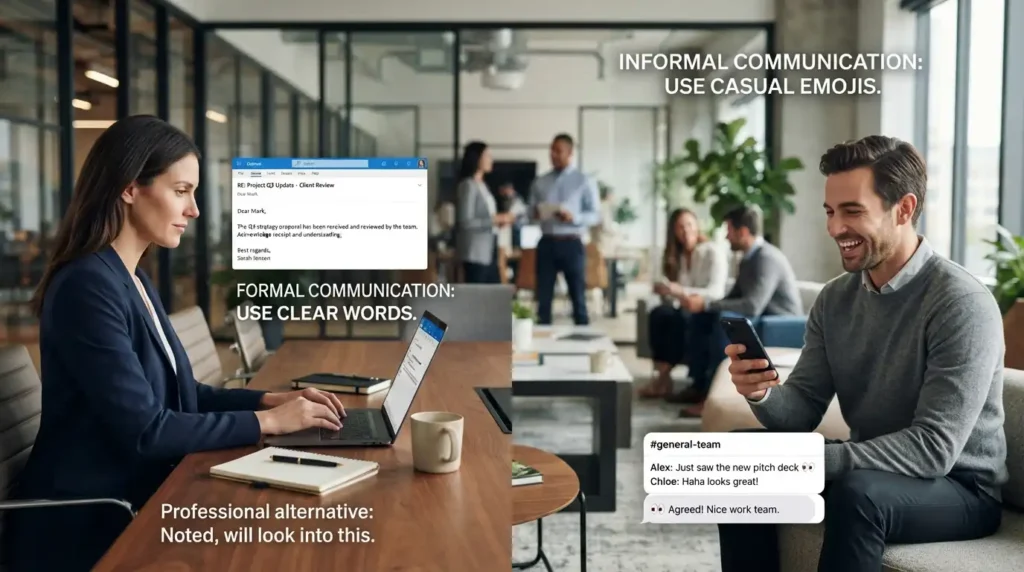
Generally, 👀 is not appropriate for formal business communication, such as emails to clients, official reports, or corporate messaging with senior leadership. It reads as casual and can seem unprofessional in serious contexts.
However, in casual internal workplace chats (like a relaxed Slack channel among close colleagues), it may be acceptable to flag interesting updates lightly.
Professional alternatives:
- “Noted, will look into this.”
- “Interesting let’s discuss further.”
- “I’ll keep an eye on this.”
- “This caught my attention, following up shortly.”
If unsure, it’s safer to avoid emojis altogether in professional settings and default to clear, direct language.
FAQs
1. Does 👀 always mean a girl is flirting with me?
No. It can mean curiosity, gossip, suspicion, or amusement, depending on context.
2. What should I say if she sends just 👀 with no text?
Ask a light follow-up question or tease her back, since it likely means she wants a reaction from you.
3. Is 👀 considered childish or unprofessional?
It’s casual, so it’s best avoided in formal business communication, but it’s completely normal in everyday texting.
4. Can 👀 be used to call someone out?
Yes, it can imply “I noticed that” in a slightly suspicious or teasing way.
5. Is the meaning of 👀 different across cultures?
The core meaning stays similar globally, though the intensity of implied flirtation can vary by region.
6. What’s the difference between 👀 and 😏?
👀 is more ambiguous and curiosity-driven, while 😏 leans more directly into flirtation or smugness.
7. Should I worry if a girl sends 👀 after a serious topic?
Not necessarily it might just mean she’s intrigued or processing what you said, not that something is wrong.
Conclusion
The 👀 emoji has become a staple of modern digital communication because of its flexibility. It can express curiosity, flirtation, suspicion, or amusement all without a single word. When a girl sends 👀 in a text, the real meaning depends on the conversation’s tone, history, and context.
Rather than overanalyzing it, treat 👀 as an invitation to keep the conversation going. Whether she’s teasing you, hinting at attraction, or just reacting to something interesting, the best response is usually one that matches her energy and keeps things light and engaging.
Discover More Article

Hello, I’m Insha, a passionate content writer with 2 years of experience creating clear, engaging, and helpful content. I specialize in the meaning niche, explaining words, slang, phrases, and online terms in simple language that readers can easily understand and use.