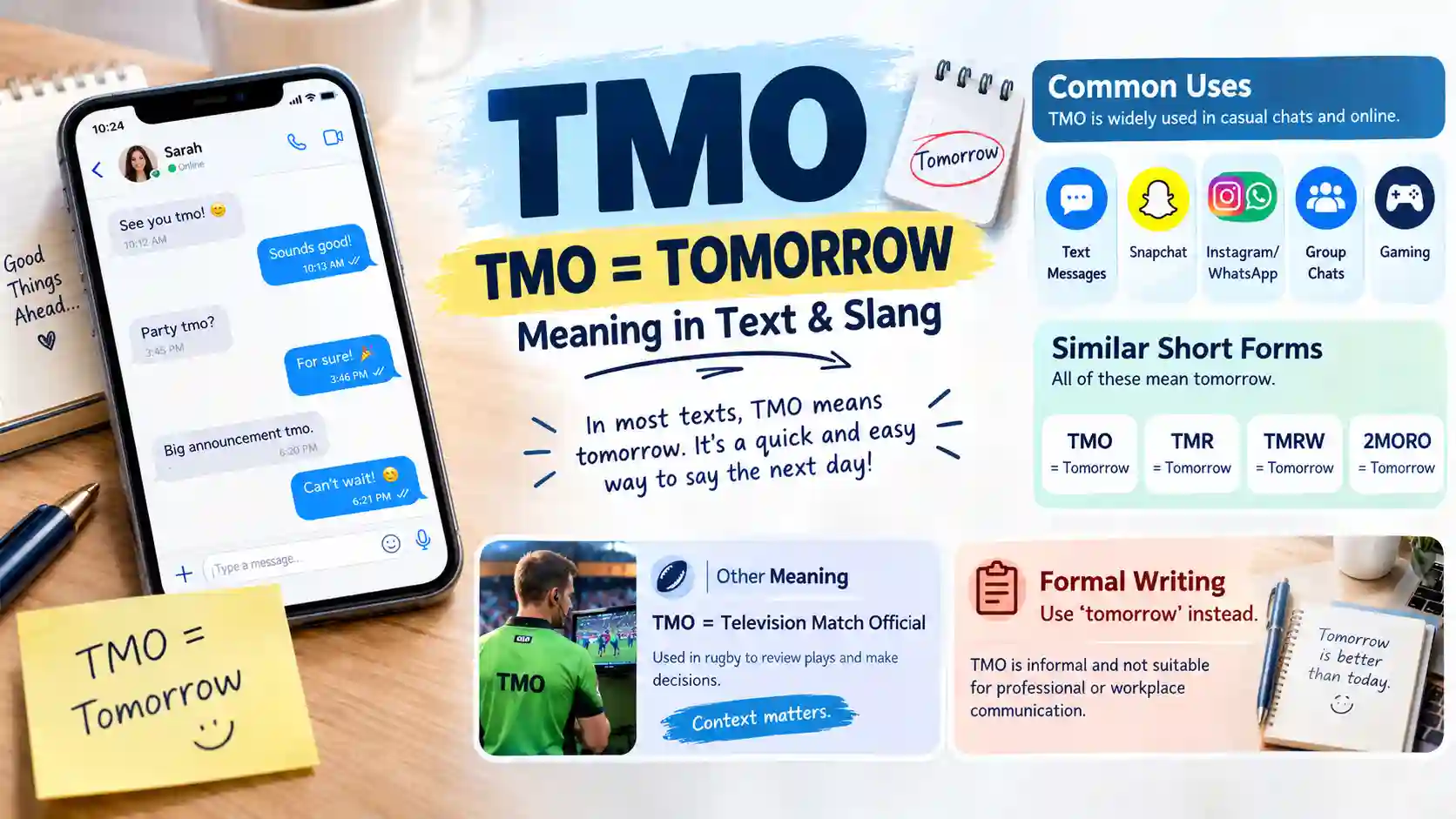
You get a text. It says, “See you tmo.”
Wait. What is “tmo”? Is it a name? A code? A mistake?
Don’t worry. It is easy once you know. In most texts, “tmo” is a short way to write “tomorrow.” People shorten it to save time. You will see it in texts, Snapchat, and group chats. Sometimes you will see it in game chats too.
This matters because plans depend on days. If you misread “tmo,” you might show up on the wrong day. You might also think a message is a secret code when it is not.
In this post, you will learn what “tmo” means.
Let’s start.
Definition & Meaning
The Short Answer
“Tmo” most often means “tomorrow.”
It is a shortened spelling. It belongs to a family of text shortcuts for the same word. You may also see “tmr,” “tmrw,” “tmro,” “2moro,” and “tomoz.” They all point to the same day.
Be Honest About the Evidence
Here is the plain truth. I could not find a trusted dictionary entry for “tmo” by itself. But the related forms are well covered. One guide says “tomorrow” is the most common and widely accepted meaning of “tmr.” Another says “tmrw” is a short form of “tomorrow” used in texts and social media. “Tmo” follows the same pattern. That is why “tomorrow” is the best answer.
Why People Use It
People shorten words when they type fast. “Tmo” has three letters. “Tomorrow” has eight. It saves time. It also feels casual.
Real Examples
Making plans:
Friend: When are we meeting?
You: tmo at 5?
Sending a reminder:
Mom: Don’t forget your test tmo.
You: I won’t. Thanks!
Talking about work:
Coworker: Can you send the file?
You: I’ll do it tmo morning.
Canceling:
Friend: Are you free tonight?
You: Can’t. Big day tmo.
Other Meanings
Some uses are not about texting:
- Rugby: “TMO” means Television Match Official, the person who checks video replays.
- T-Mobile: Some people shorten the phone company’s name to “TMO.”
You will rarely see these in a normal chat. Look at the topic.
Quick Clues
- Talking about plans? It means “tomorrow.”
- Talking about a rugby game? It means the video referee.
- Talking about phone plans? It may mean T-Mobile.
Background & History
Where Did “Tmo” Come From?
“Tmo” is a shortened spelling of “tomorrow.” People have always cut words to write faster.
Early phones had small keys and limited space. So people dropped letters. “Tomorrow” became “2moro,” “tmrw,” “tmr,” and “tmo.”
No one knows who first typed “tmo.” Slang is hard to track. It spreads quietly through chats and posts.
How It Spread
Here is the simple path:
- Short notes: People cut vowels to save time.
- Early texting: Small keypads made short forms popular.
- Chat apps: Snapchat, WhatsApp, and Instagram kept them alive.
- Today: “Tmo” is one of many ways to type “tomorrow.”
Why Letters Drop Out
Many text shortcuts keep the consonants. They drop the vowels. Think of “pls” for “please” and “txt” for “text.” “Tmo” follows that style.
Be Careful With Odd Claims
Some websites say “tmo” is a secret code. One says it comes from Japanese slang. Another says it means “text me only.” Another says it means “target marketing optimization.” These pages contradict each other. They show no real proof. Some even look auto-generated. Do not trust them.
Where It Is Common Today
You will see “tmo” in:
- Text messages
- Snapchat chats
- Instagram and WhatsApp
- Game chats
- Group chats
Usage in Various Contexts
Texting Friends
In texts, “tmo” is a quick way to say “tomorrow.”
Friend: Want to hang out?
You: Sure. tmo after school?
Social Media
On social media, it shows up in captions and comments.
Post: Big news coming tmo.
Comment: Can’t wait!
Post: New video drops tmo.
Comment: Setting a reminder.
Gaming
In games, players use it to plan sessions.
Player 1: Can you play tonight?
Player 2: No. Let’s run it tmo.
Casual Chats
Out loud, people say “tomorrow.” Some say “tomoz.” Typed “tmo” is mostly for texts.
Friend: What time is the party?
You: tmo at 7.
Family Chats
Parents may not know the short form. Be ready to explain.
Dad: What is “tmo”?
You: It means tomorrow, Dad.
Work Chats
At work, “tmo” is rare. Some casual teams use it.
Coworker: When do you need the file?
You: Can send it tmo morning.
Quick Guide
| Place | Likely Meaning |
| Texts with friends | Tomorrow |
| Social media | Tomorrow |
| Game chat | Tomorrow |
| Rugby talk | Television Match Official |
| Phone plan talk | T-Mobile |
| Work | Tomorrow (casual only) |
Common Misconceptions & Clarifications
“Tmo Is a Secret Code”
No. It is just a short spelling of “tomorrow.” Some sites make it sound mysterious. It is not.
“Tmo Has a Fixed Official Meaning”
Not really. It is informal. There is no official rule. People use it by habit.
“Tmo Means ‘Text Me Only'”
Some low-quality pages say this. It does not fit how people use it. In a normal chat, “tmo” is almost always about a day.
“Tmo Means ‘Tell Me Otherwise'”
One page says this too. It looks like a guess. Do not trust it.
“Tmo Is a Brand or a Name”
No. It is not a name. The only brand link is a casual shorthand for T-Mobile.
“Tmo, Tmr, and Tmrw Are Different”
No. They all mean “tomorrow.” The spelling changes. The meaning does not.
“Tmo Is Rude”
No. It is a harmless shortcut. The only issue is formality. It is too casual for formal writing.
Is It Inappropriate?
No. It has no rude meaning. It is just informal.
Mix-Up Risk: The Wrong Day
The big risk is simple. You read the wrong day. For example, “tmo night” means tomorrow night, not tonight. Read the whole message.
You: Dinner tmo night?
Friend: Tomorrow night? Yes!
The Best Rule
When unsure, ask. A quick question avoids a missed plan.
Similar Terms & Alternatives
Many shortcuts mean “tomorrow.”
Short Forms of “Tomorrow”
- Tmo: The shortest of the common forms.
- Tmr: A popular short form.
- Tmrw: A very common short form.
- Tmro: A common abbreviation.
- 2moro: A text-style spelling with a number.
- Tomoz: A casual spoken-style form.
- Tom: A very short form.
Related Time Shortcuts
- Tn / Tmn: Tomorrow night (some guides list “TMN”).
- Tm: Tomorrow morning (some guides list this).
- Tonite: Tonight.
- Rn: Right now.
- Asap: As soon as possible.
Comparison Table
| Term | Meaning | Tone |
| tmo | Tomorrow | Casual |
| tmr | Tomorrow | Casual |
| tmrw | Tomorrow | Casual |
| 2moro | Tomorrow | Playful |
| tomoz | Tomorrow | Relaxed |
| tomorrow | Tomorrow | Clear, works everywhere |
Why People Pick One
Some like “tmo” because it is the shortest. Others like “tmrw” because it is easier to read. Some like the full word because it is always clear.
Tip: Want everyone to understand? Write “tomorrow.”
How to Respond to This Term
Your reply depends on the mood. Here are four styles.
1. Casual
Use this with friends.
Friend: See you tmo!
You: See you then!
Friend: Free tmo?
You: Yes. What time?
2. Funny
Use humor if the mood is light.
Friend: Gym tmo?
You: Tomorrow me will handle that. Today me is busy.
Friend: Study tmo?
You: Sure, if “tomorrow me” wakes up on time.
3. For Work or School
Keep it polite and clear.
Coworker: I’ll send it tmo.
You: Thank you. Please send it by 10 a.m. tomorrow.
Teacher: Quiz tmo.
Student: Thank you. I’ll be ready.
4. Private and Safe
Sometimes you do not want to share plans. That is okay.
Stranger: Where will you be tmo?
You: I don’t share my plans.
New contact: Meet tmo at my place?
You: I’d rather meet in a public place first.
Confirm the Plan
Plans work best with clear details.
Friend: Meet tmo?
You: Sure. Where and what time?
What to Avoid
- Don’t guess the time. Ask for details.
- Don’t assume it means tonight.
- Don’t share your location with strangers.
- Don’t ignore the message. A reply keeps plans clear.
Quick Reply Guide
| Style | Best For | Example |
| Casual | Friends | “See you then!” |
| Funny | Light chats | “Tomorrow me will handle it.” |
| Work | Boss, school | “Please send it by 10 a.m.” |
| Private | Strangers | “I don’t share my plans.” |
Regional or Cultural Differences
Is “Tmo” Used Everywhere?
It is mostly English slang. You will see it in places where English is common in texts. That includes the US, UK, Canada, Australia, and many global chats.
Other Languages
One guide notes that “tmr” is used in English-speaking and Spanish-speaking regions, and has spread to other languages among younger users. Other languages have their own short forms for “tomorrow.” “Tmo” is mostly an English habit.
Regional Notes
- United States: “Tmrw” and “tmr” are more common than “tmo.”
- United Kingdom and Australia: “Tomoz” is often heard in casual speech.
- Canada: Similar to the US, with mixed forms.
- Non-English countries: Used when people chat in English online.
These are general trends. They are not strict rules.
Other Meanings by Region
In rugby countries, such as the UK, Ireland, New Zealand, Australia, and South Africa, “TMO” is a well-known term. It means the Television Match Official. A rugby fan who writes “TMO” may mean the video referee, not tomorrow.
Tip for Global Chats
When you chat with people from other places:
- Don’t assume they know the short form.
- Write “tomorrow” if plans matter.
- Ask kindly if you are unsure.
A short word can mean different things in different places.
Comparison with Similar Terms
Let’s compare “tmo” with a few look-alikes.
| Term | Meaning | Tone | Key Difference |
| TMO | Tomorrow | Casual | Shortest common form |
| TMR | Tomorrow | Casual | Very common form |
| TMRW | Tomorrow | Casual | Easier to read |
| 2MORO | Tomorrow | Playful | Uses a number |
| TOMOZ | Tomorrow | Relaxed | Sounds like speech |
| TMN | Tomorrow night | Casual | Adds the time of day |
| TMO (rugby) | Television Match Official | Neutral | Not about time |
How They Differ
TMO vs. TMR: They mean the same thing. “TMR” is more common.
TMO vs. TMN: “TMN” adds “night.” It narrows the time.
Friend: Movie tmo? (Sometime tomorrow.)
Friend: Movie tmn? (Tomorrow night.)
TMO vs. TOMOZ: Same meaning. “Tomoz” sounds like speech. “Tmo” is for typing.
TMO vs. the rugby TMO: Same letters. Totally different meaning. The topic tells you which one.
Quick Tip
When two terms look close, check the topic. Plans mean tomorrow. Rugby means the video referee.
Usage in Online Communities & Dating Apps
Snapchat and Instagram
This is where “tmo” is most common. It is a short, easy way to plan.
Friend: Party tmo?
You: I’m in!
Twitter and X
On Twitter or X, people use it for quick updates.
Post: Big announcement tmo.
Reply: Can’t wait.
Gaming Communities
On Discord and Twitch, “tmo” helps plan matches.
Captain: Raid tmo at 8.
Team: Got it.
Dating Apps
On Tinder, Bumble, and Hinge, “tmo” shows up when people plan dates.
Match: Free tmo?
You: I am. Coffee at 4?
Some clues:
- “tmo” with a time shows real interest.
- “tmo?” alone may be vague.
- Last-minute “tmo” plans may need extra care.
Tips for Replying
- Confirm the details. Ask where and when.
- Be clear. Write “tomorrow” if you need to be exact.
- Be honest. Say no if it doesn’t work.
- Be polite. Thank the person for asking.
Safety Tips
On dating apps, never share your home address. Never share your work place. Never share money details. Meet in a public place. Tell a friend where you are going. Trust your gut.
Hidden or Offensive Meanings
Is “Tmo” Rude?
No. “Tmo” is not an offensive word. It means “tomorrow.” It has no rude meaning that I could find.
Odd Meanings Online
Many pages online claim “tmo” means something strange. Those pages disagree with each other and give no proof. If a meaning does not fit your chat, do not trust it.
The Real Risk: Mix-Ups
The real problem is confusion, not rudeness. A few common mix-ups:
- Wrong day: “tmo night” is tomorrow night, not tonight.
- Rugby “TMO”: Same letters, different meaning.
- A typo: Someone may have meant “tmr” or “tm.”
When It Feels Cold
A plain “tmo” can feel flat after a long message. It is not rude. It is just short.
You: I really want to see you. Can we meet?
Friend: tmo
This may feel quick. But your friend may just be busy.
Why Tone Matters
Ask yourself:
- What was the question?
- Is this about plans?
- How does this person usually text?
- Are there emojis or details?
Still not sure? Ask. A kind question helps.
A Kind Reminder
Don’t read too much into one short word. Most “tmo” texts simply mean “tomorrow.” If you send it, a few extra words add warmth and clarity.
Suitability for Professional Communication
Is “Tmo” Okay at Work?
Usually no. “Tmo” is slang. At work, it can look careless. Some readers may not know it. Some may think it is a typo.
Where It May Be Okay
- A quick chat with a close coworker
- A casual team chat
- A fast note that no one else will read
Where It Is Not Okay
- Emails to clients
- Messages to your boss
- Job applications
- Reports and letters
- School work
One guide on similar slang says it is better to use the full word “tomorrow” in a workplace to stay professional. That is good advice here too.
Why It Can Cause Trouble
At work, “tmo” may sound:
- Too casual. It lowers the tone.
- Unclear. Some readers may not get it.
- Risky. A wrong date can cause real problems.
Better Choices for Work
| Casual | Better Choice |
| “tmo” | “Tomorrow.” |
| “tmo morning” | “Tomorrow morning.” |
| “see you tmo” | “See you tomorrow.” |
| “due tmo” | “Due tomorrow.” |
| “tmo at 3” | “Tomorrow at 3 p.m.” |
Work Example
Manager: When will the report be done?
Employee: tmo
This is short and may confuse the reader.
Better:
Manager: When will the report be done?
Employee: I’ll send it tomorrow by noon.
This is clear and polite.
Simple Rule
At work, write “tomorrow.” Add a time if you can.
FAQs
1. What does “tmo” mean in text?
It most often means “tomorrow.” It is a short, casual spelling.
2. Is “tmo” the same as “tmr” and “tmrw”?
Yes. They all mean “tomorrow.” Only the spelling is different.
3. Does “tmo” have other meanings?
Sometimes. In rugby, “TMO” means Television Match Official. Some people also use it for T-Mobile. The topic tells you which one.
4. Is “tmo” rude?
No. It is a harmless shortcut. It is just casual.
5. How do I reply to “tmo”?
Confirm the plan. Ask for the time and place. If it is work, write “tomorrow” in full.
6. Can I use “tmo” at work?
Only in very casual chats. In emails and formal messages, write “tomorrow.”
7. Why do some websites give strange meanings for “tmo”?
Many are low-quality pages that guess or copy each other. Some contradict each other. The “tomorrow” meaning fits the way people actually use it in plans and texts.
Conclusion
“Tmo” is a small word with a simple core. It most often means “tomorrow.” It is one of many short spellings, like “tmr” and “tmrw.” In rugby, “TMO” means the video referee.
Here are the key points:
- Start with “tomorrow.” It is the best fit.
- Check the topic. Plans mean tomorrow. Rugby means the referee.
- Ignore odd claims online. Many pages guess.
- It is not rude. It is just casual.
- Write “tomorrow” at work. It is clear and safe.
Next time you see “tmo,” you will know what to do. Read the whole message. Confirm the plan. And ask if you are unsure.
Discover More Article

Hello, I’m Insha, a passionate content writer with 2 years of experience creating clear, engaging, and helpful content. I specialize in the meaning niche, explaining words, slang, phrases, and online terms in simple language that readers can easily understand and use.





1 thought on “TMO Meaning in Text: What Does “TMO” Mean? (for2026)<p class="post-updated-date">🕓 <span class="updated-label">Last updated on</span> <time datetime="2026-10-23T11:27:34+00:00">October 23, 2026</time></p><script type="application/ld+json"> { "@context": "https://schema.org", "@type": "BlogPosting", "mainEntityOfPage": { "@type": "WebPage", "@id": "https://outreachnexa.com/tmo-meaning-in-text/" }, "datePublished": "2026-10-23T11:27:32+00:00", "dateModified": "2026-10-23T11:27:34+00:00" } </script>”