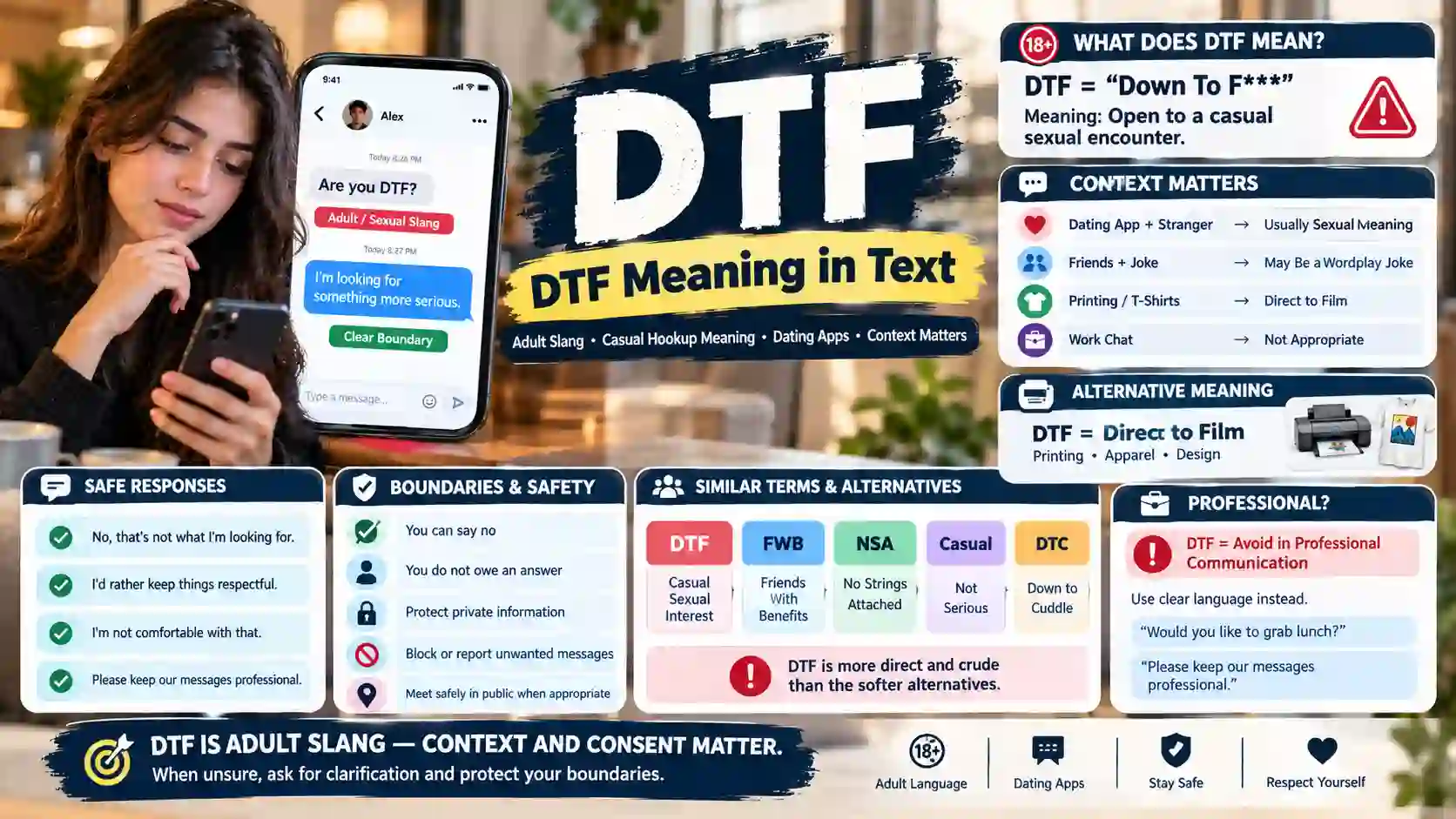
You get a message. It says, “Are you DTF?”
You freeze. What does that mean? Is it a joke? Is it rude? How should you reply?
You are not alone. “DTF” is one of the most common and most misread texting acronyms. You will see it on dating apps, in direct messages, in memes, and in jokes between friends. It is not a word for work, school, or family chats.
Why does it matter? Because the meaning is adult, and the wrong reply can cause stress or even risk. If you know what it means, you can set clear boundaries and stay safe.
In this post, you will learn what DTF means, where it shows up, and how to respond. You will also learn when it is a joke, when it is serious, and when it is best to say no.
Let’s get started.
Definition & Meaning
The Short Answer
DTF stands for “Down To F*.”** The last word is a crude one, so it is censored here. In plain terms, it means someone is open to a casual sexual encounter.
Sources agree on this. One dating site explains that DTF is commonly used in the dating scene to start hookups. A parent guide calls it crude, explicit, and tied to casual sex.
Breaking It Down
- “Down to” is everyday slang for “willing” or “ready.” Think of “Are you down to grab coffee?”
- The last word makes the meaning sexual and direct.
What It Does and Does Not Mean
It does mean: “I am open to a casual hookup,” or “Are you open to that?”
Real-Life Examples
A direct question:
Match: Hey, are you DTF?
You: No, I’m looking for something more serious.
A boundary:
Stranger: DTF tonight?
You: That’s not what I’m here for. Please stop.
A joke between friends:
Friend: Who’s DTF for pizza?
You: Me! Down to feast.
(Here, friends are joking and swapping in a different word.)
Quick Clues
- Dating app + late night: Likely the sexual meaning.
- Friends joking about food or games: Likely a joke.
- A stranger asking: Likely the sexual meaning, and a red flag.
- A DTF bio: Often clear about wanting casual hookups.
Background & History
Where Did DTF Come From?
The exact start is hard to pin down. One online guide says slang like this often comes from specific groups who use it as a quick, natural way to talk to each other.
What we do know is that “down to” has long meant “willing.” People have said “down to party” or “down to hang out” for years. Adding a crude word at the end made it a blunt invitation.
How It Spread
Here is the rough path:
- Spoken slang: “Down to…” was already common.
- Early online chats: People shortened phrases to save time.
- Dating sites and apps: The short form fit well in quick chats. One guide says that as online dating and texting grew, DTF found a natural home there.
- Social media and memes: It spread into jokes and videos.
How the Meaning Changed
At first, it was a clear sexual question. Over time, it also became a joke format. People now say “DTF” about silly things, like food or video games, to be funny.
Where It Is Common Today
You will see DTF in:
- Dating apps like Tinder, Bumble, and Hinge
- Direct messages on social media
- Text messages
- Memes and jokes
- TV and pop culture references
Usage in Various Contexts
Texting
In texts, DTF is usually sexual. It is rare between people who do not know each other well.
Him: Hey, you free tonight? DTF?
You: I’m not comfortable with that question.
Dating Apps
This is where DTF is most common. It may be in a bio or a chat.
Match: Straight to the point. Are you DTF?
You: Not for me. Good luck out there.
Social Media
On social media, it may be used in captions, comments, or DMs. Often it is a joke or a meme.
Post: Monday morning. Who’s DTF for a nap?
Comment: Me. Always.
Gaming
In gaming chats, it can be a joke or a trolling line. Some players use it to be edgy.
Player 1: DTF? (trolling)
Player 2: Report. Not okay.
Many game communities do not allow sexual comments. It can get you muted or banned.
Casual Conversations With Friends
Some friend groups use it as a joke.
Friend: Who’s DTF for pizza tonight?
You: Me. Extra cheese.
Work Chats
At work, it is not appropriate. It can count as harassment.
Quick Guide
| Place | Likely Meaning |
| Dating app | Casual hookup interest |
| Text from a stranger | Sexual, and a red flag |
| Friends joking | Playful or silly |
| Gaming chat | Trolling, often against rules |
| Work | Never okay |
Common Misconceptions & Clarifications
“DTF Means Down to Flirt”
No. Some people soften it this way as a joke. But the common meaning is sexual. Do not assume it is innocent.
“DTF Always Means a Hookup Now”
Not always. Among friends, it can be a joke about food, games, or sleep. Context decides. Still, with a stranger or a date, assume it is serious.
“DTF Is Harmless Slang”
Not really. A parent guide states it is not playful slang and is not appropriate for teens. Even when used as a joke, it carries a sexual meaning.
“If Someone Asks, I Have to Reply”
No. You never owe anyone an answer. You can say no, ignore it, or block the person.
“Saying Yes Once Means Yes Forever”
No. Consent is for one moment and one person. You can change your mind at any time.
“DTF Is Only Used by Men”
No. People of any gender use it, in any direction.
“DTF Has Another Meaning”
Yes, in a different world. In printing, DTF means “direct to film,” a way to print designs on shirts. One guide notes this printing meaning is valid but rarely appears in casual chats.
Shop owner: We just bought a DTF printer for the shirts.
You: Nice. Does it print on dark fabric?
If the topic is printing or crafts, the meaning is not sexual.
Is It Inappropriate?
In many places, yes. It is crude, so use it only where it is welcome and between consenting adults.
The Best Rule
When unsure, assume it is the sexual meaning and respond with clear boundaries.
Similar Terms & Alternatives
People use many other words for similar ideas. Some are crude. Some are milder.
Similar Terms
- “Looking to hook up”: Plain and direct.
- “Casual”: Often used in bios to mean “not serious.”
- “No strings attached” (NSA): A hookup with no commitment.
- “Friends with benefits” (FWB): A friendship with a physical side.
- “Netflix and chill”: A well-known polite code for hanging out and more.
- “Seeing where it goes”: Open to anything, softer.
- “Hookup”: A casual encounter.
Milder or Clear Alternatives
- “Are you interested in something casual?”
- “What are you looking for on here?”
- “I’m open to meeting up. How about you?”
Comparison Table
| Term | Meaning | Tone | Directness |
| DTF | Open to casual sex | Crude | Very high |
| NSA | No strings attached | Direct | High |
| FWB | Friends with benefits | Casual | Medium |
| Netflix and chill | Hanging out, maybe more | Playful | Low |
| Casual | Not serious | Neutral | Low |
| Seeing where it goes | Open-ended | Soft | Very low |
Why People Pick One Over Another
Some want to be direct and save time. Others want to be gentle or playful. And some like a clean, clear question.
Tip: If you want honest answers without awkwardness, use plain, respectful words. “What are you looking for?” works well.
How to Respond to This Term
You have the right to respond however you wish. Here are four styles.
1. Casual (When You Are Not Interested)
Match: Are you DTF?
You: Not for me, but thanks for asking.
2. Funny (Light, Low-Pressure)
Humor can ease the moment, if you feel safe.
Match: DTF?
You: Down to… order tacos. That’s about it.
Friend: DTF for movie night?
You: Always. I’ll bring popcorn.
3. Professional
Use this at work, school, or with someone who should not be asking.
Coworker: DTF?
You: That is inappropriate. Please keep our messages professional.
If it keeps happening, save the messages and tell a manager or HR.
4. Privacy-Conscious and Safe
Stranger: DTF? Where do you live?
You: I don’t share that. Please don’t message me again.
Or simply:
You: No.
You do not have to explain.
If You Are Interested
If you are an adult and you are interested, be clear, honest, and kind.
Match: Are you DTF?
You: I’m open to meeting first and seeing if we click. Public place, no pressure.
What to Avoid
- Do not feel pressured to answer.
- Do not send private photos or personal info.
- Do not agree out of guilt or fear.
- Do not argue. You can block and move on.
- Do not meet a stranger alone at a private place.
Reply Cheat Sheet
| Style | Best For | Example |
| Casual | Polite no | “Not for me, thanks.” |
| Funny | Friends | “Down to… order tacos.” |
| Professional | Work | “Please keep it professional.” |
| Privacy | Strangers | “I don’t share that.” |
Regional or Cultural Differences
Is DTF Used Everywhere?
It is mostly English-language slang. You will see it in places where English is common online, such as the US, UK, Canada, and Australia. It also appears in global dating apps.
Cultural Attitudes
People feel differently about this topic:
- In some cultures, casual dating talk is common and normal.
- In others, direct sexual talk is private or inappropriate.
- In many families and religions, it is seen as disrespectful.
Because of this, the same message can feel casual to one person and shocking to another.
Regional Slang Twists
Different places use other phrases for casual hookups. These are general patterns:
- Hook up is widely used in the US.
- Pull and get off with someone are used in the UK and Ireland.
- Shag is used in the UK and Australia, with a more playful tone.
- Some regions use code words like “Netflix and chill.”
Language Barriers
In non-English chats, people often use their own local words. The English acronym may be understood only among people who spend time on English-language apps.
Tip for Global Chats
When you chat with people from other countries:
- Do not assume they use the same slang.
- Respect cultural boundaries.
- Use clear words, not acronyms.
- Ask kindly if you are unsure.
A short acronym can feel casual in one place and offensive in another.
Comparison with Similar Terms
Let’s put DTF next to a few look-alikes.
| Term | Meaning | Tone | Key Difference |
| DTF | Open to casual sex | Crude | Very direct |
| NSA | No strings attached | Direct | Focuses on no commitment |
| FWB | Friends with benefits | Casual | Involves an existing friendship |
| DTC | Down to cuddle | Soft | Nonsexual, affectionate |
| DTH | Down to hang | Mild | Just hanging out |
| Netflix and chill | Hanging out, maybe more | Playful | Coded and less direct |
How They Differ
DTF vs. DTC: DTC means “down to cuddle.” It is gentle and non-sexual. DTF is sexual.
Friend: DTC tonight? (Cuddle and a movie.)
Match: DTF tonight? (Casual hookup.)
Quick Tip
When two acronyms look alike, do not guess. One letter can change the meaning. Ask if you are unsure.
Usage in Online Communities & Dating Apps
Dating Apps (Tinder, Bumble, Hinge)
This is where DTF shows up most. It may be in a bio, a first message, or a late-night chat.
Match: Hey, DTF?
You: I’m not looking for that. Take care.
Some clues:
- In a bio, it often signals the person wants a hookup.
- In a first message, it is blunt and may be a red flag.
- Late at night, it often has the sexual meaning.
- After a good chat, it may be less shocking, but still needs consent.
One dating guide notes that people often make the mistake of agreeing to a DTF text without understanding what it implies. Take a moment before you answer.
Twitter and X
On Twitter or X, DTF often shows up in jokes and memes.
Post: Who’s DTF for a long weekend?
Reply: Me, please.
Instagram and TikTok
In DMs, it can be unwanted. In comments, it is usually a joke.
Gaming Communities
On Discord and in game chats, it is often trolling. Many servers ban sexual talk.
Player: DTF? (trolling)
Mod: That’s against the rules. Warning issued.
Tips for Responding
- Know what you want. Be honest with yourself.
- Set clear limits early.
- Use block and report tools if someone is pushy.
- Do not feel guilty for saying no.
- If you are interested, move at your pace and stay in control.
Safety Tips
- Never share your address, workplace, or money details with a new match.
- Meet in a public place and tell a friend where you are going.
- Trust your gut. If it feels off, leave.
- Keep your own transport. Do not depend on the other person for a ride.
- Practice safe choices if you decide to meet.
- This talk is for adults only. If you suspect someone is underage, stop and report them.
Hidden or Offensive Meanings
Other Meanings
Most guides agree on the sexual meaning. A few mention other uses:
- Printing: DTF can mean “direct to film,” a method used in T-shirt printing.
- Jokes: Friends may swap the last word for something silly, like food.
If the topic is printing or crafts, it is not sexual.
Why It Can Feel Pushy
The question skips small talk. It can feel like pressure, especially when:
- You have just met.
- You have not shown interest.
- The person keeps asking after you say no.
Unwanted Messages
If someone keeps sending DTF messages after you say no, that is harassment. You can:
- Say no clearly once.
- Block the person.
- Report them on the app.
- Save screenshots if it gets serious.
Why Tone and Context Matter
Ask yourself:
- Who sent it?
- Where did they send it?
- Do we have a relationship?
- Is it a joke or a real question?
If you are the sender, think about consent. Respect any answer you get.
Consent Matters
Consent must be clear, free, and ongoing. Silence does not mean yes. A past yes does not mean always yes. Anyone can say no at any time.
A Kind Reminder
DTF is adult language. If you are young, or chatting with someone who may be young, do not use it. If a young person receives it from an adult, tell a trusted adult.
Suitability for Professional Communication
Is DTF Okay at Work?
No. DTF is sexual slang. In professional settings, it can be:
- Inappropriate. It is crude and personal.
- Harassment. Sending it can break workplace rules or laws.
- Damaging. It can hurt your job and your reputation.
Where It Is Never Okay
- Emails and work chats
- Messages to coworkers or clients
- Messages to teachers or students
- Job applications and interviews
- Formal letters and reports
- School assignments
Rare Exceptions
- The printing meaning: “DTF” as “direct to film” is fine in a shop or design setting, as long as you spell it out the first time.
Designer: We will use DTF printing for this order.
Client: Great. What does that stand for?
Designer: Direct to film. It prints designs onto a film that transfers to fabric.
What to Do if You Receive It at Work
- Do not reply in kind.
- Say clearly that it is not okay.
- Save the message.
- Report it to a manager or HR.
You have the right to a safe workplace.
Professional Alternatives
If you want to talk about a social plan or personal interest, use clear and respectful words.
| Inappropriate | Better Option |
| “DTF?” | (Do not send this at work.) |
| “Want to hang out?” | “Would you like to grab lunch sometime?” |
| “What are you doing tonight?” | “Are you free for the team event on Friday?” |
| “DTF” (printing) | “Direct-to-film (DTF) printing” |
Example at Work
Coworker: DTF?
You: That message is not appropriate. Please do not send anything like that again.
Short, clear, and firm.
Simple Rule
If it is work, leave this acronym out. The only safe use is the printing meaning, spelled out.
FAQs
1. What does DTF mean in text?
It stands for “Down To F***,” a crude phrase that means someone is open to a casual sexual encounter.
2. Is DTF always sexual?
Mostly, yes, especially on dating apps and from strangers. Friends sometimes use it as a joke. In printing, DTF means “direct to film.”
3. Is DTF rude or offensive?
It can be. It contains a crude word and is very direct. Many people find it rude when it comes from a stranger or at the wrong time.
4. How do I reply to DTF?
You can say no, change the subject, or block the person. You never owe anyone an answer. If you are interested, be clear about your limits and stay safe.
5. Can I use DTF at work?
No, not in the sexual sense. It can be seen as harassment. The printing meaning is fine if you spell it out.
6. What is the difference between DTF and DTC?
DTF is sexual. DTC means “down to cuddle,” which is gentle and non-sexual.
7. What should I do if someone keeps sending DTF messages?
Say no once, then block and report them. Save screenshots if it continues. If it is at work or school, tell a trusted adult, manager, or HR.
Conclusion
DTF is a short, blunt acronym. It stands for “Down To F*,”** and it means someone is open to a casual sexual encounter. You will see it most often on dating apps and in direct messages. Friends may also use it as a joke.
Here are the key points to remember:
- The meaning is adult. It is not a casual word for everyone.
- Context matters. Dating app, stranger, joke, or printing shop?
- You can always say no. You never owe an answer.
- Consent is key. It must be clear and ongoing.
- Stay safe. Protect your private info and meet in public.
- Keep it out of work and school. Use clean, clear words instead.
Next time you see DTF, you will know what to do. Read the situation, protect your boundaries, and reply on your own terms.
Discover More Article

Hello, I’m Insha, a passionate content writer with 2 years of experience creating clear, engaging, and helpful content. I specialize in the meaning niche, explaining words, slang, phrases, and online terms in simple language that readers can easily understand and use.







2 thoughts on “DTF Meaning in Text: What Does It Really Stand For? (2026)<p class="post-updated-date">🕓 <span class="updated-label">Last updated on</span> <time datetime="2026-10-21T12:40:09+00:00">October 21, 2026</time></p><script type="application/ld+json"> { "@context": "https://schema.org", "@type": "BlogPosting", "mainEntityOfPage": { "@type": "WebPage", "@id": "https://outreachnexa.com/dtf-meaning-in-text/" }, "datePublished": "2026-10-21T12:40:07+00:00", "dateModified": "2026-10-21T12:40:09+00:00" } </script>”