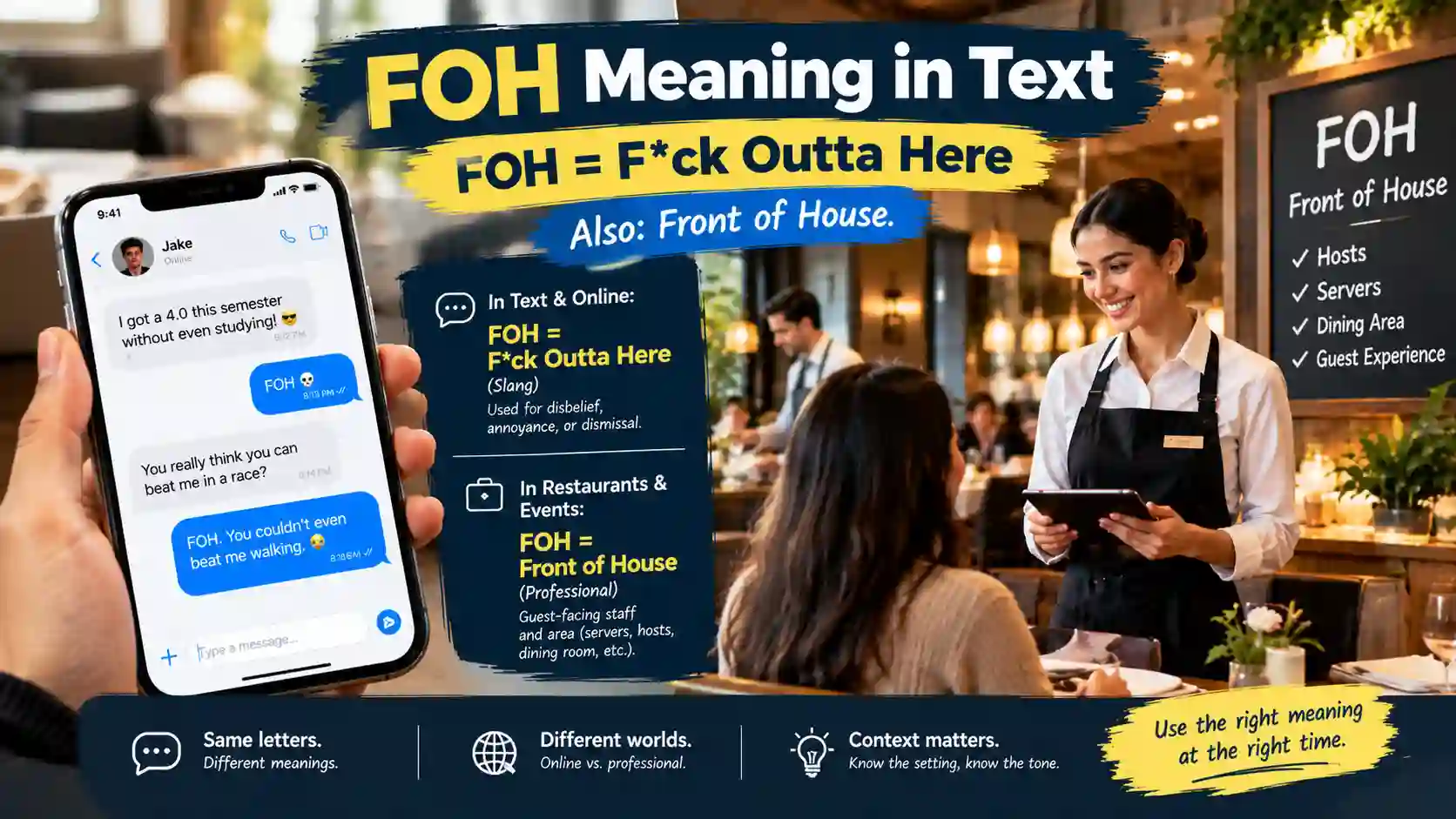
You see three letters pop up in a group chat: “FOH.” No context, no punctuation. It looks blunt because it is. “FOH” is slang for “f*ck outta here.”
People use it to shut down a bad joke, call out an obvious lie, or react to something ridiculous. It shows up in texts, comment sections, gaming chat, and casual conversation between friends.
There’s a twist, though: “FOH” has a second, completely unrelated meaning in professional settings If “front of house,” used in restaurants, theaters, and live events. Same three letters, two very different worlds.
Knowing which meaning applies, and how blunt the slang version really is, matters. Used wrong, it can come across as far harsher than you intended. This guide breaks down where “FOH” comes from, how people use it, and how to read it depending on where you see it.
Definition & Meaning
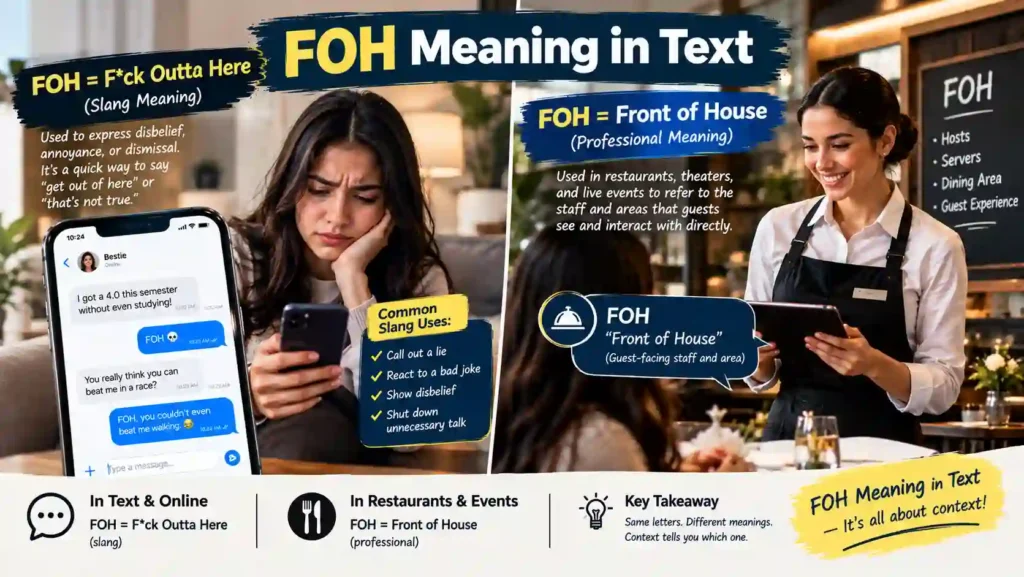
In slang, “FOH” stands for “f*ck outta here.” It’s a sharp, dismissive way of telling someone you don’t believe them, you’re annoyed with them, or you want them to stop talking.
It’s the text-speak version of saying “get out of here” in a tone that makes clear you mean it.
Real-life examples:
Text 1: “I got a 4.0 this semester without studying at all.” Text 2: “foh 💀”
Comment: “This movie was better than the book.” Reply: “foh, that’s not even close”
Group chat: “I’m thinking about quitting my job to become an influencer.” Friend: “foh, be serious”
The tone ranges from joking disbelief to genuine annoyance, depending on who’s saying it and why. Between close friends, it often reads as playful. Aimed at a stranger or said with real frustration, it reads as hostile.
Outside of slang, “FOH” also means “front of house.” In restaurants, this refers to the staff and space guests interact with directly If servers, hosts, the dining room If as opposed to “back of house” (the kitchen). In theater and live events, “FOH” refers to the audience-facing side of a venue, including the sound and lighting booth.
Restaurant manager: “We’re short-staffed on FOH tonight.” Coworker: “I’ll grab an extra server for the floor.”
Context makes the meaning obvious almost instantly If a group chat versus a work shift schedule are not easy to confuse.
Background & History
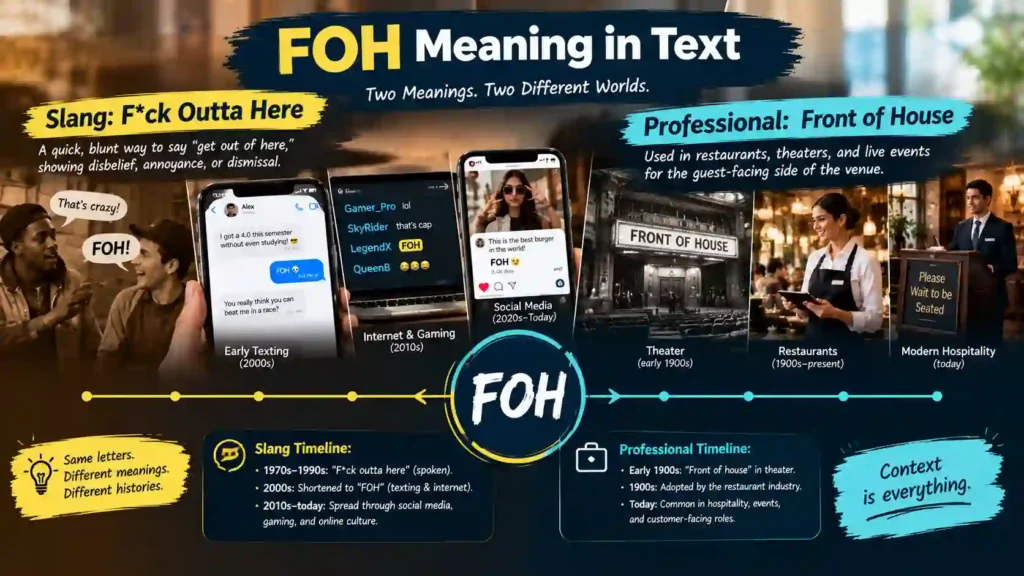
The slang meaning of “FOH” grew out of the phrase “f*ck outta here,” a blunt way of dismissing something as unbelievable or ridiculous. The full phrase has circulated in casual and African American Vernacular English speech for decades, well before texting existed, as a way to call out an exaggeration or a bad excuse.
As texting and early internet slang took off in the 2000s, the phrase got shortened the same way many others did If trimmed down to its initials for speed. “FOH” joined the same wave as terms like “STFU” and “GTFO,” all built around blunt, dismissive phrasing squeezed into a few letters.
The term later spread into social media comment culture, where its short length made it perfect for quick reactions to posts, tweets, and videos. Wiktionary now lists this slang meaning alongside the term’s older, unrelated meanings.
The “front of house” meaning has a completely separate history. It comes from theater and hospitality industries, where venues have long been divided into “front of house” (guest-facing areas) and “back of house” (kitchens, backstage, staff-only areas). This usage predates texting entirely and remains standard industry terminology today.
So “FOH” carries two histories that never crossed paths If one rooted in blunt street and internet slang, the other in decades of hospitality and theater vocabulary. Only context tells you which one you’re looking at.
Usage in Various Contexts
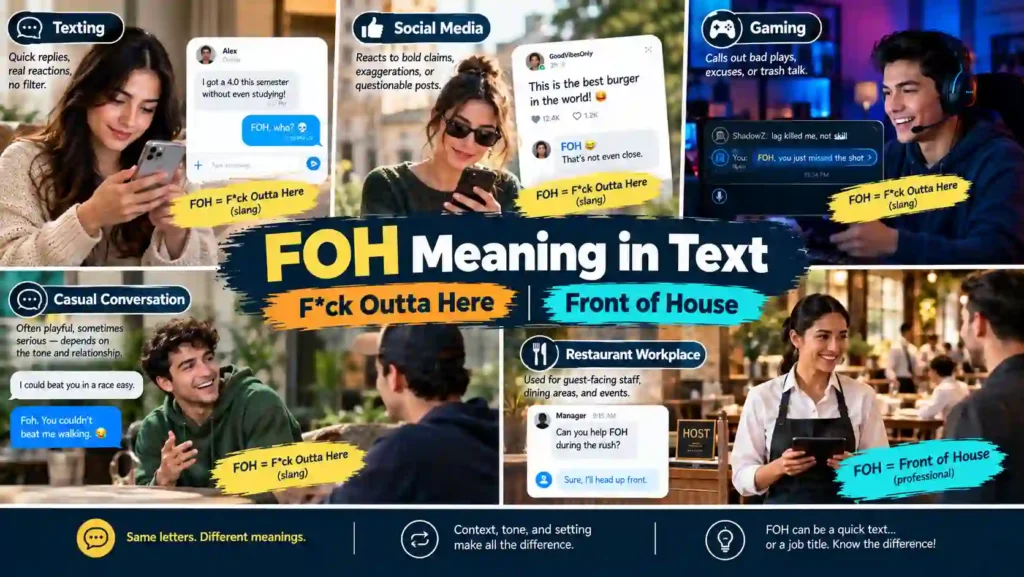
Texting. Used to shut down an unbelievable claim or a bad excuse from a friend.
Text 1: “I swear I saw a celebrity at the gas station.” Text 2: “foh, who”
Social Media. Common in comment sections reacting to a bold or questionable claim.
Comment: “This is the best fast food burger in the country.” Reply: “foh 😭 have you even tried the other ones”
Gaming. Used to call out a bad play, an obvious excuse for losing, or trash talk.
In-game chat: “lag killed me, not skill” Reply: “foh, you just missed the shot”
Casual conversation (spoken). Some people say it out loud too, often as a quick, dismissive reaction.
Friend 1: “I could beat you in a race easy.” Friend 2: “Foh. You couldn’t beat me walking.”
Workplace (as “front of house”). Used constantly in restaurant and event scheduling.
Manager: “Can you help FOH during the rush?” Employee: “Yeah, I’ll head up front.”
The slang and professional meanings never really overlap in the same sentence If the setting makes it obvious which one is in play.
Common Misconceptions & Clarifications
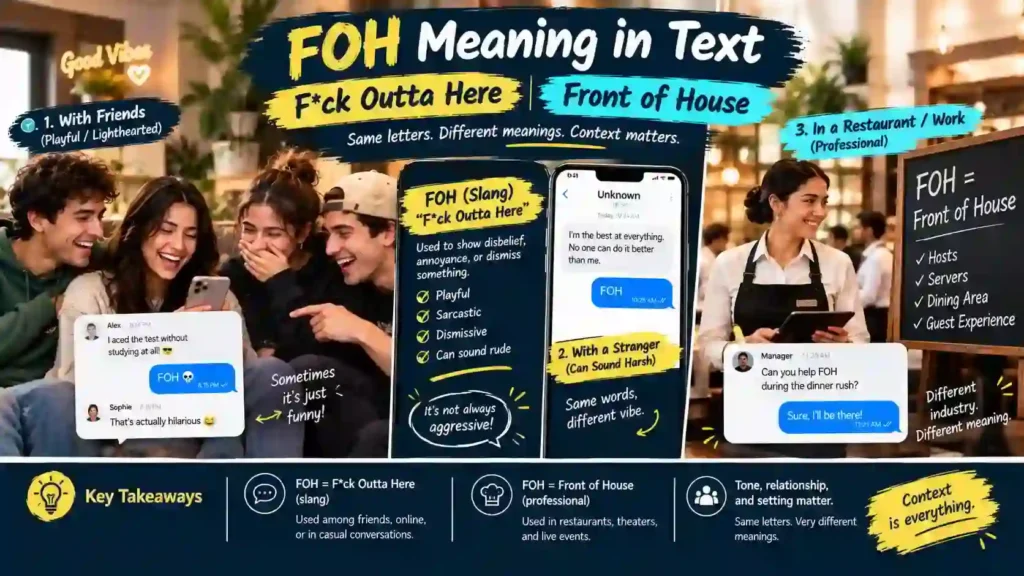
The biggest misconception is that “FOH” is always aggressive. It isn’t. Between friends, it’s often playful disbelief If closer to “come on, really?” than a genuine insult.
That said, tone matters a lot here, more than with milder slang. Because the full phrase behind “FOH” includes profanity, it carries more edge than something like “L” or “HRU.” Said to someone you don’t know well, or said with real frustration, it can land as genuinely rude or dismissive.
Another misconception: people sometimes think “FOH” always means the slang version. In professional and hospitality contexts, “front of house” is the default meaning, and nobody reads it as vulgar there. A restaurant scheduling text that says “need more FOH staff Friday” has nothing to do with the slang meaning.
A third misconception: some assume “FOH” is a new term. It isn’t. The slang phrase behind it has circulated in spoken language for a long time; texting just shortened it.
Clarification on intensity: a short, lowercase “foh 💀” among friends usually signals humor. “FOH.” with a period and no emoji, sent in anger, signals something much sharper. The letters don’t change If the delivery does.
Similar Terms & Alternatives
“FOH” belongs to a family of blunt, dismissive slang terms.
| Term | Meaning | Example |
| FOH | “F*ck outta here” If dismissive disbelief | “foh, that never happened” |
| GTFO | “Get the f*ck out” If stronger dismissal | “gtfo, no way that’s true” |
| STFU | “Shut the f*ck up” If tells someone to stop talking | “stfu, that’s hilarious” |
| Cap / No cap | Calling out a lie / confirming something’s true | “that’s cap” |
| Sure, Jan | Sarcastic disbelief | “Sure, Jan. Keep telling yourself that.” |
“Cap” is the closest non-vulgar alternative If it calls out a lie without any profanity attached, which makes it safer for wider audiences.
How to Respond to This Term
How to respond depends heavily on tone and relationship here, more than with milder slang.
Casual response (if it’s clearly a joke):
“lol fair, I was exaggerating”
Funny response:
“foh received and noted”
Professional response (if it’s “front of house” at work):
“Got it, I’ll cover FOH during the rush.”
If it feels genuinely hostile rather than playful:
“Whoa, what’s that about?” If worth addressing directly rather than escalating with slang back.
Privacy-conscious or neutral response (if you’d rather not engage with the tone):
“Haha okay” If a short, low-key reply that doesn’t add fuel either way.
Because the phrase carries real profanity underneath it, matching someone’s energy works fine among close friends, but escalating slang-for-slang with someone you don’t know well can turn a joke into a real conflict fast.
Regional or Cultural Differences

The slang meaning of “FOH” is rooted in American English, with strong ties to African American Vernacular English, where the underlying phrase has long been used to call out exaggeration or dishonesty. From there, it spread broadly through US-based internet and texting culture, then out to other English-speaking online spaces.
It doesn’t translate directly into other languages, since it’s built from an English phrase and a specific tone of dismissal. Other cultures and languages have their own blunt phrases for “you’re lying” or “get out of here,” but they aren’t tied to these same three letters.
The “front of house” meaning, by contrast, is standard hospitality and theater terminology across most English-speaking countries, without strong regional variation If a restaurant in London and one in Chicago both use “FOH” the same way.
Comparison with Similar Terms
| Term | Core Meaning | Tone | Best Used |
| FOH (slang) | Dismissive disbelief | Blunt, can be harsh | Reacting to an exaggeration or lie |
| FOH (front of house) | Guest-facing staff/area | Neutral, professional | Restaurant/theater work contexts |
| GTFO | Strong dismissal | Very blunt | Reacting to something shocking or unbelievable |
| Cap | Calling out a lie | Light, common | Everyday disbelief, safe for wider audiences |
| Sure, Jan | Sarcastic disbelief | Dry, sarcastic | Mocking an obvious exaggeration |
The clearest split here isn’t between similar slang terms If it’s between the two meanings of FOH itself. No other term on this list carries a completely unrelated professional definition the way “FOH” does.
Usage in Online Communities & Dating Apps
In gaming communities, “FOH” shows up during trash talk or when someone offers a weak excuse for losing. It’s blunt, but usually still part of the game’s normal back-and-forth banter.
On Twitter and other social platforms, “FOH” often reacts to an obviously exaggerated claim or a post that seems designed to provoke a reaction (“ratio bait”).
On dating apps, “FOH” is far less common than lighter slang like “L” or “HRU,” precisely because of its edge. Using it toward a match, even jokingly, risks coming across as harsh before any real rapport is built.
Tips for responding appropriately:
- In gaming chat, a quick “foh” back is normal banter If no real offense meant or taken.
- On social media, think twice before using it toward a stranger; it reads as more aggressive without an established rapport.
- On dating apps, it’s safer to skip this one entirely and use something lighter to express disbelief or teasing.
Hidden or Offensive Meanings
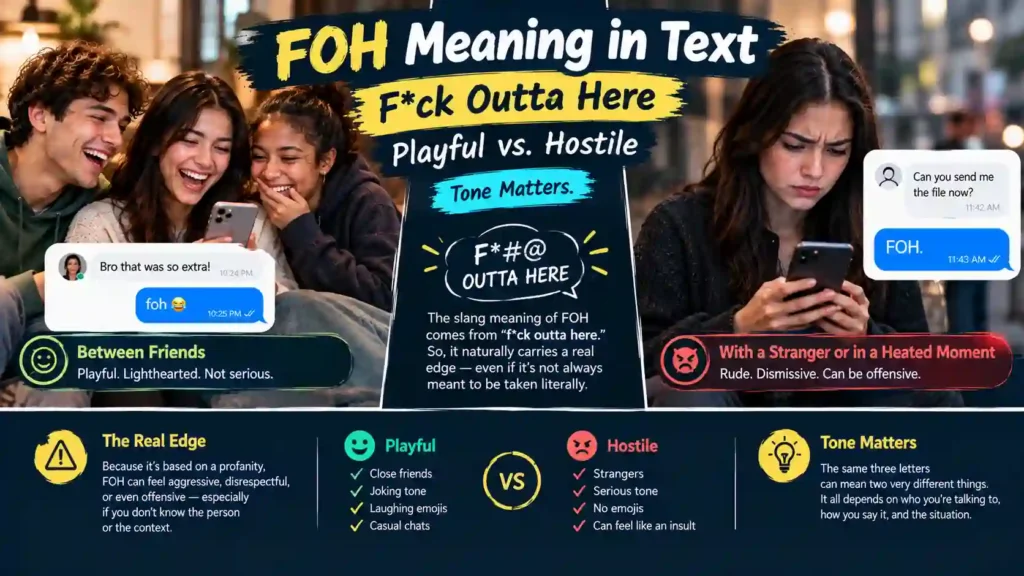
“FOH” doesn’t have a hidden meaning beyond its two known definitions If the slang dismissal and “front of house.” But the slang meaning itself already carries real weight, since it’s built directly on a curse word.
This makes tone and context especially important. The same “foh” can be:
- Playful teasing between close friends (“foh, you did not just say that 😂”)
- Genuine dismissal of something you find ridiculous or offensive
- A real insult if said with hostility, especially to someone you don’t know well
Because the phrase behind it is already blunt, there’s less room for it to be “secretly” more offensive than it appears If what you see is close to what you get. The risk isn’t a hidden meaning; it’s that the visible meaning already carries more edge than people sometimes intend.
Suitability for Professional Communication
The slang meaning of “FOH” is not appropriate for professional communication If it’s built on profanity, and using it at work, even casually, risks coming across as unprofessional or disrespectful.
The “front of house” meaning, however, is entirely appropriate in the right industries. Restaurant, hotel, and event professionals use it constantly in schedules, emails, and internal messages without any issue.
If you want to express disbelief professionally instead of using the slang version, try:
- Instead of “foh, that’s not true” try: “I’m not sure that’s accurate.”
- Instead of “foh, be serious” try: “Let’s take a more realistic approach.”
- Instead of “foh” as a reaction try: “I find that hard to believe.”
A simple rule: text a friend “foh,” but write “front of house” in full (or just “FOH” if it’s clearly a hospitality context) at work If and skip the slang meaning in any formal writing entirely.
FAQs
1. What does “FOH” mean in texting?
It’s slang for “f*ck outta here,” used to express disbelief or dismiss something as ridiculous.
2. Does “FOH” always mean the slang version?
No. In restaurants, theaters, and events, “FOH” means “front of house,” a completely different, professional term.
3. Is “FOH” rude?
It can be. Because it’s built on profanity, tone and relationship matter a lot. Among friends, it’s often playful; toward strangers, it can feel hostile.
4. What’s a less harsh alternative to “FOH”?
“Cap” or “no cap” express similar disbelief without any profanity attached.
5. Can I use “FOH” at work?
Only in its “front of house” meaning, and only in industries where that term is standard, like hospitality or events. The slang meaning doesn’t belong in professional writing.
6. Where did “FOH” slang come from?
It comes from the spoken phrase “f*ck outta here,” used for a long time before texting shortened it to three letters.
7. Is “FOH” common on dating apps?
Not really. Its edge makes it risky to use with someone you don’t know well, so lighter slang is usually safer there.
Conclusion
“FOH” carries two very different lives. As slang, it’s short for “f*ck outta here,” a blunt way to call out disbelief, exaggeration, or annoyance. In hospitality and theater, it simply means “front of house,” with no edge at all.
The key takeaway: context decides everything here. Among friends, the slang version is often just playful teasing. Toward strangers, it carries real bite. And at work, only the “front of house” meaning belongs in the conversation.
Understanding both sides of “FOH” means you’ll never mix up a friendly jab with a scheduling text If and you’ll know exactly how much edge you’re bringing when you type it yourself
Discover More Article

Hi, I’m Mahgull, a dedicated content writer with 2 years of experience in the meaning niche. I enjoy turning complex words, slang, abbreviations, and phrases into simple, informative content that helps readers understand their meanings clearly and quickly.







1 thought on “FOH Meaning in Text: What It Really Means<p class="post-updated-date">🕓 <span class="updated-label">Last updated on</span> <time datetime="2026-09-22T05:41:20+00:00">September 22, 2026</time></p><script type="application/ld+json"> { "@context": "https://schema.org", "@type": "BlogPosting", "mainEntityOfPage": { "@type": "WebPage", "@id": "https://outreachnexa.com/foh-meaning-in-text/" }, "datePublished": "2026-09-17T16:06:20+00:00", "dateModified": "2026-09-22T05:41:20+00:00" } </script>”