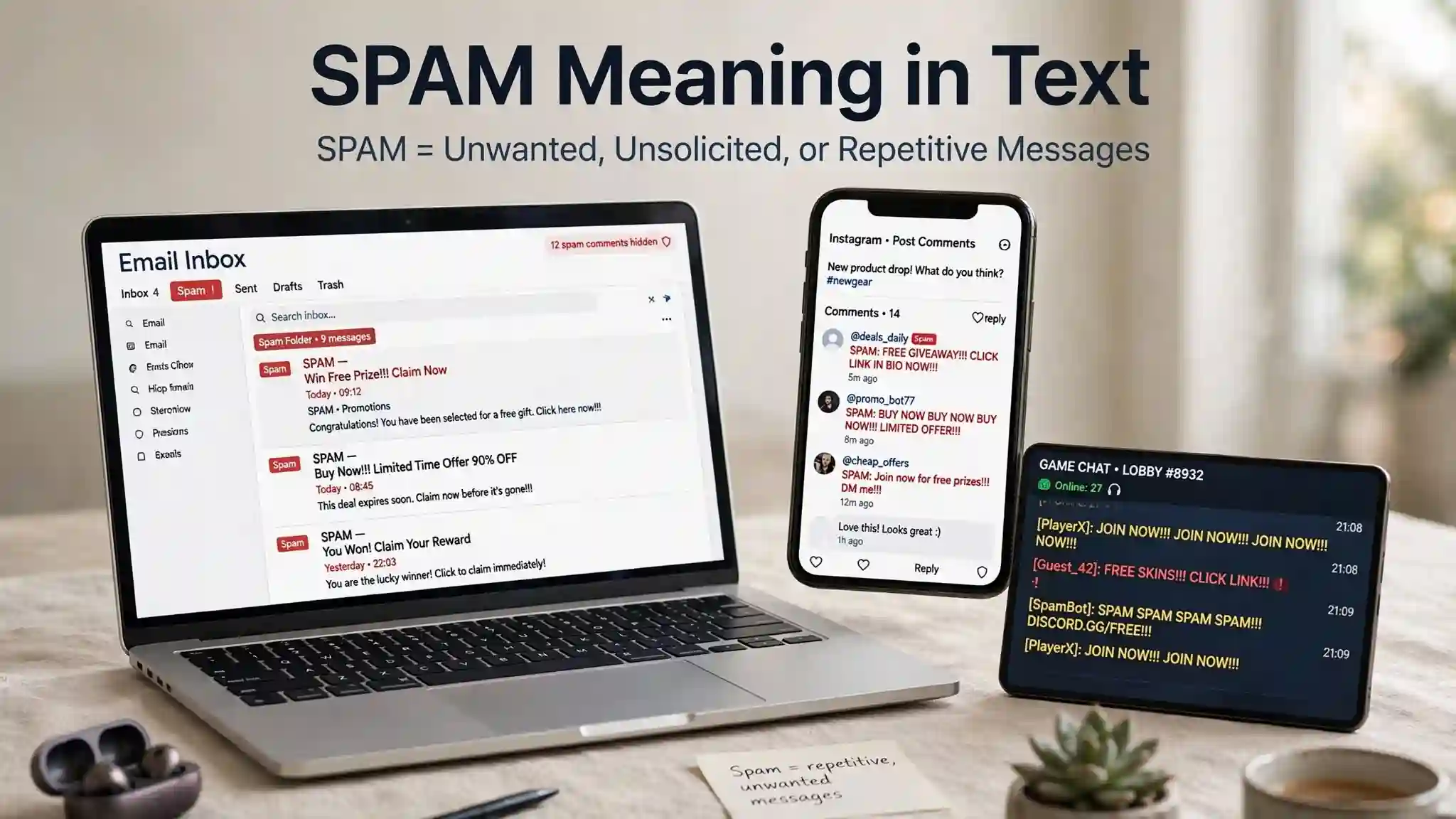
Everyone has seen it. A weird text from an unknown number. A flood of promotional emails. A comment section full of the same repeated link. You call it spam, and you know instantly what that means: unwanted, unsolicited, and usually annoying.
“Spam” started as the name of a canned meat product. Today, it means something totally different online. You’ll spot it in texting, email inboxes, social media comments, gaming chats, and even dating apps.
Understanding what “spam” really means, and how to spot it, matters more than ever. Scammers use spam to steal money and personal information. Businesses use spam filters to protect customers. And regular people use the word every day to describe anything unwanted, repetitive, or fake online.
This guide breaks down everything about “spam”: where it came from, how people use it now, and how to respond when you see it.
Definition & Meaning
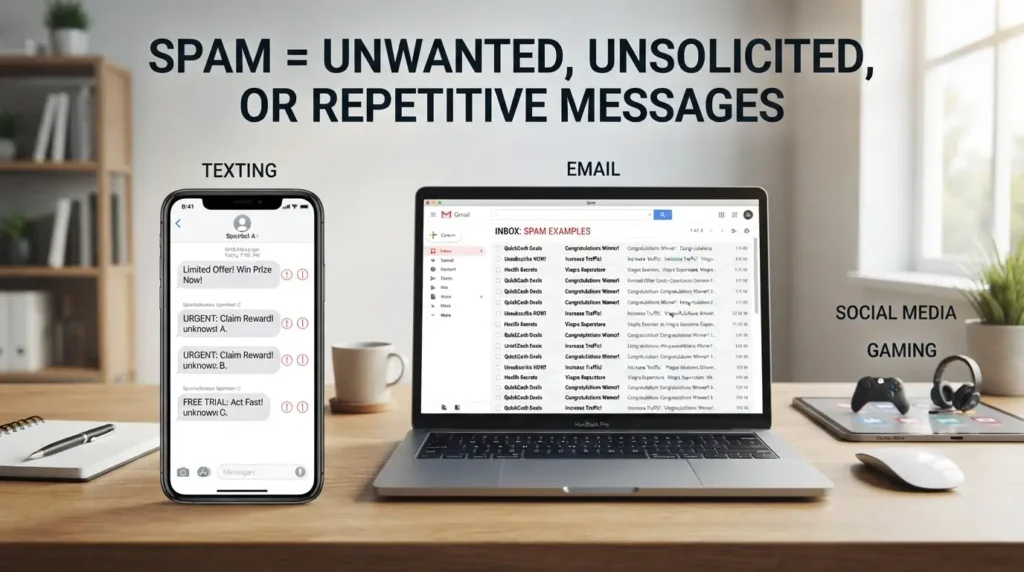
“Spam” means unwanted, unsolicited, or repetitive messages sent to many people at once, usually for advertising, scamming, or disruption. It applies to emails, texts, social media posts, comments, and direct messages.
The word works as both a noun and a verb.
As a noun:
“My inbox is full of spam again.”
As a verb:
“Stop spamming my comments with links.”
Here are common real-life examples of how people use it:
In texting:
Mom: Did you get that text about winning a free cruise?
You: Yeah, that’s spam. Don’t click anything.
In email:
Subject: “You’ve Won $1,000,000!!!”
This lands straight in your spam folder.
On social media:
Comment: “🔥🔥 Check my profile for free followers 🔥🔥” (posted on 50 different posts)
Reply: “Reported for spam.”
In gaming chats:
Player1: Can you stop spamming the chat with emojis?
Player2: My bad, lol.
Spam isn’t limited to sales pitches, either. It also describes:
- Repetitive messages sent rapidly (like the same emoji 20 times in a row)
- Fake accounts that flood comment sections
- Phishing attempts disguised as real companies
- Chain messages asking you to forward them to “10 friends”
The common thread is always the same: spam is unwanted, excessive, and usually not from someone you trust.
Background & History

The word “spam” has a strange origin story. It didn’t start online at all.
1937: The canned meat
Hormel Foods created SPAM, a canned meat product made mostly from pork. The name was the winning entry in a company contest, submitted by Kenneth Daigneau, the brother of a Hormel vice president. The exact meaning of the name was never officially confirmed, though “spiced ham” is the most popular guess.
1970: The Monty Python sketch
On December 15, 1970, Monty Python’s Flying Circus aired a sketch set in a cafe where nearly every item on the menu includes SPAM. A group of Vikings in the background chant “SPAM, SPAM, SPAM, SPAM” louder and louder, drowning out all other conversation in the cafe. The joke was that SPAM was everywhere, overwhelming everything else.
Late 1980s–1993: Early internet slang
On MUDs (early text-based online games) and Usenet newsgroups, some users flooded channels with repetitive messages, sometimes typing “SPAM” hundreds of times to disrupt conversations. The behavior got its name from the Python sketch, since the flood of repeated text drowned out real discussion, just like the Vikings’ chanting.
1994: The turning point
Lawyers Laurence Canter and Martha Siegel posted an advertisement for their immigration law services to every Usenet newsgroup at once, an act widely seen as the first large-scale commercial spam. This incident cemented “spam” as the standard term for unwanted bulk messaging.
Today
Spam has expanded far beyond email. It now covers text messages, social media comments, fake reviews, bot accounts, and even repetitive posts in gaming chats. Hormel, the company behind the original canned meat, eventually accepted the internet usage. They only asked that the internet term stay lowercase (“spam”), while their food product remains capitalized (“SPAM”).
Usage in Various Contexts

“Spam” shows up almost everywhere online, but it looks a little different depending on the platform.
In Texting
Spam texts are extremely common. They often pretend to be delivery notices, bank alerts, or prize announcements.
Text: “Your package couldn’t be delivered. Click here to reschedule.”
You: That’s spam, I didn’t order anything.
In Email
This is the original digital home of spam. Most email providers now have dedicated spam folders.
Coworker: Did you see that email about a free iPhone?
You: Straight to spam. Don’t open it.
In Social Media
Spam on platforms like Instagram, TikTok, and Twitter/X often looks like:
- Bot comments with generic praise (“Nice post! 😍 Check my page!”)
- Fake giveaways
- Repeated hashtag flooding
Comment: “OMG check my bio for a free gift card!!”
Reply: “This account is 100% spam.”
In Gaming
In gaming chat, “spam” usually means flooding the chat with the same message, emote, or action.
Player1: Quit spamming the ping button.
Player2: Sorry, got excited.
In Casual Conversation
People also use “spam” loosely to describe anything excessive, even outside of messaging.
Friend: You’ve texted me five times in a row about the same thing.
You: Sorry, I’m spamming you today.
Common Misconceptions & Clarifications

Misconception 1: Spam is always a scam.
Not always. Some spam is just annoying advertising, not a scam. Other spam is dangerous, like phishing attempts trying to steal your information. The category is broad.
Misconception 2: Spam only happens through email.
Spam has expanded well beyond email. It happens in texts, direct messages, comments, and even phone calls (robocalls are a form of spam).
Misconception 3: If it’s marked spam, it must be illegal.
Not necessarily. Aggressive marketing emails might get flagged as spam by filters, even if the company is legitimate. Laws like CAN-SPAM in the U.S. regulate unsolicited commercial email, but not everything caught by a spam filter breaks the law.
Misconception 4: Calling someone a “spammer” is always harsh.
Sometimes it’s playful, especially among friends. Sending too many messages or memes in a row can get you jokingly labeled a “spammer,” with no real offense meant.
Is “spam” ever inappropriate to use?
Generally, no. It’s a neutral, widely understood term. That said, calling a real person’s genuine message “spam” repeatedly might come across as dismissive, even rude, especially if that wasn’t their intent.
Clarifying the different types of spam:
- Commercial spam unwanted ads or promotions
- Phishing spam messages trying to steal personal information
- Malware spam messages carrying harmful links or attachments
- Social spam bot comments or fake engagement online
Recognizing which type you’re dealing with helps you respond safely.
Similar Terms & Alternatives
Several related terms describe similar or overlapping ideas.
| Term | Meaning | Common Use |
| Junk mail | Physical or digital unwanted mail | Email, postal mail |
| Phishing | Fake messages trying to steal info | Email, text |
| Bot | Automated account sending spam | Social media |
| Flooding | Sending repeated messages quickly | Chat, gaming |
| Smishing | Phishing through SMS text messages | Texting |
| Robocall | Automated spam phone calls | Phone |
“Spam” vs “Phishing”
Spam is the broader category. Phishing is a specific, dangerous type of spam designed to trick you into giving up personal information, like passwords or credit card numbers.
“Spam” vs “Junk mail”
“Junk mail” is often used for physical mail (flyers, catalogs), while “spam” is almost always digital.
“Spam” vs “Flooding”
Flooding usually refers to rapid repeated messages in real-time chat (like gaming or Discord), while spam covers a wider range, including one-time unwanted messages like a single scam text.
Choosing the right term helps others understand exactly what kind of unwanted content you’re dealing with.
How to Respond to This Term

How you respond to spam, or to being called a spammer, depends on the situation.
Casual Response
When a friend jokes about you spamming them:
Friend: You’re spamming my phone with memes lol
You: Can’t help it, they’re too good not to share 😂
Funny Response
When flagging obvious spam with humor:
Text: “Congrats! You’ve won a free vacation!”
You (to a friend): Add this to my collection of fake vacations I’ve “won.”
Professional Response
When reporting spam at work:
“This email appears to be a phishing attempt. Please do not click any links, and I’ve reported it to IT.”
Privacy-Conscious Response
The safest response to spam is often no response at all.
- Don’t click links in suspicious texts or emails.
- Don’t reply to confirm your number or email is active.
- Block and report the sender through your phone or email provider.
When You Should Respond
- If a legitimate company account gets mistakenly flagged, letting them know can help.
- If a friend gets hacked and is unknowingly sending spam, a heads-up is helpful.
When You Shouldn’t Respond
- Never reply to unknown numbers or emails asking for personal information.
- Never click “unsubscribe” links in obviously fake or suspicious spam. Sometimes this confirms your contact info is active, leading to more spam.
Regional or Cultural Differences
Spam is a global problem, and the word itself is understood almost everywhere thanks to the dominance of email and smartphones worldwide.
English-speaking countries (US, UK, Canada, Australia)
“Spam” is the default, universally understood term for unwanted digital messages, including email, texts, and social media content.
European countries
Most European languages have adopted the English word “spam” directly, especially in tech and everyday internet use, though formal legal documents may use local terms for “unsolicited commercial communication.”
Asian markets
In countries like Japan and South Korea, “spam” (often written phonetically) is commonly used online, alongside local terms for junk messages or scam texts, especially with the rise of smishing (SMS phishing) in mobile-heavy markets.
Regional scam trends
While the word “spam” stays consistent, the type of spam varies by region:
- US: Fake delivery notices, IRS scam texts, robocalls
- UK: Fake parcel delivery texts, HMRC tax scams
- India: Fake lottery or prize-winning messages
- Global: Romance scams, crypto investment spam
Business and legal context
Laws differ by country. The U.S. has the CAN-SPAM Act. The European Union enforces strict rules through GDPR regarding unsolicited marketing. Despite legal differences, the everyday word “spam” stays the same worldwide.
Comparison with Similar Terms
Here’s a clearer side-by-side comparison of spam-related terms.
| Term | Full Meaning | Danger Level | Best Used For |
| Spam | Unwanted bulk messages | Low to high | General unwanted content |
| Phishing | Fake messages stealing info | High | Scam attempts |
| Smishing | Phishing via text message | High | SMS-based scams |
| Bot spam | Automated fake engagement | Low to medium | Social media |
| Flooding | Repeated real-time messages | Low | Chat, gaming disruption |
| Robocall | Automated spam calls | Medium | Phone scams |
Key differences:
- Spam is the umbrella term; phishing and smishing are specific, riskier subtypes.
- Flooding is usually harmless annoyance; phishing can lead to real financial harm.
- Bot spam usually aims for engagement or scams, not direct theft.
Knowing these differences helps you judge how seriously to treat a spam message. A flooded gaming chat is annoying. A phishing text asking for your bank details is dangerous.
Usage in Online Communities & Dating Apps
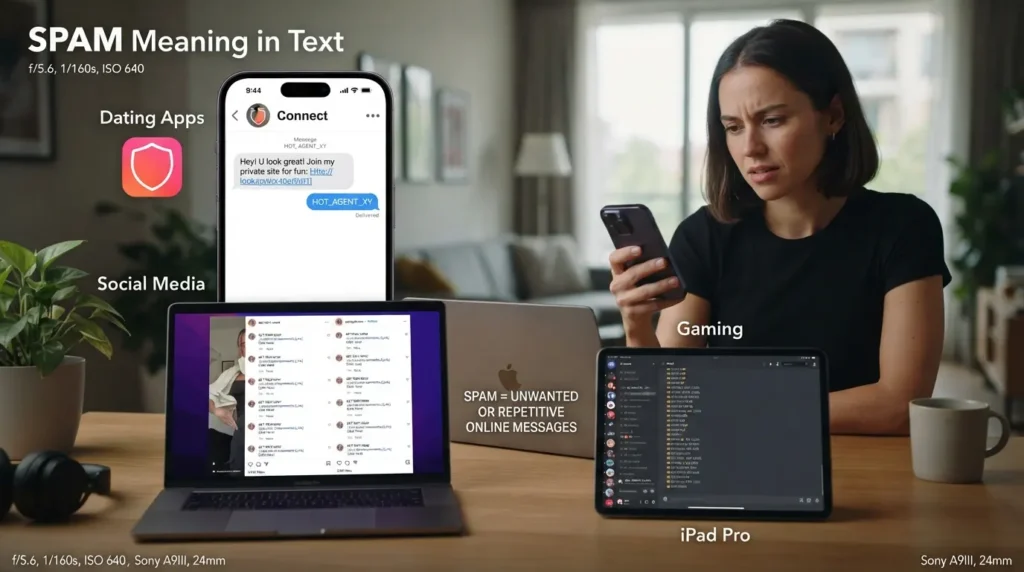
On Dating Apps (Tinder, Bumble, Hinge)
Spam is a well-known problem on dating apps, usually appearing as:
- Fake profiles promoting OnlyFans or adult content
- Bots asking you to move the conversation to another app quickly
- Scam accounts asking for money after a few messages
Match: “Hey! I’m actually a model, check out my Instagram for more pics 😘” (sent to hundreds of matches)
Tips for Responding on Dating Apps:
- Report and unmatch if a profile pushes you to another app immediately.
- Be cautious of matches who avoid video calls or phone conversations.
- Never send money, no matter how convincing the story sounds.
On Twitter/X
Spam bots often reply to popular posts with fake giveaways or crypto scams.
Reply bot: “Congrats on the engagement! DM me for a free NFT drop 🎁”
In Gaming Communities
Spam in gaming chats usually means repeated messages, emotes, or pings that disrupt gameplay. Most games have report or mute functions for this exact reason.
General Tip for Online Communities
If something feels too good to be true, like a free prize, gift card, or unusually attractive dating match, it’s worth treating with suspicion.
Hidden or Offensive Meanings

For the most part, “spam” carries no offensive meaning. It’s a neutral, widely accepted term for unwanted content.
That said, a few nuances are worth noting:
- Calling someone a “spammer” in a joking context among friends is harmless. Calling a real person’s genuine messages “spam” repeatedly, especially in a dismissive tone, can feel rude or hurtful.
- In some online communities, “spamming” can carry a slightly negative undertone if used to describe someone who posts too frequently, even without malicious intent.
- Sarcastic use (“Oh sure, thanks for the totally not spam email”) shifts the tone, but that comes from context, not the word itself.
Why context matters so much:
The word itself is neutral, but tone and intent shape how it lands:
- Who’s using it (friend joking vs. stranger reporting)
- What platform it’s on (casual chat vs. formal report)
- Whether it’s aimed at content or at a person
If you’re ever unsure whether “spam” is being used playfully or as a genuine complaint, context clues from the rest of the conversation usually make it clear.
Suitability for Professional Communication
Is “spam” appropriate at work? Yes, in most cases.
Fine for:
- Reporting suspicious emails to IT or security teams
- Flagging unwanted marketing emails
- Describing bulk unsolicited messages in official communication
“This message appears to be spam. Please do not click any links and forward it to IT for review.”
Use caution with:
- Calling a colleague’s frequent, legitimate emails “spam.” This can come across as dismissive of their work.
- Informal slang versions like “spamming my inbox” in very formal client communication; a more neutral phrasing works better.
Professional Alternatives:
- Instead of “spam” (unwanted email): use “unsolicited email” or “suspicious message.”
- Instead of “stop spamming me” (to a colleague): use “Please limit the frequency of these updates” or “Can we consolidate these into fewer messages?”
Using precise language in professional settings keeps things clear and avoids unintended offense.
FAQs
1. What does “spam” mean in a text message?
It means an unwanted, unsolicited message, often advertising something, trying to scam you, or sent in bulk to many people.
2. Where did the word “spam” come from?
It started as the name of a canned meat product from Hormel Foods in 1937, then became internet slang after a Monty Python sketch and its use on early online forums.
3. Is spam always dangerous?
Not always. Some spam is just annoying advertising. Other spam, like phishing, can be genuinely dangerous and try to steal personal information.
4. Should I reply to spam texts or emails?
No. Replying, or even clicking “unsubscribe” on suspicious messages, can confirm your contact information is active, leading to more spam.
5. What’s the difference between spam and phishing?
Spam is the broad category of unwanted messages. Phishing is a specific, riskier type of spam designed to trick you into giving up personal information.
6. Is it okay to call something “spam” in a professional email?
Yes, especially when reporting suspicious messages to IT or security teams. Just avoid using it dismissively about a real coworker’s messages.
7. How can I stop getting spam?
Use your email or phone’s built-in spam filters, avoid sharing your contact information publicly, and report suspicious messages instead of engaging with them.
Conclusion
“Spam” started as a canned meat product, took a detour through a Monty Python sketch, and ended up as one of the most recognized words in the digital world. Today, it covers unwanted emails, texts, social media comments, and gaming chat floods.
Recognizing spam, and knowing how to respond, protects you from scams and keeps your inbox and social feeds cleaner. Whether it’s a suspicious text, a bot comment, or a flood of chat messages, the safest move is usually simple: don’t click, don’t engage, and report when needed.
Understanding this one small word helps you navigate a much bigger part of digital life.

Hi, I’m Mahgull, a dedicated content writer with 2 years of experience in the meaning niche. I enjoy turning complex words, slang, abbreviations, and phrases into simple, informative content that helps readers understand their meanings clearly and quickly.

1 thought on “SPAM Meaning in Text: What It Means and Why It’s Everywhere<p class="post-updated-date">🕓 <span class="updated-label">Last updated on</span> <time datetime="2026-09-18T11:48:56+00:00">September 18, 2026</time></p><script type="application/ld+json"> { "@context": "https://schema.org", "@type": "BlogPosting", "mainEntityOfPage": { "@type": "WebPage", "@id": "https://outreachnexa.com/spam-meaning-in-text/" }, "datePublished": "2026-09-18T11:48:54+00:00", "dateModified": "2026-09-18T11:48:56+00:00" } </script>”