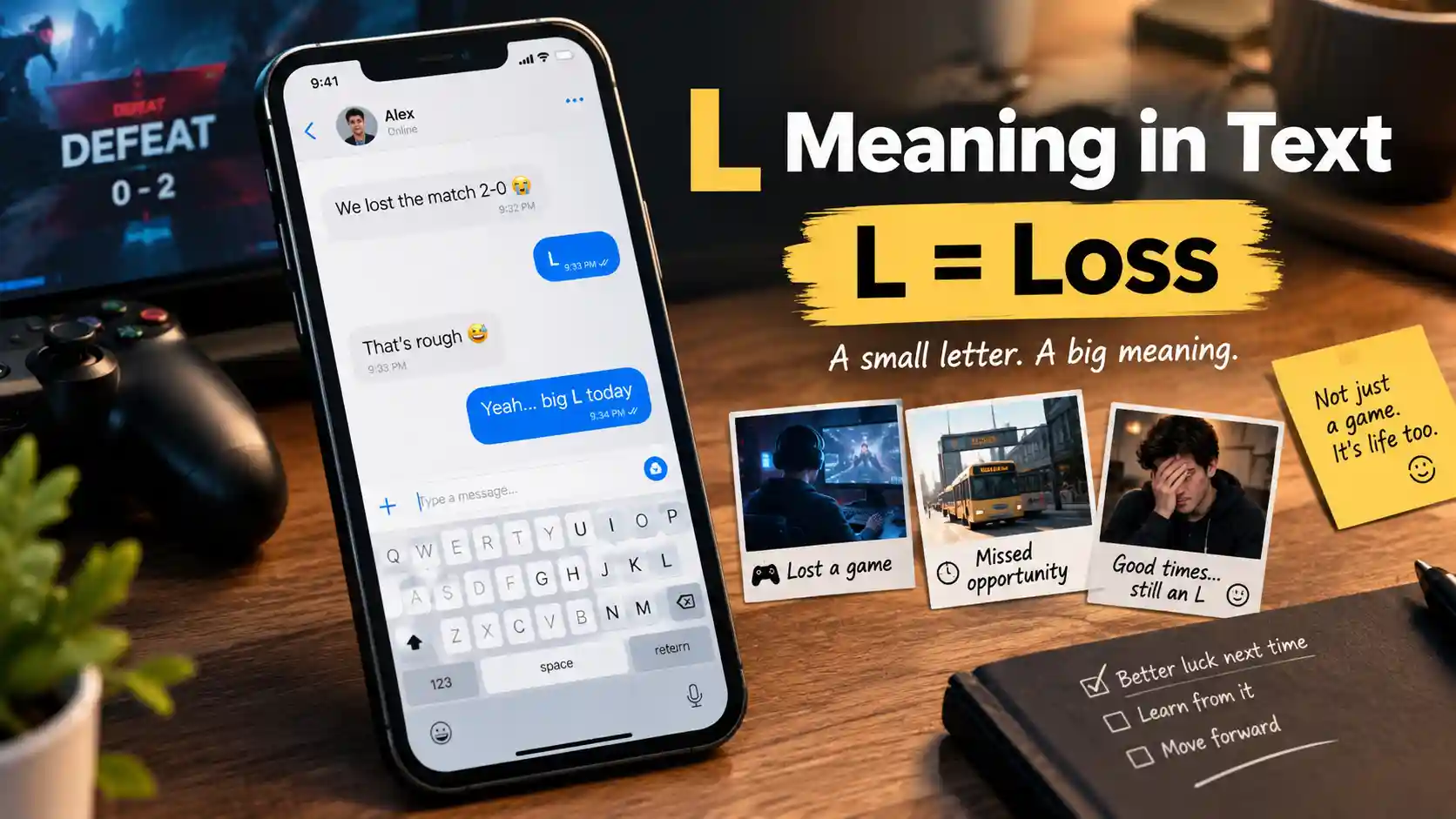
You see one letter pop up everywhere online. “L.” It shows up in gaming chat, tweets, group texts, and comment sections. At first, it looks like a typo or a stray key press. It is not. “L” is short for “loss.”
People use it to react to a defeat, a mistake, or an embarrassing moment. A friend loses a match. Someone says: “That’s an L.” A person trips in a video. The caption reads: “Big L.”
This one letter carries a lot of meaning. It shows up in texting, on social media, in gaming lobbies, and even in casual office chat. Knowing what it means helps you read the room. It helps you know when someone is joking, venting, or just being blunt. This guide breaks down where “L” comes from, how people use it, and how you can respond when you see it.
Definition & Meaning
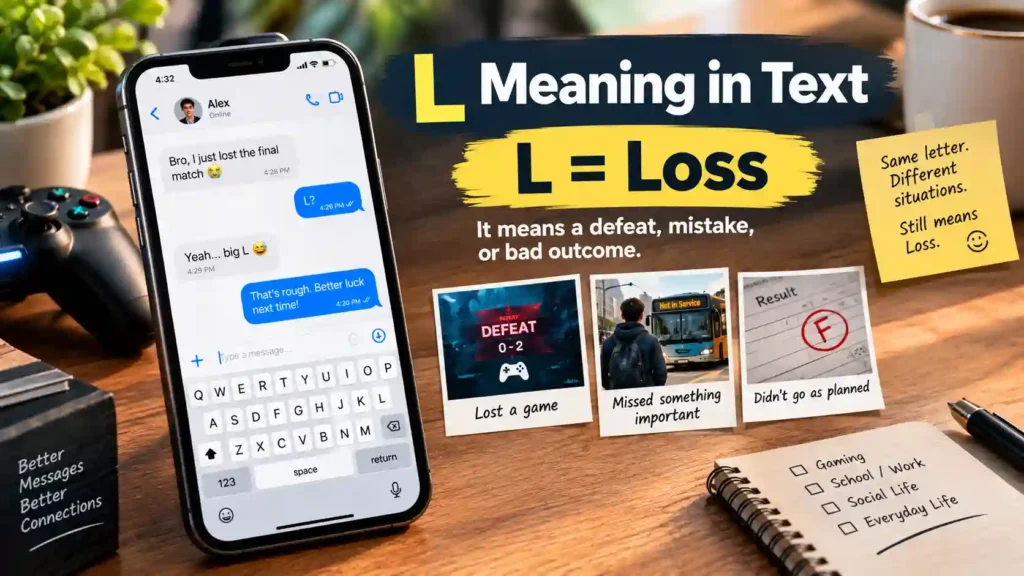
“L” stands for “loss.” It is the opposite of “W,” which stands for “win.” Together, they form one of the simplest scoring systems in slang: W for good outcomes, L for bad ones.
When someone “takes an L,” they accept a defeat, failure, or setback. It does not have to be a big deal. It can be a lost game, a bad grade, a missed bus, or a joke that fell flat.
Here are a few real-life examples:
Alex: “I studied all night and still failed the quiz.” Sam: “Ah man, that’s a rough L.”
Jordan: “We lost the tournament 2-0.” Casey: “Big L for the team today.”
Riley: “I tripped in front of the whole cafeteria.” Morgan: “LOL, take the L.”
Notice the tone. It is rarely mean-spirited. Most of the time, “L” is a quick, almost affectionate way to say: “That did not go your way.” It softens a bad moment with humor instead of making it heavier.
The letter can stand alone (“L”), or appear in short phrases:
- “Take the L” – accept the loss, move on.
- “Big L” – a large or especially embarrassing loss.
- “Hold this L” – you are stuck with this loss, whether you like it or not.
- “L-take” – a bad opinion or bad decision, treated as a “loss” in itself.
Background & History
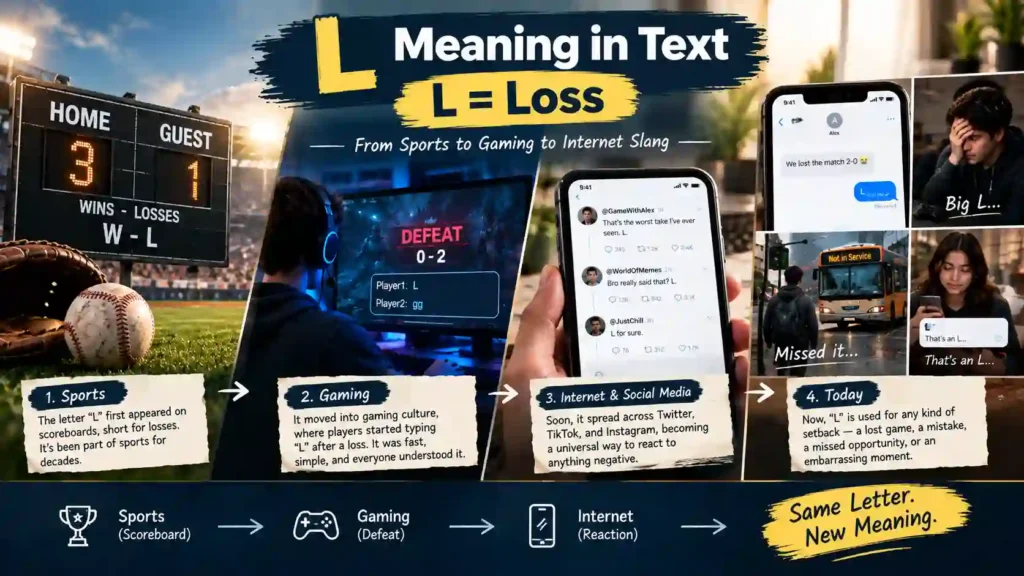
“L” did not start online. It started on the scoreboard. In sports, a team’s record is written as W-L, short for wins and losses. Fans and commentators have used “L” this way for decades, long before texting existed.
The jump from sports stat sheets to internet slang happened through gaming culture. Competitive video games track wins and losses the same way sports do. In multiplayer games, players started typing “L” in chat right after losing a round or a match. It was fast, it fit the moment, and everyone understood it instantly.
From there, the term spread. Streamers and esports commentators used “L” on camera. Gaming forums and Discord servers picked it up. Eventually, it crossed over into general internet culture on Twitter, TikTok, and Instagram, where it stopped being just about games.
Today, “L” describes any kind of setback:
- A sports loss (the original use)
- A gaming defeat
- A social media flop (a post that gets mocked or ignored)
- A personal mishap (burning dinner, missing a flight, bad date)
The word “loss” barely changed. What changed is the size of the stage it is used on. It went from a scoreboard stat to a way people describe almost any bad moment in daily life.
Usage in Various Contexts
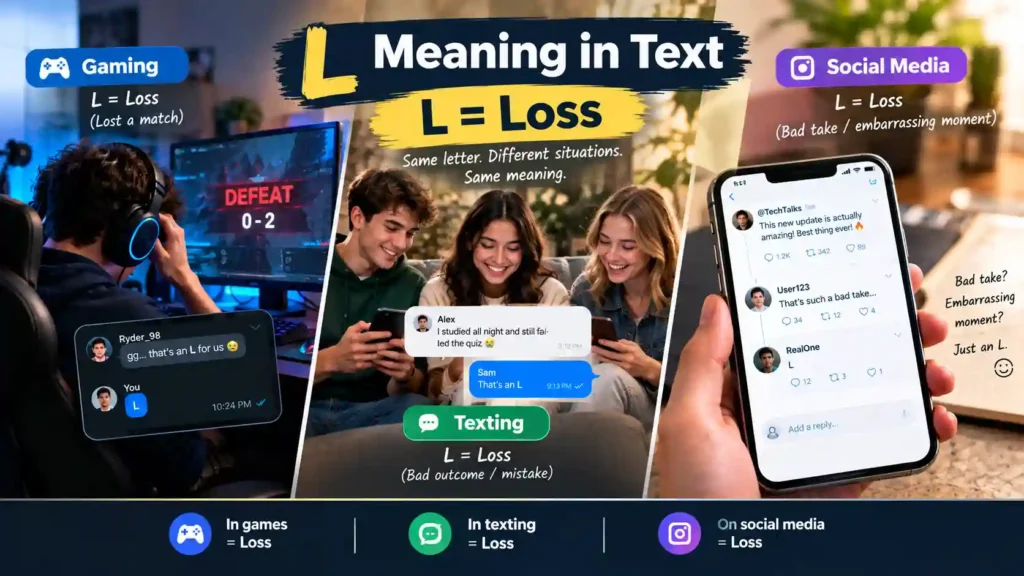
Texting. Friends use “L” as shorthand instead of typing out “that’s unfortunate” or “you failed at that.”
Text 1: “Forgot my charger at home again 💀” Text 2: “L behavior fr”
Social Media. On Twitter and TikTok, “L” often reacts to a viral moment, a bad take, or someone’s public mistake.
Comment: “This is an L take, ngl.”
Gaming. This is where “L” still feels most at home. Players type it after losing a match, sometimes as a joke, sometimes to needle an opponent.
In-game chat: “gg, that’s an L for us this round”
Casual conversation. Friends use it out loud too, not just in text.
Friend 1: “I asked her out and she said no.” Friend 2: “Bro… that’s an L. You’ll get the next one though.”
Group chats. “L” often shows up as a reaction to someone sharing bad news, sometimes paired with a laughing emoji to soften it.
Across all these settings, the tone stays mostly playful. It is a way to name a bad outcome quickly, without turning it into a bigger deal than it needs to be.
Common Misconceptions & Clarifications
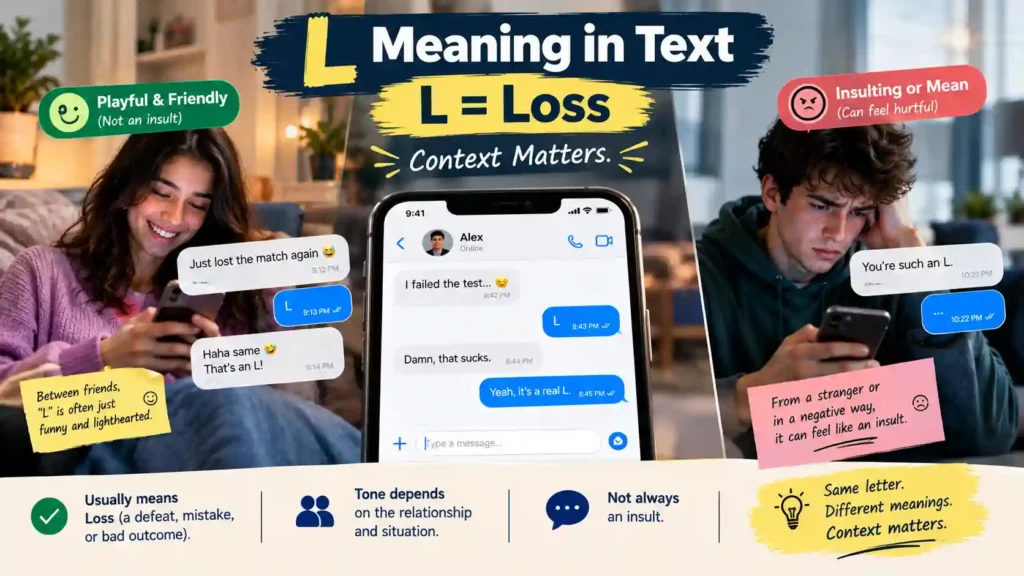
The biggest misconception is that “L” is always an insult. It usually is not. Most of the time, it is observational, not attacking. Saying “that’s an L” is closer to “that’s rough” than it is to a personal attack.
That said, tone and relationship matter. Between friends, “L” is often lighthearted. From a stranger, especially repeated or aimed at someone’s character rather than a single event, it can feel like mockery.
Another misconception: people sometimes think “L” only applies to games. In reality, it has expanded to cover almost any negative outcome If a bad decision, a failed plan, an awkward moment, or even a losing argument.
A third misconception: some assume “L” is a brand-new term. It is not new at all. The W-L format has existed in sports for generations. What is newer is using the single letter as a standalone reaction in casual chat, separate from any actual scoreboard.
Clarification on intensity: not every “L” is equal. A small, throwaway “L” (forgetting your umbrella) is different from a “major L” or “catastrophic L” (missing a big opportunity). The size of the loss usually gets an extra word attached to signal how bad it really was.
Clarification on sincerity: context decides whether “L” is comforting, teasing, or dismissive. The same word can soften bad news among friends or feel cold from someone who does not know you well.
Similar Terms & Alternatives
“L” belongs to a small family of slang terms that describe wins, losses, and reactions to them.
| Term | Meaning | Example |
| W | A win, a good outcome | “Got the job, that’s a W” |
| L | A loss, a bad outcome | “Missed the bus, that’s an L” |
| Ratio’d | Getting more critical replies than likes on a post | “He got ratio’d hard” |
| GG | “Good game,” said after a match ends, win or lose | “GG, close match” |
| Ded / 💀 | Something so bad or funny it’s “deadly” | “That fumble was ded” |
| Cooked | In serious trouble or facing a bad outcome | “If the boss finds out, you’re cooked” |
Some people also say “that’s rough” or “tough break” as more neutral, non-slang alternatives that carry a similar meaning without the internet-culture flavor.
How to Respond to This Term
How you respond to “L” depends on the setting and the relationship.
Casual response:
“Yeah, that was an L. Better luck next time.”
Funny response:
“L taken. Adding it to my collection.”
Supportive response (if the loss feels heavier than a joke):
“That’s a tough one. You okay?”
Professional response (if it somehow comes up at work):
Best to avoid slang entirely. Something like: “That didn’t go as planned If let’s figure out next steps.”
Privacy-conscious response: If you’d rather not share details about what happened, a short, light reply works:
“Ha, yeah, one of those days.”
The key is reading the tone of the original message. If someone is laughing at their own mistake, matching that energy is usually right. If they sound genuinely upset, skip the slang and check in on them directly.
Regional or Cultural Differences
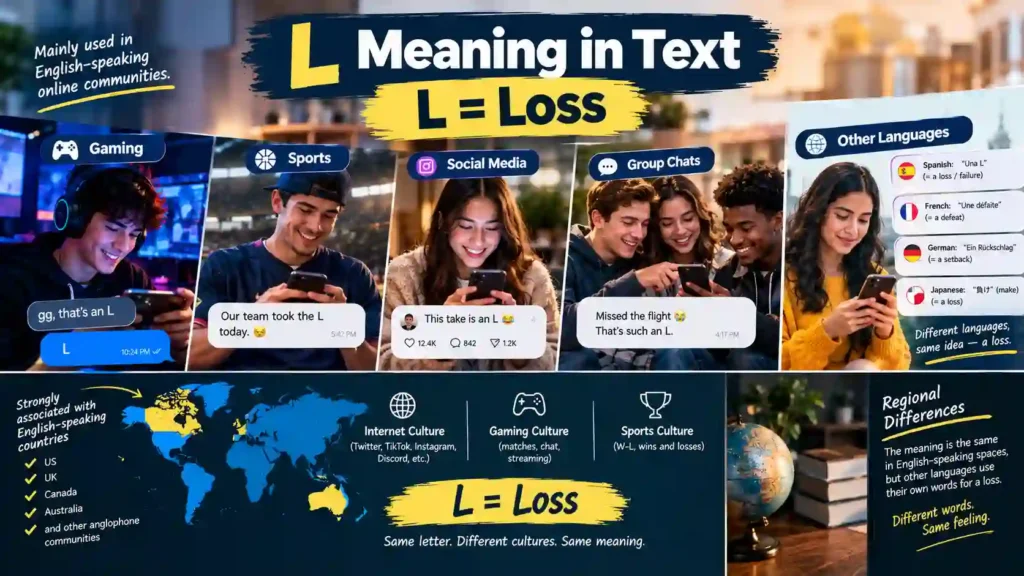
“L” is mostly an English-language, internet-driven term. It grew out of American sports and gaming culture, where the W-L format is standard, so the slang travels most naturally in English-speaking online spaces If the US, UK, Canada, Australia, and other anglophone gaming and social media communities.
In non-English-speaking regions, the letter itself does not always translate, since “win” and “loss” are different words in other languages. Instead, many of those communities use their own local slang for the same idea (celebrating wins or mocking losses), while still borrowing globally-understood gaming terms like “GG” alongside it.
Within English-speaking spaces, there are not strong regional splits in what “L” means If it is used the same way, more or less, across the US, UK, and other markets. What does vary is intensity and frequency: it shows up most often in spaces already saturated with gaming and sports slang, like esports Discords and Twitter gaming communities, and less often in more formal or older-skewing online spaces.
Comparison with Similar Terms
Here is a closer look at how “L” differs from a few terms people sometimes confuse it with:
| Term | Core Meaning | Tone | Best Used |
| L (Loss) | A defeat or setback | Light, resigned | Any bad outcome, big or small |
| W (Win) | A success or good outcome | Positive, celebratory | Any good outcome |
| Ratio’d | Publicly out-argued on social media | Mocking | Specifically social media posts |
| Cooked | In serious, often unavoidable trouble | Alarmed, dramatic | Situations with real consequences |
| Skill issue | A loss blamed on lack of ability (mainly gaming) | Teasing, sometimes harsh | Gaming losses specifically |
The main difference between “L” and terms like “skill issue” or “cooked” is severity and blame. “L” is neutral If it just names the loss. Terms like “skill issue” add a judgment about why the loss happened, which can feel more pointed.
Usage in Online Communities & Dating Apps
In gaming communities, “L” is practically native vocabulary. It shows up in chat after nearly every competitive match, often followed by a rematch request or a joke.
On Twitter (X), “L” frequently reacts to bad takes, embarrassing screenshots, or public mistakes. A viral post with a bad opinion might get flooded with replies just saying “L.”
On dating apps, the term shows up less as an in-app message and more in how people talk about dating on social media. Someone might post about a bad date and caption it “another L,” using the term to laugh off the experience rather than dwell on it. It is less common to see “L” used directly in a conversation with a match, since it can read as blunt or dismissive in a context where tone is already hard to read through text.
Tips for responding appropriately:
- In gaming chats, a quick “L” or “GG” back is normal and expected.
- On social media, think twice before commenting “L” on a stranger’s post If it can come across as mean without context.
- On dating apps, it is safer to skip the slang altogether and respond with something warmer, since first impressions rely heavily on tone.
Hidden or Offensive Meanings
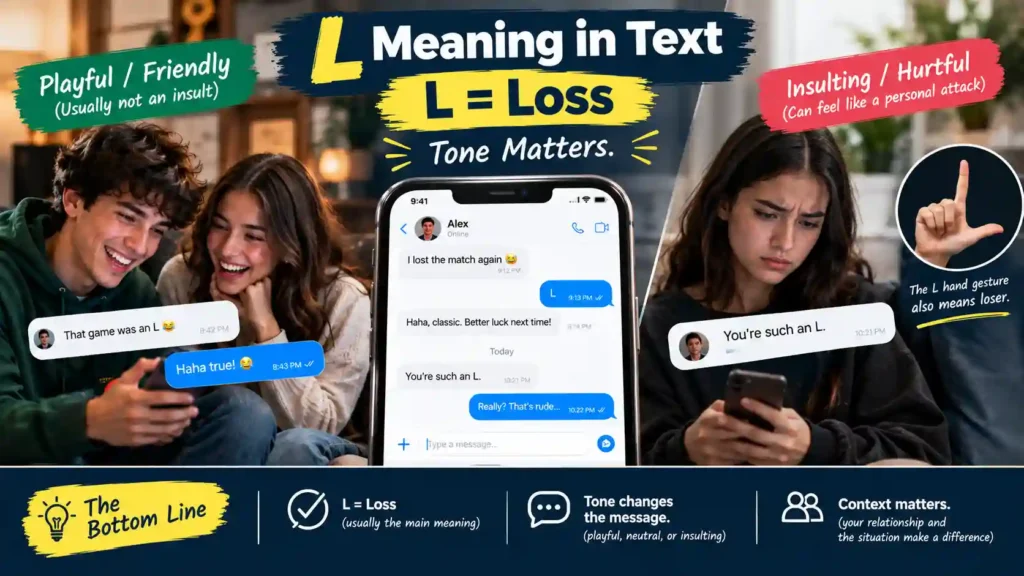
Most of the time, “L” is harmless. But it can carry a sharper edge depending on how it’s used.
Using “an L” to describe someone usually sounds more personal and direct than saying they “took an L.” While “took an L” often refers to a specific mistake, loss, or bad outcome, “an L” can suggest that the person is being viewed as the problem.
There is also a related hand gesture: forming an “L” shape with the thumb and index finger and holding it to the forehead. This started as a way to call someone a “loser” in casual, often mocking, ways well before it connected to the texting slang. When paired with the written “L,” it reinforces the same idea, but more pointedly.
Why tone and context matter: the exact same word, “L,” can be:
- A joke between friends (“L taken, no worries”)
- Playful teasing (“that fit was an L today”)
- A genuine insult (“you’re such an L”) when aimed at someone’s character rather than a single mistake
Written text strips out tone of voice, so “L” can land differently than intended. It is worth pausing before using it with someone who might not read it as lightly as you meant it.
Suitability for Professional Communication
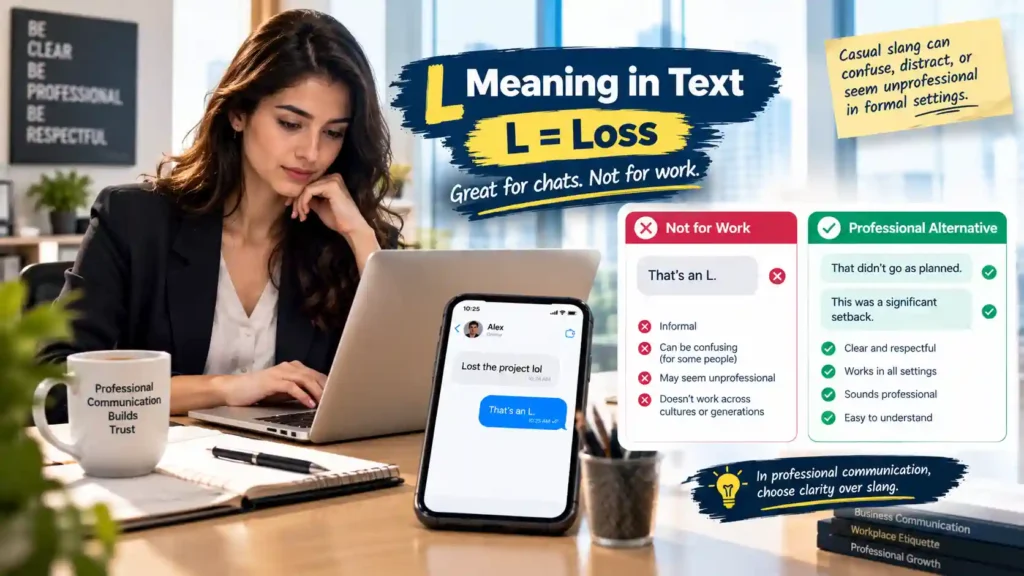
“L” does not belong in professional communication. It is casual internet slang, tied closely to gaming and social media culture, and it reads as unprofessional or even confusing in a work email, report, or formal message.
If you want to express a similar idea professionally, here are safer alternatives:
- Instead of “that’s an L,” try: “That didn’t go as planned.”
- Instead of “big L for the team,” try: “This was a significant setback for the team.”
- Instead of “take the L,” try: “Let’s acknowledge this outcome and move forward.”
These alternatives keep the honesty of admitting a loss or mistake without the slang. They also travel better across generations and cultures, since not every reader will know what “L” means.
A simple rule: if you are texting a close friend, “L” fits fine. If you are writing to a manager, client, or anyone outside your close circle, spell it out instead.
FAQs
1. What does “L” mean in texting?
It means “loss.” It is used to describe a defeat, mistake, or bad outcome.
2. Is “L” always an insult?
No. Most of the time it is a light, joking way to acknowledge something went wrong. It can turn insulting depending on tone and who is saying it.
3. Where did “L” come from?
It comes from sports scoring, where records are shown as W-L (win-loss). Gaming culture picked it up and turned it into standalone slang.
4. What is the opposite of “L”?
“W,” short for “win.”
5. Can I use “L” at work?
It is best to avoid it in professional settings. Use a plain phrase like “that didn’t go as planned” instead.
6. What does “take the L” mean?
It means to accept a loss or mistake without arguing or making excuses.
7. Is “L” used the same way in gaming and on social media?
Mostly yes. In gaming, it usually refers to losing a match. On social media, it has broadened to cover almost any bad outcome or embarrassing moment.
Conclusion
“L” is a small letter that does a lot of work. It started as sports shorthand for “loss,” moved into gaming chat, and spread across social media and texting. Today, people use it to react to anything from a lost match to a bad day, almost always with a light, joking tone.
The key takeaway: context decides the meaning. Among friends, it is usually harmless humor. Aimed at someone’s character, it can sting. And in professional settings, it is best left out entirely.
Understanding “L” helps you read digital conversations more clearly If and know exactly when to laugh it off, offer support, or just say “GG” and move on.
Discover More Article

Hello, I’m Insha, a passionate content writer with 2 years of experience creating clear, engaging, and helpful content. I specialize in the meaning niche, explaining words, slang, phrases, and online terms in simple language that readers can easily understand and use.




1 thought on “L Meaning in Text: What It Really Means<p class="post-updated-date">🕓 <span class="updated-label">Last updated on</span> <time datetime="2026-09-22T05:42:12+00:00">September 22, 2026</time></p><script type="application/ld+json"> { "@context": "https://schema.org", "@type": "BlogPosting", "mainEntityOfPage": { "@type": "WebPage", "@id": "https://outreachnexa.com/l-meaning-in-text/" }, "datePublished": "2026-09-17T12:01:35+00:00", "dateModified": "2026-09-22T05:42:12+00:00" } </script>”