
You’re scrolling through texts. You see “NR” pop up. You pause. What does it mean?
This short abbreviation shows up everywhere. You’ll spot it in texts, tweets, gaming chats, and even work emails. It’s small, but it carries different meanings depending on where you see it.
Most often, “NR” means “No Reply” or “No Reply Needed.” It tells the other person: you don’t have to write back. Sometimes, though, “NR” stands for something else entirely, like “Near” or “Number.”
Knowing what “NR” means matters. Use it wrong, and your message gets confusing. Use it right, and you save time and avoid awkward back-and-forth texts. Let’s break down every meaning, use case, and response style for this handy little abbreviation.
Definition & Meaning

“NR” most commonly means “No Reply” or “No Reply Needed” in texting and casual chat. People add it to the end of a message to signal that a response isn’t required. It’s a small courtesy. It tells the reader: relax, you don’t owe me anything back.
Here’s a simple example:
Sam: Picked up the package for you, it’s on your porch. NR
Sam: Meeting moved to 3pm. NR
In both cases, “NR” saves the other person from feeling like they need to type “ok thanks!” It closes the loop.
But “NR” isn’t a one-trick term. It has other common meanings too:
- Near used in classified ads and directions (“House NR the station”)
- Number an old-school abbreviation, still used in some European languages and formal writing (“Order Nr. 4521”)
- Not Rated used for movies, credit ratings, and reviews
- No Response similar to “No Reply,” used when describing outcomes (“I texted him twice, NR.”)
- National Record used in sports commentary and reporting
Context decides which meaning applies. A text between friends almost always means “No Reply Needed.” A formal document using “Nr.” before a number almost always means “Number.”
The rise of texting shorthand made abbreviations like “NR” popular because they save time and character space. People type fast, and dropping unnecessary words fits the pace of modern conversation.
Background & History

The letters “NR” didn’t start in texting. They’ve been around for over a century, mostly in written and business communication.
In many European languages, especially German, Dutch, and Scandinavian languages, “Nr.” is a standard abbreviation for “number” (from “Nummer,” “Numero,” etc.). You’ll still see it today on invoices, product labels, and official documents across Europe.
In English, “nr” also appeared early as a shorthand for “near,” especially in newspaper classifieds and real estate listings. A vacation rental ad from decades ago might read: “Cottage NR lake, sleeps 4.”
The texting meaning, “No Reply” or “No Reply Needed,” is much newer. It grew out of the same wave of abbreviations that gave us “LOL,” “BRB,” and “TTYL.” As mobile texting became the default way people communicated in the 2000s and 2010s, shorthand exploded. People needed fast ways to end a conversation politely, and “NR” filled that gap.
Email culture helped popularize a close cousin: “NRN,” meaning “No Reply Necessary.” Busy professionals used it to close emails without demanding a response. Over time, casual texters shortened this further, and “NR” picked up the same meaning in everyday chat.
Today, “NR” lives in several worlds at once:
- Texting and messaging apps mostly means “No Reply Needed”
- Gaming chat sometimes shorthand for status updates or quick notes
- Business and technical documents usually means “Number” or “Not Rated”
- European languages almost always “Number”
The term keeps evolving. As younger texters favor even shorter replies, expect abbreviations like “NR” to stick around, especially for quick, low-effort communication.
Usage in Various Contexts

“NR” changes meaning based on where you see it. Here’s how it plays out across different platforms.
In Texting
This is the most common spot for “NR” as “No Reply Needed.” People use it to end a message without expecting anything back.
Mia: Left your keys with the doorman. NR
Jake: 👍
Dad: Car’s ready for pickup. NR
You: Thanks!
Even though “NR” says no reply is needed, people often reply anyway. That’s fine. It’s a suggestion, not a rule.
In Social Media
On platforms like Twitter/X or Instagram comments, “NR” shows up less often but still appears, usually meaning “No Reply” in the same casual sense.
User1: Just dropped the new post, check it out. NR, just sharing 🙂
It signals the poster isn’t looking for a debate or a response. Just a share.
In Gaming
In gaming chats, “NR” isn’t as standardized. Some players use it to mean “No Reply” during fast-paced matches when they don’t want distractions.
Player1: Reviving you now, hold position. NR
Other gaming communities barely use it at all, since faster shorthand like “brb” or “afk” dominates instead.
In Casual Conversation
Friends and family use “NR” the same way as texting, often at the end of quick updates.
Friend: Running late, 10 mins. NR
You: No worries!
In Professional Settings
Here, “NR” shifts meaning. In emails or documents, it more often stands for “Number” (Nr. 202), “Not Rated,” or appears in formal notices.
Email: Please reference invoice Nr. 4432 for payment details.
Context always drives the meaning here. A quick internal Slack message might use “NR” casually, like texting. A formal report uses it the traditional way.
Common Misconceptions & Clarifications
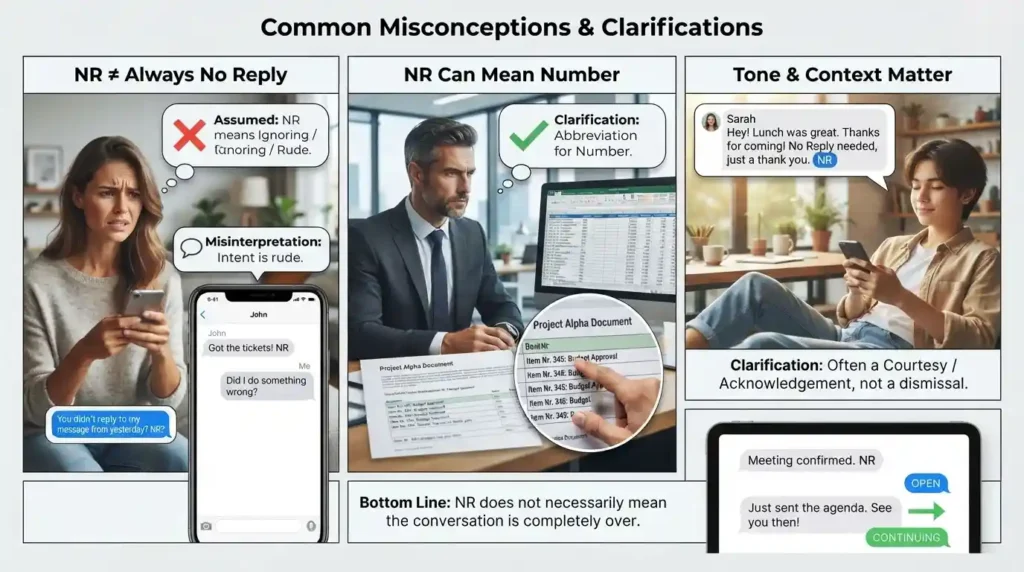
People sometimes get confused by “NR,” and that’s understandable since it carries multiple meanings.
Misconception 1: “NR” always means “No Reply.”
Not true. In business writing, engineering, and non-English documents, “NR” usually means “Number” or “Not Rated.” Always check the context before assuming.
Misconception 2: “NR” is rude.
Some people worry that saying “No Reply Needed” sounds dismissive, like you don’t want to hear back. In reality, it’s usually a courtesy. It tells the other person they’re not obligated to respond, easing any pressure they might feel.
Misconception 3: “NR” means the conversation is over.
Not necessarily. People can still reply after seeing “NR.” It just removes the expectation, not the option.
Misconception 4: Everyone knows what “NR” means.
Actually, many people have never seen this abbreviation and might think it’s a typo or an unfamiliar acronym. Because it’s less common than “LOL” or “OMG,” some confusion is normal, especially across age groups or platforms.
Is “NR” ever inappropriate?
Generally, no. It’s neutral. But tone matters. If someone uses “NR” after delivering bad news or ending a serious conversation, it can feel cold or dismissive, even if that wasn’t the intent. For sensitive topics, skip the abbreviation and write a complete sentence instead.
Clarifying the different meanings
If you’re ever unsure which meaning applies, look at:
- The platform (texting vs. business document)
- The surrounding words (a number, an address, or a casual sentence)
- The relationship (coworker vs. close friend)
When in doubt, just ask.
Similar Terms & Alternatives
Several other abbreviations serve a similar purpose to “NR” or overlap with its meanings.
| Term | Meaning | Common Use |
| NRN | No Reply Necessary | Emails, texts |
| FYI | For Your Information | Sharing info, no response expected |
| NTS | Note to Self | Personal reminders |
| JIC | Just In Case | Adding context to a message |
| N/A | Not Applicable | Forms, documents |
| No. | Number (English) | Formal writing |
| Nr. | Number (European languages) | Invoices, addresses |
“NRN” vs “NR”
These two are closest in meaning. “NRN” is more explicit, spelling out “No Reply Necessary” more fully, while “NR” is shorter and more ambiguous. Some people use them interchangeably.
“FYI” vs “NR”
“FYI” shares information and implies no response is expected, but it doesn’t explicitly say so. “NR” is more direct about not needing a reply.
“No.” vs “NR” (Number)
Both abbreviate “number,” but “No.” is standard in English, while “Nr.” dominates in German, Dutch, and other European languages.
Choosing between these depends on your audience. For a quick, casual text, “NR” works fine. For clarity in professional writing, spell it out fully or use “NRN” to avoid confusion.
How to Respond to This Term

Even though “NR” suggests no reply is needed, how you respond (or don’t) can say a lot. Here are different styles.
Casual Response
Just acknowledge it briefly.
Them: Dropped your book off. NR
You: Thanks! 🙌
Funny Response
Play along with the “no reply” idea, but reply anyway.
Them: On my way, NR
You: Replying anyway because I can’t help myself 😄
Professional Response
Keep it brief and polite, especially in email threads.
Them: Report Nr. 220 attached for review, NRN.
You: Received, thank you.
Privacy-Conscious Response
If you’d rather not engage further, simply don’t reply. That’s exactly what “NR” allows. No explanation needed.
When You Should Reply Anyway
Even with “NR” attached, some situations call for a response:
- If plans need confirming
- If there’s a question buried in the message
- If the relationship calls for warmth (family, close friends)
When It’s Fine to Stay Silent
- Quick updates (“Left the package. NR”)
- Status notes (“Running 5 min late. NR”)
- FYI-style texts with no real question
Regional or Cultural Differences

The meaning of “NR” shifts depending on language and region.
English-speaking countries (US, UK, Canada, Australia)
“NR” as “No Reply Needed” is mostly a texting and internet slang term. It’s informal and mainly used among younger texters and casual communicators.
European countries (Germany, Netherlands, Scandinavia)
“Nr.” almost always means “Number.” You’ll see it on official paperwork, addresses, and product labels constantly. It’s rarely used to mean “No Reply.”
Asian markets
Texting slang in many Asian countries relies more on emoji and platform-specific shorthand (like stickers in messaging apps) rather than English abbreviations like “NR.” When it appears, it’s usually understood through English-language influence, especially among younger, bilingual users.
Gaming communities worldwide
Since gaming culture spans many countries, English gaming slang like “NR” spreads globally, but usage stays inconsistent. Some regions have their own shorthand instead.
Business and academic writing
Across most Western countries, “Nr.” or “No.” for “number” stays consistent in formal writing, regardless of local slang trends.
Understanding these differences helps avoid confusion, especially in international group chats or when working with global teams.
Comparison with Similar Terms
Here’s a clearer side-by-side look at “NR” against related shorthand.
| Term | Full Meaning | Tone | Best Used For |
| NR | No Reply (Needed) | Neutral, casual | Quick updates |
| NRN | No Reply Necessary | Slightly more formal | Emails, professional texts |
| FYI | For Your Information | Neutral | Sharing facts |
| JIC | Just In Case | Casual | Adding backup info |
| Nr. | Number | Formal | Documents, invoices |
| N/A | Not Applicable | Formal | Forms |
Key differences:
- “NR” is shorter and more casual than “NRN.”
- “FYI” shares info; “NR” removes the pressure to respond.
- “Nr.” (number) is almost exclusively formal and unrelated to texting slang.
Picking the right term depends on formality and audience. Texting a friend? “NR” works great. Writing a business report? Stick with “No.” or spell it out.
Usage in Online Communities & Dating Apps

On Dating Apps (Tinder, Bumble, Hinge)
“NR” isn’t extremely common here, but it does show up, usually meaning “No Reply Needed” after sharing something like a number or plan.
Match: Here’s my number, NR if you’re not interested, I get it.
In this context, it softens rejection. It gives the other person an easy out without needing an awkward explanation.
Tips for Responding on Dating Apps:
- If you’re interested, reply anyway, “NR” doesn’t mean “don’t.”
- If you’re not interested, silence is accepted. That’s the whole point.
- Avoid using “NR” right after asking a genuine question. It sends mixed signals.
On Twitter/X
“NR” occasionally appears in casual posts or replies, mostly meaning the poster isn’t looking for engagement.
In Gaming Communities
Usage varies widely. In some competitive gaming Discord servers, “NR” might mean “No Reply” during matches, or it could refer to something entirely different, like “Not Ranked.”
General Tip for Online Communities
Always check pinned rules or community guides if unsure. Slang meanings can differ from platform to platform, and even between different servers on the same platform.
Hidden or Offensive Meanings
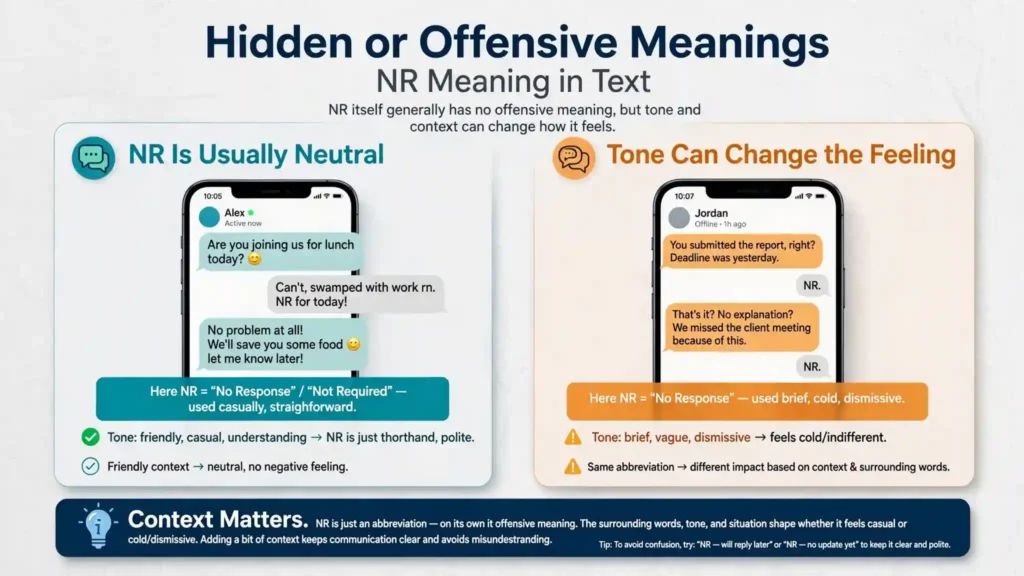
For the most part, “NR” carries no offensive meaning. It’s a neutral, functional abbreviation.
That said, tone and context still matter:
- If someone uses “NR” right after saying something hurtful or dismissive, it can come across as cold, even if the abbreviation itself isn’t rude.
- In rare cases, some online slang dictionaries list obscure or joke definitions for almost any two-letter combination, including “NR.” These aren’t widely recognized and shouldn’t be assumed unless the specific community you’re in uses them that way.
- Sarcastic use (“Sure, NR, like I even care”) can shift the tone negatively, but this comes from the surrounding words, not “NR” itself.
Why context matters so much:
Two-letter abbreviations are flexible. The same letters can mean different things in different rooms. Before assuming a hidden or negative meaning, look at:
- Who sent it
- What came before and after it
- The relationship and platform
If you’re ever unsure whether someone meant it kindly or dismissively, it’s fine to ask directly.
Suitability for Professional Communication

Is “NR” appropriate at work? It depends on the setting.
Fine for:
- Quick internal Slack or Teams messages between coworkers who know the shorthand
- Casual status updates (“Sent the file over, NR”)
Not ideal for:
- Formal emails to clients or executives
- Official documents, contracts, or reports (unless using “Nr.” for “Number” in the traditional formal sense)
- Any communication where clarity matters more than speed
Professional Alternatives:
- Instead of “NR” (No Reply Needed): write “No response necessary” or “Feel free to disregard if no action is needed.”
- Instead of “NR” (Number): spell out “No.” or “Number” depending on your style guide.
Using full phrases in professional settings avoids confusion, especially with international colleagues who might not recognize casual slang.
FAQs
1. What does “NR” mean in a text message?
Most often, it means “No Reply” or “No Reply Needed,” telling the reader they don’t have to respond.
2. Is “NR” the same as “NRN”?
They’re very close. “NRN” spells out “No Reply Necessary” a bit more clearly, while “NR” is shorter and more casual.
3. Can “NR” mean something other than “No Reply”?
Yes. It can also mean “Number,” “Near,” “Not Rated,” or “National Record,” depending on context.
4. Is it rude to use “NR” after a message?
No, it’s usually seen as considerate. It removes pressure on the other person to reply.
5. Should I reply even if someone writes “NR”?
You can if you want to. “NR” just means a reply isn’t required, not that it’s unwelcome.
6. Is “NR” appropriate for work emails?
It’s better suited for casual internal chats. For formal emails, spell out the full phrase instead.
7. Does “NR” mean the same thing everywhere?
No. In many European languages, “Nr.” usually means “Number,” not “No Reply.”
Conclusion
“NR” might look like a small, forgettable abbreviation, but it carries real meaning depending on where you see it. In texting and casual chat, it usually means “No Reply Needed,” a polite way to close a message without expecting anything back. In business or European contexts, it often means “Number” instead.
Understanding the difference helps you avoid confusion and communicate clearly, whether you’re texting a friend, chatting in a gaming server, or writing a formal report. Context is everything.
Next time you see “NR” pop up, you’ll know exactly what it means, and how to respond, or not respond, with confidence
Discover More Article

Hello, I’m Insha, a passionate content writer with 2 years of experience creating clear, engaging, and helpful content. I specialize in the meaning niche, explaining words, slang, phrases, and online terms in simple language that readers can easily understand and use.









1 thought on “NR Meaning in Text: What It Really Means and How to Use It<p class="post-updated-date">🕓 <span class="updated-label">Last updated on</span> <time datetime="2026-09-22T05:45:30+00:00">September 22, 2026</time></p><script type="application/ld+json"> { "@context": "https://schema.org", "@type": "BlogPosting", "mainEntityOfPage": { "@type": "WebPage", "@id": "https://outreachnexa.com/nr-meaning-in-text/" }, "datePublished": "2026-09-18T14:27:34+00:00", "dateModified": "2026-09-22T05:45:30+00:00" } </script>”