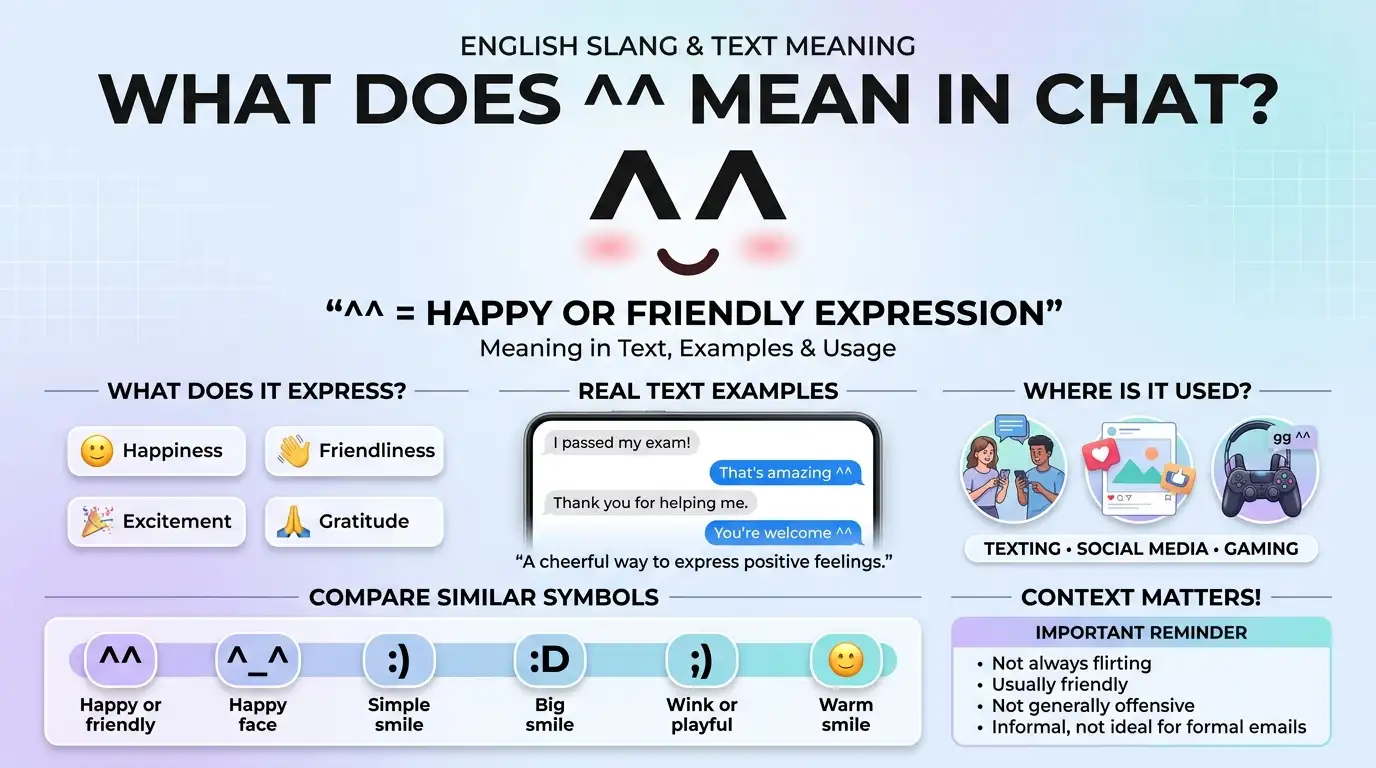
Have you ever received a text with “^^” at the end and wondered what it means? You are not alone. People use symbols, emojis, and short forms every day to make online chats faster and more fun. One of these symbols is ^^, which often shows happiness, excitement, friendliness, or a smiling expression.
You may see ^^ in text messages, social media comments, gaming chats, and online communities. For example, a friend might say, “Thanks for helping me ^^.” This can make the message feel warm and cheerful.
However, ^^ does not have one fixed meaning in every conversation. Its meaning can change based on the message, the person sending it, and the situation. Some people use it as a cute smile, while others use it to show a positive mood.
In this guide, you will learn what ^^ means in text slang, where it came from, how people use it, and how to reply. You will also discover similar symbols and tips for understanding its meaning in different situations.
Definition and Meaning of ^^
^^ is a text symbol that often represents a happy face, smiling eyes, or a cheerful mood. It is made from two caret symbols. These symbols look like raised eyes when viewed as a simple text face.
People often use ^^ to show that they feel happy, friendly, excited, or thankful. It can also make a short message sound softer and more welcoming.
Unlike words such as “happy” or “excited,” ^^ lets people show emotion without writing a full sentence. This is useful in quick online chats.
What does ^^ stand for?
The symbol ^^ usually does not stand for a specific phrase. It is not normally an abbreviation with a full form. Instead, it works as an emoticon, which is a face or expression made from keyboard characters.
Here are some common meanings:
- Happiness: The sender feels good or cheerful.
- Friendliness: The sender wants to sound kind and welcoming.
- Excitement: The sender is pleased about something.
- Gratitude: The sender wants to make a thank-you message warmer.
- Playfulness: The sender is joking or keeping the chat light.
Examples of ^^ in text
Example 1: Showing happiness
Alex: I passed my exam!
Sam: That’s amazing ^^
Here, ^^ adds a happy and supportive feeling.
Example 2: Saying thank you
Mia: I sent you the notes.
Lily: Thank you so much ^^
The symbol makes the reply feel friendly.
Example 3: Ending a casual message
Noah: See you tomorrow ^^
This sounds warm and cheerful rather than cold or formal.
Remember, the meaning depends on the context. A person may use ^^ out of habit, even when they are not feeling especially excited.
Background and History of ^^
The symbol ^^ belongs to a wider group of text faces called emoticons. Emoticons use keyboard characters to show feelings, expressions, or reactions. They became popular because early digital messages did not always support colorful emojis.
Before modern smartphones, people used symbols such as 🙂 and 🙂 to show a smile. These simple faces helped readers understand the feeling behind a message. Without facial expressions or voice, written conversations could sometimes seem cold or confusing.
Over time, people began using many other text faces. Examples include for a big smile, 😉 for a wink, and ^^ for a cheerful or smiling expression.
Why do people use two carets?
The two caret symbols can look like closed or raised smiling eyes. In some online communities, especially those influenced by anime, manga, and East Asian internet culture, ^^ became a familiar way to show a cute or happy expression.
However, it is difficult to point to one exact person or date when ^^ first appeared. Text faces developed across different websites, chat rooms, forums, and gaming communities. Their meanings often grew through shared use rather than through a single official definition.
How has ^^ changed over time?
In early online chats, people relied heavily on keyboard symbols to express feelings. Today, most messaging apps offer emojis, stickers, GIFs, and animated reactions. Even so, ^^ remains useful because it is quick to type and easy to recognize for people who know it.
You may still see it in:
- Online games and team chats
- Discord servers and fan communities
- Casual text messages
- Social media comments
- Forums and online discussion groups
Some users type ^^ often, while others prefer emojis such as 😊 or 😄. Both styles can express happiness, but the symbol ^^ has a simple, old-school internet feel.
Usage of ^^ in Different Contexts
The meaning of ^^ can change slightly depending on where it appears. It usually creates a friendly tone, but the exact feeling comes from the rest of the message.
1. In text messages
Friends may use ^^ to show kindness, happiness, or thanks.
Example:
Emma: I saved you a seat.
Olivia: Aww, thank you ^^
The symbol makes the reply sound warm.
2. On social media
People may add ^^ to comments, posts, or replies. It can show that they like something or feel happy about it.
Example:
User 1: Finally got my new puppy!
User 2: So cute ^^
Here, ^^ shows excitement or affection.
3. In online gaming
Gamers may use ^^ to keep team chats friendly. It can appear after a win, a helpful action, or a funny moment.
Example:
Player 1: We won that match!
Player 2: Great teamwork ^^
It shows a positive mood without taking up much space.
4. In online communities
Members of forums, fan groups, and chat servers may use ^^ to sound approachable.
Example:
Member 1: Welcome to the group!
Member 2: Thanks for having me ^^
The symbol makes the message feel welcoming and relaxed.
5. In friendly conversations
Some people use ^^ as a simple way to end a message on a positive note.
Example:
Ava: Hope you have a good day ^^
The message feels kind and cheerful.
In all these situations, ^^ is usually informal. It works best when the conversation is relaxed and the other person understands the symbol.
Common Misconceptions and Clarifications
People sometimes misunderstand ^^ because it does not have a single, official meaning. The symbol can look different to different readers, especially if they rarely use text faces.
Misconception 1: ^^ is an abbreviation
Clarification: ^^ is generally an emoticon, not an abbreviation. It does not normally stand for a set phrase.
Misconception 2: It always means flirting
Clarification: ^^ can appear in friendly, playful, or affectionate messages, but it does not automatically mean romantic interest.
Example:
Chris: Thanks for sharing the link ^^
This may simply be a friendly thank-you.
Misconception 3: It always means excitement
Clarification: It often shows happiness, but people may also use it out of habit or as a polite way to end a message. The surrounding words matter.
Misconception 4: Everyone understands it
Clarification: Some people recognize ^^ right away, while others may not know what it means. Emojis and text symbols can vary across age groups and online communities.
Misconception 5: It is suitable for every situation
Clarification: ^^ is usually casual. It may feel out of place in formal emails, official reports, or serious work conversations.
The best way to understand ^^ is to read the whole message. Do not decide what someone feels based on two symbols alone.
Similar Terms and Alternatives to ^^
Many symbols and emojis can express feelings like those shown by ^^. However, each one may carry a slightly different tone.
| Symbol | Common meaning | Tone |
| ^^ | Happy or friendly expression | Cute, cheerful |
| 🙂 | Smile | Friendly, simple |
| 🙂 | Smile | Classic, neutral |
| Big smile or excitement | Very happy | |
| 😉 | Wink | Playful, sometimes flirty |
| 😊 | Warm smile | Kind, gentle |
| 😄 | Happy grin | Excited, cheerful |
| ^_^ | Happy face | Cute, positive |
| <3 | Heart or love | Affectionate |
When should you use these alternatives?
Use 🙂 when you want a simple, friendly smile. Choose when you feel very happy or excited. Use 😊 for a warm and gentle tone, especially if the other person prefers emojis.
The symbol ^_^ is close to ^^ because it also looks like a happy face. The extra characters make the expression more complete.
If you want to keep your message clear, you can also use words instead of symbols.
For example:
- “Thanks, that helped a lot!”
- “I’m so happy for you!”
- “That sounds great.”
- “Hope you have a lovely day.”
These phrases are easy to understand, even for people who do not use text slang.
How to Respond to ^^
Your reply depends on what the other person said before using ^^. In most cases, you do not need to explain the symbol or make a special response. Just reply to the message in a natural way.
1. Casual response
If a friend uses ^^ after a friendly message, you can answer in the same tone.
Friend: See you soon ^^
You: See you! 😊
You can also say, “Talk to you later!” or “Have a great day!”
2. Funny response
If you are joking with someone, a playful reply may fit.
Friend: I finally cleaned my room ^^
You: A historic moment! 😂
This works when you already share a joking relationship.
3. Warm response
If the message feels kind or caring, you can respond with warmth.
Friend: Hope everything goes well for you ^^
You: Thank you! That means a lot.
You do not need to copy the same symbol. A sincere reply is enough.
4. If you are unsure what it means
If the symbol confuses you, you can ask in a relaxed way.
You: I see you use ^^ a lot. What does it mean?
This is a simple way to learn how that person uses it.
5. If the message feels flirty
Do not assume that ^^ means someone likes you romantically. Look at the whole conversation.
If you are interested, you can keep chatting and see how the person responds. If you are not interested, stay friendly without giving a romantic impression.
6. If you prefer not to use symbols
You can answer with plain words. For example, “Thanks!” or “That sounds good.” There is no rule that says you must use ^^ just because someone else does.
Regional and Cultural Differences
The symbol ^^ appears in many online spaces, but its use is not the same everywhere. People learn text slang from friends, games, social media, and online communities. As a result, a symbol may feel familiar to one group and unusual to another.
Online gaming and East Asian internet culture
The symbol is often associated with cute text expressions found in gaming, anime-related spaces, and some East Asian online communities. In these settings, ^^ may be used to show happiness or a friendly mood.
However, not everyone in these communities uses it, and its meaning can still vary from person to person.
English-speaking users
In English-language chats, ^^ is often understood as a smile or a cheerful expression. Some users prefer it because it is quick to type. Others use modern emojis instead.
Different age groups
People who spent time in older chat rooms, forums, or online games may recognize ^^ more easily. Users who mostly communicate through modern messaging apps may prefer emoji faces.
Across languages
Because ^^ uses keyboard symbols rather than a word, it can appear in conversations between people who speak different languages. Still, that does not mean everyone will understand it in the same way.
The key point is that ^^ has no universal cultural meaning. If you are unsure how someone intends it, consider the message and the relationship you have with them.
Comparison With Similar Terms
Several text symbols can look similar to ^^ or express the same general feeling. Knowing the differences can help you read messages more clearly.
| Expression | Main use | Difference from ^^ |
| ^^ | Happy or friendly mood | Simple, cute text expression |
| ^_^ | Happy face | Shows a more complete face |
| 🙂 | Friendly smile | More widely recognized as a smile |
| Strong happiness | Often suggests bigger excitement | |
| 😉 | Wink | Can suggest teasing or flirting |
| 😊 | Warm smile | A modern emoji with a clear face |
| lol | Laughing or amusement | Refers to laughter, not just a happy mood |
| <3 | Love or affection | More directly linked to a heart |
^^ vs. ^_^
Both symbols often show happiness. The symbol ^_^ includes a mouth, so it looks more like a complete face. The symbol ^^ is shorter and may be used as a quick, cheerful ending.
^^ vs. 🙂
Both can make a message feel friendly. However, 🙂 is widely known as a smile, while ^^ may look cute or playful to people familiar with it.
^^ vs. 😉
These two symbols can create different impressions. ^^ usually suggests a happy or friendly mood. 😉 is a wink and may suggest teasing, a private joke, or flirting. Context still matters.
^^ vs. 😊
The emoji 😊 shows a face with a warm smile. The symbol ^^ is made from text characters and may feel more casual or old-school.
No symbol can tell you everything about a person’s feelings. Read the words around it before deciding what the sender means.
^^ in Online Communities and Dating Apps
People may use ^^ on social platforms, gaming servers, discussion boards, and dating apps. Its basic meaning often stays the same: a happy, friendly, or playful expression. But the relationship between the people can affect how it feels.
On social media
A person may add ^^ to a comment to show that they like a photo, enjoy a post, or want to sound friendly.
Example:
Post: My first day at university!
Comment: Hope you have an amazing year ^^
In gaming communities
Players may use it after a good match or to thank a teammate.
Example:
Player 1: Thanks for helping me level up.
Player 2: No problem ^^
On dating apps
On apps such as Tinder, a person might use ^^ to make a message feel warm or playful. However, it is not proof of romantic interest.
Example:
Person A: I had fun talking with you ^^
Person B: Me too! We should chat again.
The friendly tone comes from the full message, not just the symbol.
Tips for responding online
- Read the whole message before judging its tone.
- Match the other person’s level of friendliness if you feel comfortable.
- Do not assume ^^ means flirting.
- Ask what it means if you are unsure.
- Keep your personal boundaries in mind.
Online symbols can add warmth, but they cannot replace clear communication.
Hidden or Offensive Meanings of ^^
^^ is not generally known as an offensive symbol. It is most often used as a happy or friendly emoticon. Still, its meaning can change with the words, tone, and situation around it.
For example, a person might use ^^ after a kind message to show warmth. Another person might use it while joking or teasing. In some situations, a reader could even see it as sarcastic, especially if the message itself sounds unkind.
Example:
Person A: I forgot my homework again.
Person B: Great job ^^
Depending on the relationship and the conversation, this could be a joke rather than real praise.
There is no strong reason to treat ^^ as offensive by itself. However, online communities can develop their own meanings for symbols, so a local or unusual use is possible.
If you receive a message that makes you uncomfortable, focus on the words and behavior rather than trying to decode the symbol alone. You can ask the sender what they meant or set a boundary if needed.
Also, do not assume that ^^ has a hidden romantic or sexual meaning. It usually does not carry one by default.
Context matters more than the symbol itself. Look at the full message, the sender’s usual style, and your relationship with that person.
Is ^^ Suitable for Professional Communication?
In most professional settings, ^^ is best avoided unless you know that the workplace uses casual chat styles. The symbol is informal and may not be understood by every colleague, client, or manager.
In a friendly team chat, it may be fine. In a formal email, business proposal, job application, or message to a new client, clear words are usually a better choice.
Professional alternatives to ^^
Instead of using ^^, you can write:
- “Thank you for your help.”
- “I’m glad to hear that.”
- “That sounds good.”
- “I appreciate the update.”
- “Have a great day.”
- “Happy to help.”
These phrases show a positive tone without relying on slang.
Example: Casual workplace chat
Colleague: I fixed the issue.
You: Great, thanks for sorting it out!
This is clear and friendly without needing an emoticon.
Example: Professional email
Colleague: I’ve attached the final report.
You: Thank you for sending the final report. I appreciate your work on this.
This wording is suitable for a more formal setting.
When is ^^ acceptable at work?
If your team uses informal messaging and colleagues often add emojis or text faces, ^^ may fit a casual conversation. Even then, use your judgment. A message to a close teammate may need a different tone from a message to a customer.
A good rule is to choose clarity over slang at work. If you are unsure whether the reader understands ^^, use words instead.
FAQs
1. What does ^^ mean in texting?
It usually represents a happy face, smiling eyes, or a cheerful mood. People use it to make messages sound friendly and positive.
2. Is ^^ an abbreviation?
No. It is generally an emoticon made from keyboard symbols, not an abbreviation that stands for a full phrase.
3. Does ^^ mean someone is flirting?
Not necessarily. It can be friendly, playful, or affectionate, but it does not prove romantic interest. Look at the full conversation.
4. What is the difference between ^^ and ^_^?
Both can show happiness. The symbol ^_^ looks more like a complete face because it includes a mouth, while ^^ is shorter.
5. Is ^^ rude or offensive?
Usually, no. It is commonly used as a positive expression. However, the surrounding words can make a message sound sarcastic or teasing.
6. How should I reply to ^^?
You can reply naturally with “Thanks!”, “That’s great!”, or a smile emoji. You do not have to use the same symbol.
7. Can I use ^^ in a professional email?
It is usually better to avoid it in formal emails. Use clear phrases such as “Thank you,” “That sounds good,” or “Have a great day” instead.
Conclusion
The symbol ^^ usually means happiness, friendliness, or a cheerful expression in text slang. It is a simple emoticon made from two caret symbols, and people often use it in text messages, gaming chats, social media comments, and online communities.
Unlike an abbreviation, ^^ does not normally stand for a full phrase. Instead, it helps show the feeling behind a message. It may make a thank-you sound warmer or help a casual conversation feel more friendly.
Still, the symbol does not always mean the same thing to everyone. It does not automatically show flirting, and it is not generally offensive. The best way to understand it is to read the full message and consider the relationship between the people chatting.
If you are unsure how to respond, keep it simple. A friendly reply or clear words are enough. In formal settings, professional language is usually the safer choice.
In short, ^^ is a small symbol that often adds a happy tone to online conversations, but context is what gives it meaning.
Discover More Article

Hello, I’m Insha, a passionate content writer with 2 years of experience creating clear, engaging, and helpful content. I specialize in the meaning niche, explaining words, slang, phrases, and online terms in simple language that readers can easily understand and use.



1 thought on “^^ Meaning in Text Slang: What Does ^^ Mean in Chat? (2026)<p class="post-updated-date">🕓 <span class="updated-label">Last updated on</span> <time datetime="2026-10-24T13:40:30+00:00">October 24, 2026</time></p><script type="application/ld+json"> { "@context": "https://schema.org", "@type": "BlogPosting", "mainEntityOfPage": { "@type": "WebPage", "@id": "https://outreachnexa.com/meaning-in-text-slang/" }, "datePublished": "2026-10-24T13:40:29+00:00", "dateModified": "2026-10-24T13:40:30+00:00" } </script>”