Have you ever received a text that says “SYM” and wondered what it means? You are not alone. Many people see this short form in text messages, social media comments, and group chats. However, its meaning is not always clear.
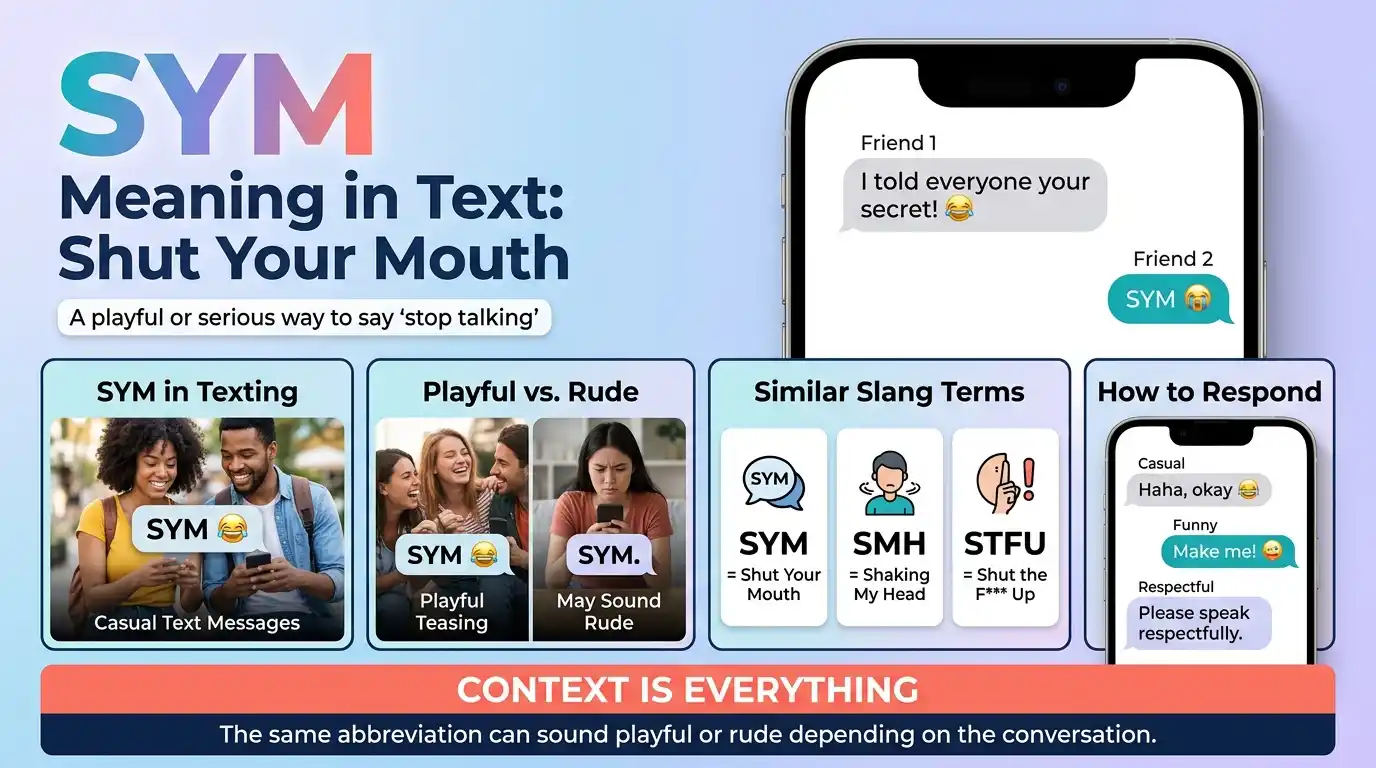
In casual internet slang, SYM most commonly means “Shut Your Mouth.” People may use it to tease a friend, react to surprising news, or tell someone to stop talking. Depending on the conversation, it can sound funny, playful, or rude.
For example, if your friend shares some unexpected gossip, you might see a reply like “SYM 😂!” The sender may not be angry. They might simply be shocked or excited.
However, SYM can have other meanings in different situations. It may be used as a personal abbreviation or as shorthand for another phrase. That is why it helps to look at the full message before deciding what someone means.
In this guide, you will learn the meaning of SYM in text, its possible origins, common uses, similar slang terms, and the best ways to respond.
What Does SYM Mean in Text? Definition and Meaning
SYM usually stands for “Shut Your Mouth” in casual texting slang. It is an informal abbreviation that people use to tell someone to stop talking.
The phrase can sound harsh when taken literally. However, friends sometimes use it as a playful reaction to a surprising story, a funny comment, or an embarrassing secret.
Think of it as a short way to say, “Stop it!” or “I cannot believe you just said that!” The exact meaning depends on the situation.
What Does SYM Stand For?
Here is a simple breakdown:
- S: Shut
- Y: Your
- M: Mouth
People type the three letters instead of writing the full phrase. This makes the message shorter and faster to send.
For example:
Friend 1: “I told everyone about your secret crush.”
Friend 2: “SYM 😭 You promised you wouldn’t!”
In this conversation, SYM expresses surprise and mock anger. The crying emoji suggests that the sender may be joking.
However, the same abbreviation can sound unfriendly during a serious argument.
Person 1: “I think we need to talk about your behavior.”
Person 2: “SYM. I don’t want to hear it.”
Here, the message sounds dismissive rather than playful.
Can SYM Have Other Meanings?
Yes. Although “Shut Your Mouth” is a common interpretation in online slang, SYM does not have one universal meaning.
Depending on the conversation, it might be a personal shorthand, an abbreviation for a different phrase, or a technical term.
For example, someone discussing a meeting might use SYM to mean “See You Monday,” but this interpretation should not be assumed without supporting context.
In technical writing, SYM may also appear as an abbreviation related to symbols or symmetry.
The key point is simple: If someone sends you SYM, read the surrounding messages before deciding what they mean.
Background and History of SYM
The exact origin of SYM as internet slang is unclear. There is no widely established record identifying the first person who used it or the exact date it became popular.
Still, its form fits a familiar pattern in digital communication: people shorten common expressions to make messages quicker to type.
How Texting Created Short Forms
Before messaging apps became widespread, text messages were often written on phones with small keypads. Typing long sentences could take time, and traditional SMS messages had character limits.
As a result, people began using short forms such as LOL, BRB, and BTW.
These abbreviations made conversations faster. They also created a casual style of writing that felt different from formal letters or emails.
SYM follows the same general pattern. Instead of typing “Shut Your Mouth,” a person can type three letters.
How Internet Culture Changed Its Tone
Short expressions can take on new meanings as people use them in different situations.
For example, a phrase that sounds rude in a serious argument might become a joke between close friends. The same thing can happen with SYM.
Consider this conversation:
Friend 1: “I ate the whole pizza by myself.”
Friend 2: “SYM 😂 How were you even hungry enough?”
The second friend is likely teasing rather than demanding silence.
Online humor, memes, and quick reactions can also make short expressions feel less serious. Emojis and exaggerated punctuation often help show the intended tone.
However, not everyone interprets slang in the same way. A person who has never seen SYM before might understand it as a genuine insult.
Where Is SYM Used Today?
SYM may appear in informal conversations on messaging apps, social media, and gaming platforms.
People can use it in private messages, group chats, comments, and replies. Its meaning may also vary between online communities.
It is important not to confuse common usage with proven popularity. SYM is not as universally recognized as abbreviations such as LOL or BRB, and its meaning may be unfamiliar to many users.
The safest approach is to understand the context instead of assuming everyone knows the same slang.
How Is SYM Used in Different Contexts?
The meaning of SYM can change with the situation. The following examples show how it might appear in everyday digital conversations.
1. SYM in Text Messages
In private chats, SYM may be used to tease someone or react to unexpected news.
Example:
Alex: “I got the highest score in the class!”
Sam: “SYM 😭 You said you didn’t even study!”
Sam is expressing surprise and playful disbelief.
Another example:
Mia: “I saw your crush at the mall.”
Zara: “SYM!! Tell me everything 😂”
Here, the abbreviation works as an exaggerated reaction. However, this is an informal interpretation, not a fixed rule.
2. SYM on WhatsApp
WhatsApp users often exchange jokes, stories, and personal updates in private chats and groups.
Example:
Friend 1: “He forgot his own birthday.”
Friend 2: “SYM 😂 That’s actually unbelievable.”
The reply suggests surprise or amusement.
Still, if you receive SYM from someone you do not know well, do not automatically assume it is friendly. Their wording and the previous conversation matter.
3. SYM on Instagram and TikTok
On Instagram and TikTok, short expressions can appear in comments, captions, and direct messages.
Someone might use SYM while reacting to a funny video or an unexpected confession.
Example:
Creator: “I learned the whole dance in ten minutes.”
Commenter: “SYM 😭 I have been trying for three days!”
The commenter is using exaggerated language to show disbelief and humor.
Not every person will use or understand SYM this way. Some users may interpret it as a direct command to stop talking.
4. SYM in Gaming Chats
Online gaming often involves quick messages during matches. Players use abbreviations to save time and react quickly.
Example:
Player 1: “I defeated the final boss on my first try.”
Player 2: “SYM 😂 Teach me your skills!”
The reply is a playful reaction to an impressive result.
However, during a heated match, SYM may sound aggressive. It could be used to silence another player or express frustration.
5. SYM in Casual Conversations
People may also use SYM while chatting with siblings or close friends.
Example:
Sister: “I showed Mom your old school photos.”
Brother: “SYM! Why would you do that? 😂”
The expression suggests embarrassment and playful frustration.
These examples illustrate possible uses rather than fixed definitions. Always consider the relationship between the people involved.
Common Misconceptions About SYM
SYM can cause confusion because it is short and does not explain its meaning on its own.
Here are some common misunderstandings.
Misconception 1: SYM Is Always Rude
Not necessarily.
Between close friends, SYM may be part of a joke. During a disagreement, it may be a rude way to tell someone to stop talking.
Compare these examples:
- “SYM 😂 You actually did that?” possibly playful.
- “SYM. Nobody asked you.” likely dismissive.
The letters are the same, but the tone is different.
Misconception 2: SYM Has Only One Meaning
SYM does not have one meaning in every situation. It may be used as internet slang or as an abbreviation specific to a group, workplace, or technical subject.
For example, a person discussing a schedule may use a personal abbreviation for a meeting day. That does not mean every SYM message refers to a schedule.
Misconception 3: SYM Means the Same as SMH
These expressions are different.
SMH usually means “Shaking My Head.” It often expresses disappointment, disbelief, or disapproval.
SYM commonly means “Shut Your Mouth” in slang.
For example:
- “SMH, he forgot again.” expresses disappointment.
- “SYM 😂 You are joking!” may express playful disbelief.
Misconception 4: An Emoji Always Makes SYM Friendly
Emojis can soften a message, but they do not guarantee that the sender is joking.
Someone might add a laughing emoji to a sarcastic or unkind comment. Likewise, a message without emojis may still be playful.
Do not judge a message by its emoji alone. Consider the full conversation, the sender’s usual style, and your relationship with them.
Similar Terms and Alternatives to SYM
Several other slang expressions can communicate surprise, disbelief, annoyance, or a desire for someone to stop talking.
However, these expressions do not all mean the same thing.
| Term | Full form or meaning | Common use |
| SYM | Shut Your Mouth | Telling someone to stop talking, sometimes playfully |
| SMH | Shaking My Head | Showing disappointment or disbelief |
| STFU | Shut the F*** Up | A much harsher command to stop talking |
| LOL | Laughing Out Loud | Showing amusement |
| OMG | Oh My God | Expressing surprise or excitement |
| FR | For Real | Showing sincerity or asking if something is true |
| WYD | What You Doing? | Asking what someone is doing |
| BRB | Be Right Back | Saying you will return shortly |
| Shush | Be quiet | Asking someone to lower their voice or stop talking |
| No way! | Expression of disbelief | Reacting to surprising information |
Which Alternative Should You Use?
The best choice depends on what you want to express.
If you want to react to surprising news without sounding rude, try “No way!” or “OMG!”
If you want to show disappointment, SMH may fit better.
If you are joking with a close friend, SYM might work if you both understand the expression.
However, avoid using harsh expressions such as STFU when you want to keep a conversation respectful.
How to Respond When Someone Sends You SYM
Your reply depends on the sender, the topic, and the tone of the message. You do not need to respond in the same style if you are uncomfortable with it.
1. A Casual Response
If a close friend appears to be joking, you can answer naturally.
Them: “SYM 😂”
You: “Make me 😂”
Or:
You: “Okay, okay! I’ll stop 😭”
These replies keep the conversation light. Use them only when you understand the joke and feel comfortable with it.
2. A Funny Response
If the conversation is playful, try a humorous answer.
Them: “SYM!”
You: “My mouth has its own plans 😂”
Another option:
You: “Too late. The story must be told!”
These responses turn the exchange into a joke without taking the phrase too seriously.
3. A Calm Response
If you are unsure what the sender means, ask for clarification.
Them: “SYM.”
You: “Wait, what do you mean by SYM?”
This is a good option when you do not know the person well or cannot tell whether they are joking.
4. A Response to a Rude Message
If someone uses SYM during an argument, you can set a clear boundary.
Them: “SYM. I don’t care what you think.”
You: “You can disagree with me, but please speak respectfully.”
You could also say:
“I’m happy to talk when we can both be respectful.”
You do not need to insult the other person in return.
5. A Professional Response
If a coworker or manager sends SYM and the meaning is unclear, keep your reply neutral.
Them: “SYM about tomorrow’s meeting.”
You: “Could you clarify what SYM means here?”
This avoids making assumptions. The sender may be using an internal abbreviation rather than internet slang.
6. A Privacy-Conscious Response
If the message appears to pressure you into sharing something private, you can protect your boundaries.
Them: “SYM 😂 Tell me who you like!”
You: “Haha, that stays between me and myself!”
If the person continues to pressure you, you can simply say, “I’d rather keep that private.”
The best response is one that matches your comfort level. You do not have to share personal information or accept rude behavior just because someone uses slang.
Regional and Cultural Differences in SYM
Internet slang travels across countries through social media, online games, messaging apps, and videos. However, not everyone uses the same expressions or understands them in the same way.
SYM is no exception.
SYM in American and British English
English-speaking users may recognize SYM as an abbreviation for “Shut Your Mouth.” However, familiarity with the abbreviation varies.
Some people may understand it as a playful reaction. Others may read it as a rude command.
In both American and British English, expressions such as “Be quiet,” “Stop it,” and “No way!” are often easier to understand.
SYM in South Asian Chats
In Pakistan, India, and other South Asian communities, people often mix English slang with local languages in digital conversations.
For example, a person might write:
Friend 1: “I told him your secret.”
Friend 2: “SYM 😂 Yaar, why did you do that?”
The word “yaar” adds a familiar, informal tone. Still, this example shows a possible mixed-language conversation rather than a claim that SYM is widely used across South Asia.
Many people may prefer expressions in Urdu, Hindi, Punjabi, or other languages they speak with friends.
SYM in Other Languages
The English phrase behind SYM may not translate naturally into another language. People often use local expressions instead.
Some may understand the abbreviation through English-language social media, while others may not recognize it at all.
There is also no reason to assume that every region gives SYM the same cultural meaning.
When speaking with someone from a different background, use clear words if there is any doubt. This helps prevent a playful comment from becoming an unintended insult.
SYM Compared With Similar Expressions
SYM is easy to confuse with other short forms because many internet abbreviations contain only a few letters.
The following table highlights their differences.
| Expression | Meaning | Main purpose |
| SYM | Shut Your Mouth | Telling someone to stop talking |
| SMH | Shaking My Head | Showing disappointment or disbelief |
| STFU | Shut the F*** Up | Telling someone to be quiet in a harsh way |
| LOL | Laughing Out Loud | Showing amusement |
| FR | For Real | Showing sincerity or disbelief |
| WDYM | What Do You Mean? | Asking someone to explain |
| WYD | What You Doing? | Starting or continuing a casual chat |
| Hush | Be quiet | Asking someone to stop speaking softly or quietly |
SYM vs. SMH
These two abbreviations serve different purposes.
SYM is directed at the other person and can mean “Shut Your Mouth.” SMH describes a reaction of disappointment, disbelief, or disapproval.
Example:
Person 1: “I forgot my keys again.”
Person 2: “SMH 😂”
The second person is reacting to the mistake.
Now consider:
Person 1: “I know your secret.”
Person 2: “SYM 😂”
Here, the second person may be jokingly telling the first person to stop talking.
SYM vs. STFU
Both can tell someone to stop talking, but STFU contains a profanity and is usually much harsher.
SYM may also sound rude, so neither expression is ideal for a formal conversation.
If you want to be polite, say “Let’s pause this conversation” or “Please let me finish.”
SYM vs. FR
FR means “For Real.” It can express sincerity or ask whether something is true.
Example:
Friend 1: “I won two tickets to the concert.”
Friend 2: “FR? That’s amazing!”
SYM and FR are not interchangeable. One may tell someone to stop talking, while the other expresses disbelief or sincerity.
SYM in Online Communities and Dating Apps
Online communities develop their own ways of speaking. A term that makes sense in one group may confuse people in another.
SYM may appear in gaming chats, social media replies, or dating conversations. Its meaning still depends on the words around it.
SYM on Dating Apps
On apps such as Tinder, people often use informal language to keep conversations short and friendly.
For example:
Person 1: “I have an embarrassing story about our first date.”
Person 2: “SYM 😂 Now I need to hear it!”
The second person may be playfully reacting to the situation.
However, SYM is not a reliable sign of romantic interest. It does not automatically mean someone is flirting, attracted to you, or trying to start a romantic conversation.
Look at the broader exchange rather than reading too much into three letters.
SYM on Instagram and X
On social platforms, people may use SYM as a quick reaction to an unexpected comment or a funny post.
For example:
User 1: “I watched the same movie five times this week.”
User 2: “SYM 😭 That’s dedication!”
The tone may be humorous, but users can interpret the same phrase differently.
SYM in Gaming Communities
Gaming chats often favor short messages because players may need to communicate quickly.
A player might use SYM jokingly after a friend makes an unbelievable claim. In a competitive match, the same expression could be hostile or dismissive.
If someone repeatedly uses slang to insult or harass you, you can mute, block, or report them through the platform’s available tools.
Tips for Understanding SYM Online
- Read the messages that came before it.
- Notice whether the conversation is friendly or tense.
- Do not assume it means flirting.
- Ask what it means if you are unsure.
- Avoid using it with strangers who may find it rude.
Online slang is useful, but clear communication matters more than knowing every abbreviation.
Hidden or Offensive Meanings of SYM
The most familiar slang interpretation of SYM is “Shut Your Mouth.” This phrase can range from playful teasing to a serious insult.
The letters themselves do not tell you which tone the sender intends.
Can SYM Be Offensive?
Yes. If someone uses SYM to silence you, dismiss your opinion, or embarrass you, it can feel disrespectful.
For example:
Person 1: “I don’t agree with that decision.”
Person 2: “SYM. Nobody asked you.”
In this case, the phrase appears dismissive. It is not simply a friendly joke.
By contrast, close friends may use the abbreviation during playful banter without intending harm.
Does SYM Have Hidden Meanings?
SYM can have different interpretations in different communities. It may also appear as an abbreviation for a name, phrase, or technical term.
Some online slang discussions describe additional regional meanings, including offensive ones. However, such claims should not be treated as universal definitions without reliable evidence and a clear cultural context.
If someone uses SYM in a way you do not understand, ask them what they mean instead of assuming the worst.
How Can You Tell If Someone Is Being Rude?
Look for clues such as:
- The surrounding words: Insults or threats suggest a hostile tone.
- The relationship: Close friends may have a different style of humor than strangers.
- The situation: An argument is different from a funny story.
- Repeated behavior: Continued disrespect matters more than a single abbreviation.
Remember that an emoji cannot make every message harmless.
If someone makes you uncomfortable, you can ask them to stop or end the conversation.
Is SYM Appropriate for Professional Communication?
In most professional settings, it is better to avoid SYM unless everyone involved clearly understands the intended meaning.
The abbreviation can sound rude because its common slang interpretation is “Shut Your Mouth.” It can also confuse people who are unfamiliar with internet slang.
SYM in Workplace Chats
Imagine sending this message to a coworker:
“SYM about the report.”
The coworker may interpret it as a command to stop talking, even if you intended something else.
This creates unnecessary confusion.
For work-related communication, spell out what you mean.
Better Professional Alternatives
| Instead of SYM | Use this phrase |
| Telling someone to stop talking | “Could I finish my point, please?” |
| Asking for a pause | “Let’s pause for a moment.” |
| Responding to surprising news | “That’s surprising!” |
| Asking someone to clarify | “Could you explain what you mean?” |
| Ending a discussion politely | “Let’s return to this later.” |
| Referring to a meeting | “See you Monday.” |
SYM in Emails and Formal Messages
Avoid using SYM in business emails, job applications, customer service messages, and formal reports.
A clear message is more useful than an unexplained abbreviation.
For example:
Informal: “SYM, I’ll explain later.”
Professional: “I’ll share the details in a separate message.”
The second version is clear and respectful.
A simple rule: Use SYM only when the conversation is informal and the intended meaning is clear. In professional communication, choose words that leave little room for confusion.
FAQs
1. What does SYM mean in text?
SYM commonly means “Shut Your Mouth” in casual texting slang. It can be playful among friends or rude during an argument. Context helps you understand the intended meaning.
2. Is SYM a bad word?
SYM itself is an abbreviation, not a swear word. However, its full phrase can sound harsh or disrespectful. Whether it is offensive depends on how it is used and how the recipient interprets it.
3. What does SYM mean from a girl?
If a girl sends SYM, it may mean “Shut Your Mouth.” She might be joking, reacting to surprising news, or expressing annoyance. The abbreviation alone does not reveal whether she likes you or is flirting.
4. What does SYM mean from a boy?
A boy may use SYM in the same way: as a playful reaction, a teasing comment, or a direct request to stop talking. Do not assume his intention based only on his gender.
5. What is the difference between SYM and SMH?
SYM commonly means “Shut Your Mouth,” while SMH means “Shaking My Head.” SYM is directed at someone, whereas SMH usually expresses a reaction such as disappointment or disbelief.
6. How should I reply to SYM?
If a friend is joking, you can respond with “Haha, okay 😂” or “Make me!” If the message feels rude, ask what they mean or say, “Please speak respectfully.”
7. Is SYM appropriate for work?
Usually, no. SYM can sound disrespectful and may confuse coworkers. Use clear alternatives such as “Could I finish my point?” or “Could you clarify what you mean?” instead.
Conclusion
Understanding SYM meaning in text can help you read online conversations with more confidence. In casual slang, SYM most commonly stands for “Shut Your Mouth.” People may use it to tease friends, react to surprising news, or tell someone to stop talking.
However, the phrase can sound playful in one conversation and rude in another. The sender’s tone, the relationship between the people chatting, and the surrounding messages all help explain its meaning.
SYM may also have other meanings in specific situations, so it is best not to assume that every message uses it in the same way.
If you receive SYM and feel unsure, read the conversation carefully or ask the sender to explain. If you want to use it yourself, save it for informal chats where the other person understands your humor.
Discover More Article

Hi, I’m Mahgull, a dedicated content writer with 2 years of experience in the meaning niche. I enjoy turning complex words, slang, abbreviations, and phrases into simple, informative content that helps readers understand their meanings clearly and quickly.