You’re scrolling through a group chat. Someone drops a message. Then, out of nowhere: 🤠. No words. Just a smiling cowboy face with a big yellow hat.
What does it mean?
The cowboy emoji (🤠) shows up everywhere now If in texts, on Twitter, in gaming chats, even on dating apps. It’s playful. It’s a little chaotic. And it doesn’t always mean what you’d expect.People use 🤠 to signal fun, sarcasm, excitement, or just pure silliness
Understanding emoji like this matters more than people think. A single emoji can change the whole tone of a message. Miss the meaning, and you might misread a joke as an insult If or a compliment as sarcasm. This guide breaks down everything you need to know about 🤠: what it means, where it came from, how people use it today, and how to respond when someone sends it your way.
Definition & Meaning
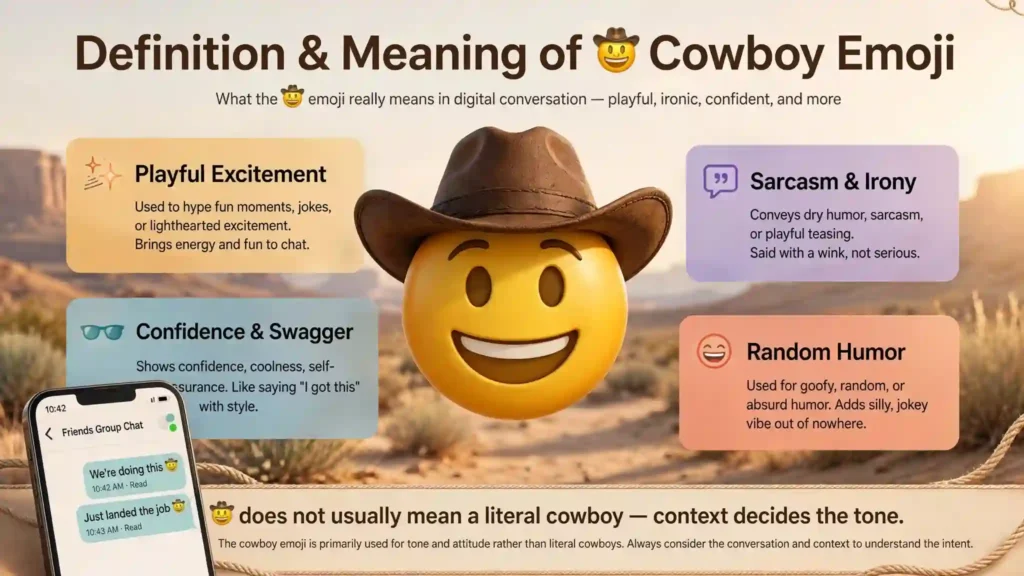
The official name for 🤠 is “Cowboy Hat Face.” It’s part of the Unicode emoji standard, and it shows a smiling yellow face wearing a wide-brimmed cowboy hat.
At its core, the emoji represents fun, boldness, and a laid-back attitude. Think Wild West energy If confident, carefree, a little reckless.
But in real conversations, it rarely means “I am literally a cowboy.” Instead, people use it to add flavor to a message. Here’s what it typically signals:
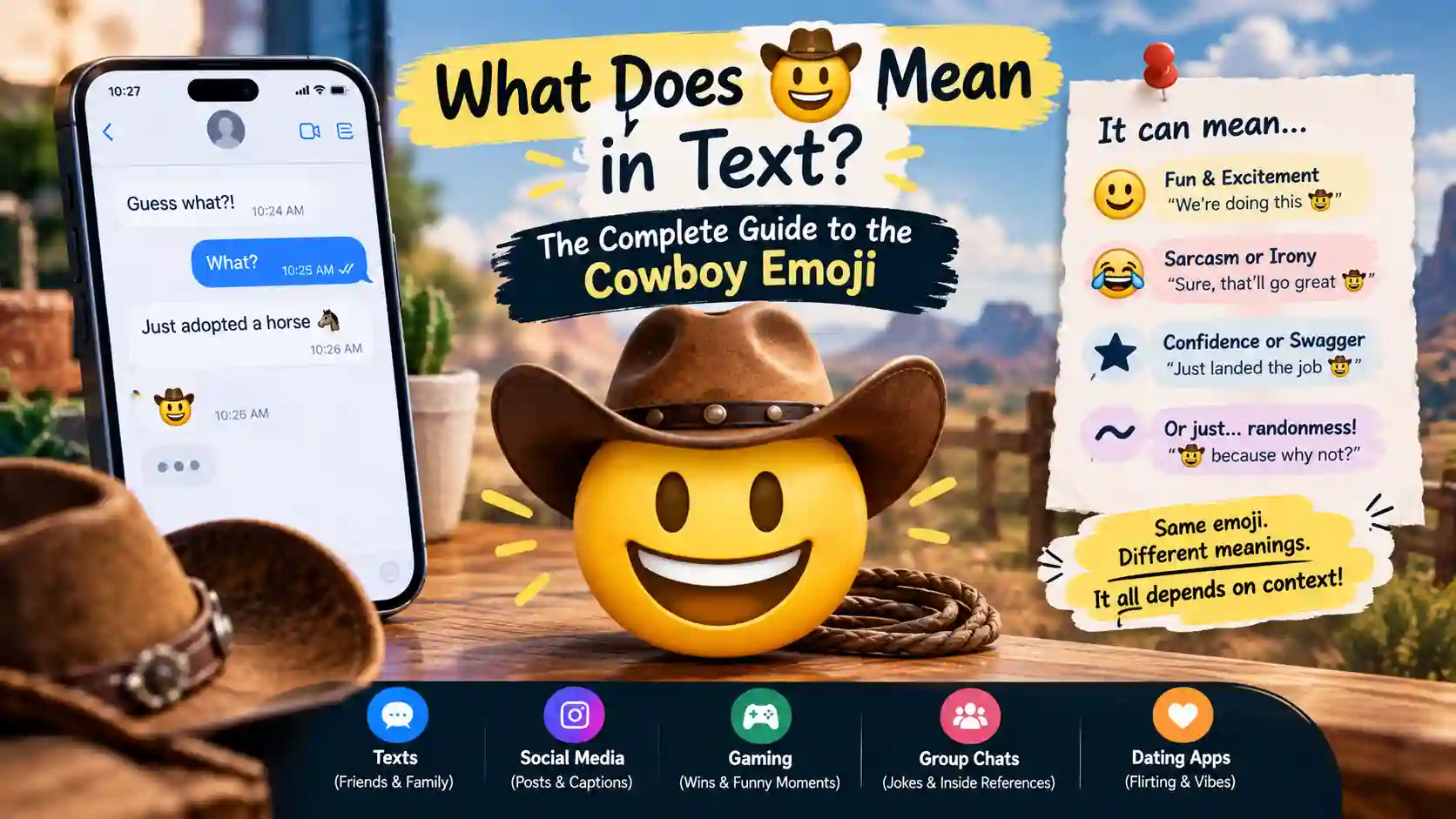
- Playful excitement If “We’re doing this 🤠”
- Sarcasm or irony If “Sure, that’ll go great 🤠”
- Confidence or swagger If “Just landed the job 🤠”
- Randomness or humor If used just because it’s a fun face
Example in text:
Sam: guess who just adopted a horse
Jess: 🤠 no way
Sam: yeah I’m basically a rancher now
Here, 🤠 works as a stand-in for “that’s wild” or “love that for you.” It reacts to the moment without needing extra words.
The emoji doesn’t have one fixed meaning. Context decides the tone. The same 🤠 can read as excited, joking, or dismissive depending on what comes before it.
Background & History
The cowboy hat face emoji was added to Unicode in 2015, as part of Unicode 8.0, and rolled out across platforms like Apple, Android, and Twitter shortly after.
Its design draws from a classic image: the American cowboy. Wide-brim hat, wild frontier, rugged independence. Emoji designers picked this look because it’s instantly recognizable across cultures, even to people who’ve never set foot near a ranch.
At first, people used 🤠 pretty literally If cowboy movies, country music, rodeo events, Western-themed parties. But like most emoji, its meaning drifted over time.
By the late 2010s, internet culture had reshaped it into something bigger. Meme culture and Twitter humor turned 🤠 into a symbol of exaggerated confidence and comedic chaos. People started using it ironically, pairing it with wild claims or over-the-top statements.
Gaming communities picked it up too. Streamers and players began using 🤠 to react to big plays, wins, or chaotic moments If often alongside phrases like “yeehaw” or “howdy,” which had also become internet inside jokes.
Today, 🤠 sits in an interesting spot. It still nods to its cowboy roots, but most people use it for humor, hype, or lighthearted sarcasm rather than anything literal. Its meaning keeps evolving with each new platform and trend that picks it up.
Usage in Various Contexts
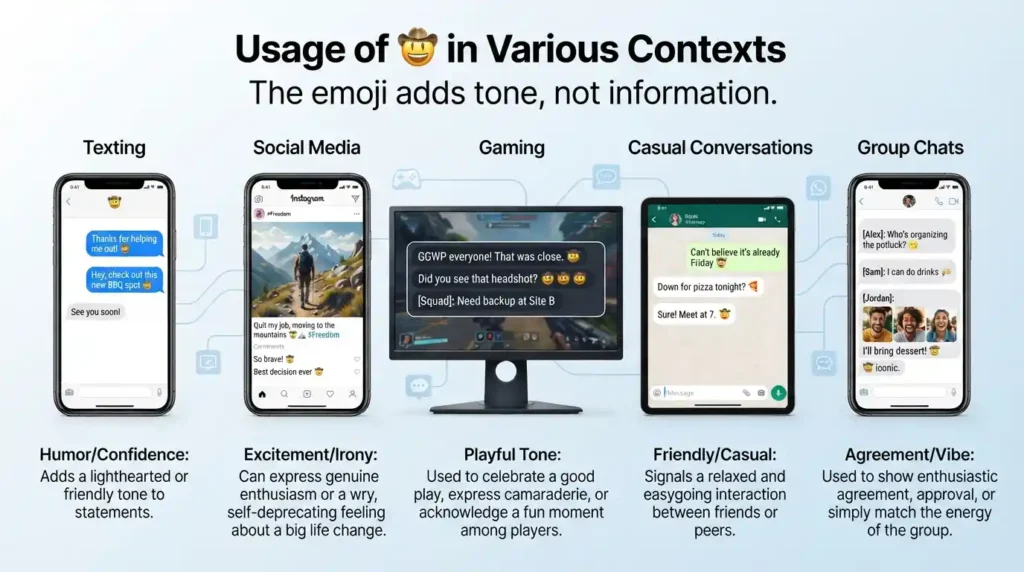
The cowboy emoji shows up differently depending on where you see it. Here’s a breakdown by context.
Texting
In one-on-one texts, 🤠 usually softens or adds humor to a statement.
Mia: I ate an entire pizza by myself
Leo: 🤠 respect
Social Media
On platforms like Twitter and Instagram, 🤠 often pairs with confident or chaotic captions.
“Quit my job, moving to the mountains 🤠”
It signals boldness If real or joking.
Gaming
In gaming chats, 🤠 often celebrates a win, a bold move, or a funny fail.
Player1: clutched that 1v4
Player2: 🤠🤠🤠
Casual Conversations
Friends often use 🤠 just to react to something ridiculous or unexpected, without needing to type a full response.
Friend: he showed up in a full suit to a barbecue
You: 🤠 iconic
Group Chats
In group settings, 🤠 sometimes appears with zero context, purely as a joke or inside reference the group has built up over time.
Across all these contexts, one thing stays true: the emoji adds tone, not information. It rarely stands alone as the full message If it colors whatever’s already being said.
Common Misconceptions & Clarifications
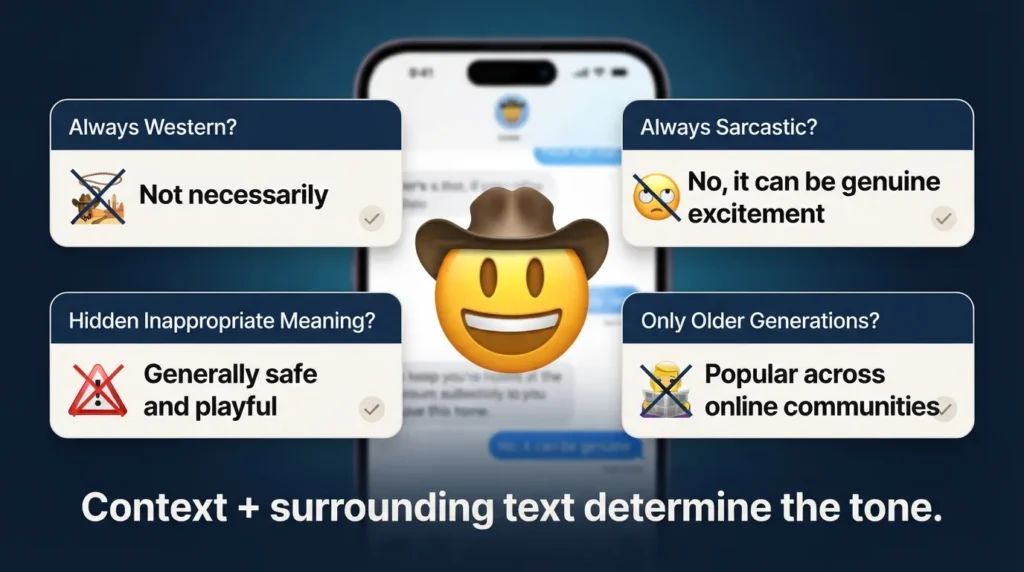
A few misunderstandings pop up around 🤠. Let’s clear them up.
Misconception 1: It always means something Western or country-related.
Not true anymore. While it started with cowboy imagery, most modern use has nothing to do with actual cowboys, ranches, or country culture.
Misconception 2: It’s always sarcastic.
Also not accurate. It can be genuinely enthusiastic. Tone depends entirely on the surrounding text and relationship between the people texting.
Misconception 3: It has a hidden inappropriate meaning.
Unlike some emoji, 🤠 doesn’t carry a widely recognized suggestive or offensive double meaning. It’s generally considered safe and playful.
Misconception 4: It’s outdated or only used by older generations.
Actually, it’s popular across age groups, especially in meme culture and gaming spaces, where irony and humor drive a lot of emoji use.
Clarification: If someone sends you 🤠 and you’re unsure what they mean, the safest read is usually “this is fun/funny/bold” If not literal, not hostile, not deeply symbolic. When in doubt, the surrounding words matter more than the emoji itself.
Similar Terms & Alternatives
Several emoji and phrases carry a similar playful, high-energy tone to 🤠.
| Emoji/Term | Typical Meaning | Vibe |
| 🤠 | Playful confidence, humor, hype | Bold, fun |
| 😎 | Cool, confident, unbothered | Smooth |
| 🥳 | Celebration, excitement | Party |
| 😂 | Something’s funny | Laughter |
| “Yeehaw” | Excitement, Western-flavored hype | Chaotic joy |
| “Howdy” | Casual greeting, often ironic | Friendly/funny |
Word alternatives people use instead of the emoji:
- “Let’s go”
- “Wild”
- “Absolutely sending it”
These alternatives cover similar emotional ground If excitement, humor, or bold energy If but 🤠 adds a specific playful, slightly chaotic flavor that plain words don’t fully capture.
How to Respond to This Term
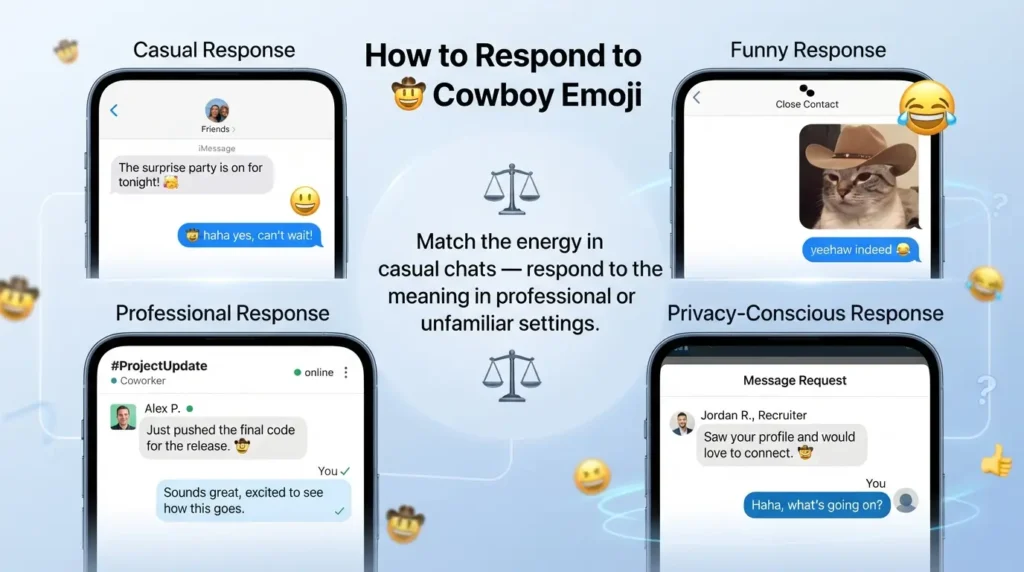
How you respond to 🤠 depends on the setting and your relationship with the sender.
Casual response
“🤠 haha yes”
“lol 🤠 love that”
Funny response
“yeehaw indeed”
“🤠 giddy up”
Professional response
In work settings, it’s best to skip mirroring the emoji directly. Instead:
“Sounds great, excited to see how this goes.”
Privacy-conscious response
If you’re unsure of the context or the person, a neutral reply works well:
“Haha, what’s going on?”
“🙂 tell me more”
General tip: Matching energy usually works fine between friends. In professional or unfamiliar settings, it’s safer to respond to the meaning, not the emoji itself.
Regional or Cultural Differences
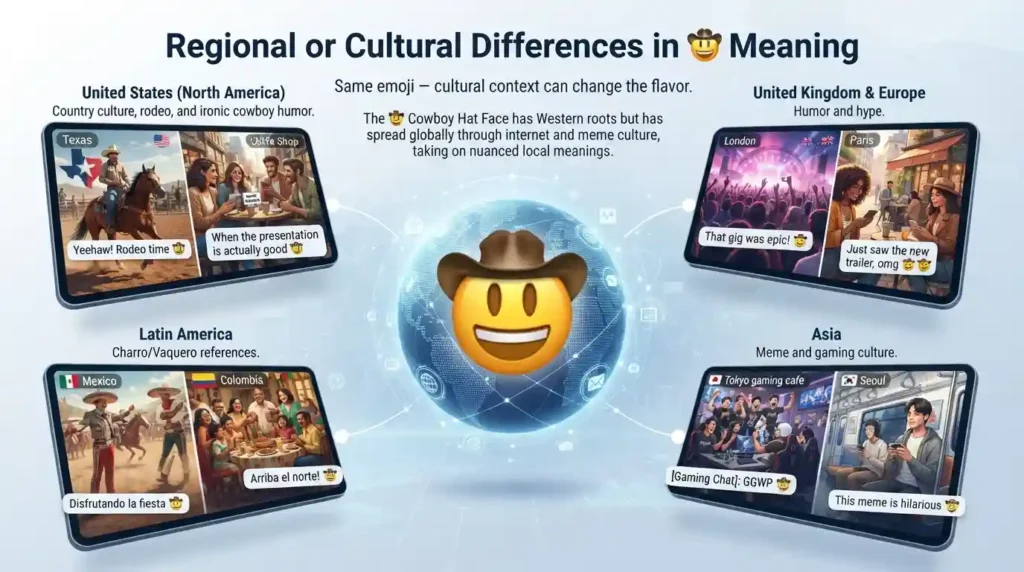
The cowboy hat emoji carries a strong association with American culture, especially the imagery of the American West. Because of this, its use can feel more natural or common in the U.S., particularly in regions with strong country or rural cultural ties, like the American South and Midwest.
That said, thanks to global meme culture, 🤠 has spread far beyond that. In many countries, people use it purely for its humor and confidence signal, without any real connection to Western or cowboy culture.
Regional variations to note:
- United States: Often tied to country culture, rodeo humor, or ironic “cowboy” jokes.
- United Kingdom & Europe: Used mostly for humor and hype, detached from cowboy imagery.
- Latin America: Sometimes paired with charro or vaquero references, tying into regional cowboy-adjacent culture.
- Asia: Frequently used in meme and gaming contexts, mostly stripped of cultural connotation.
Language also shapes how it’s paired. Non-English speakers often combine 🤠 with local slang for excitement or boldness, rather than English terms like “yeehaw.”
Comparison with Similar Expressions
| Expression | Meaning | Formality | Best Use Case |
| 🤠 | Bold, playful, confident | Casual | Texts, social media, gaming |
| 😎 | Cool, unbothered | Casual | Reacting to good news |
| 🥳 | Celebratory | Casual | Achievements, parties |
| “Nice one” | Approval | Neutral/Formal | Any setting |
| “Well done” | Approval, more formal | Formal | Professional contexts |
Key difference: 🤠 leans into humor and chaos more than straightforward approval terms like “nice one” or “well done.” It’s less about politeness and more about energy and personality.
Usage in Online Communities & Dating Apps
Twitter/X: 🤠 often appears in bold, joking, or exaggerated posts If announcements, life updates, or reactions to chaotic news.
Gaming communities: Used to celebrate wins, react to funny fails, or hype up teammates during matches.
Dating apps: On platforms like Tinder or Bumble, 🤠 sometimes appears in bios to signal a fun, laid-back, not-too-serious personality. It can also show up in messages as a playful, low-pressure way to react to something charming or funny the other person said.
Example on a dating app:
Match: I once tried to ride a mechanical bull and lost immediately
You: 🤠 legendary, tell me everything
Tip for responding on dating apps: Treat 🤠 as an invitation to keep things light. It rarely signals anything serious If matching that playful tone usually keeps the conversation flowing naturally.
Hidden or Offensive Meanings
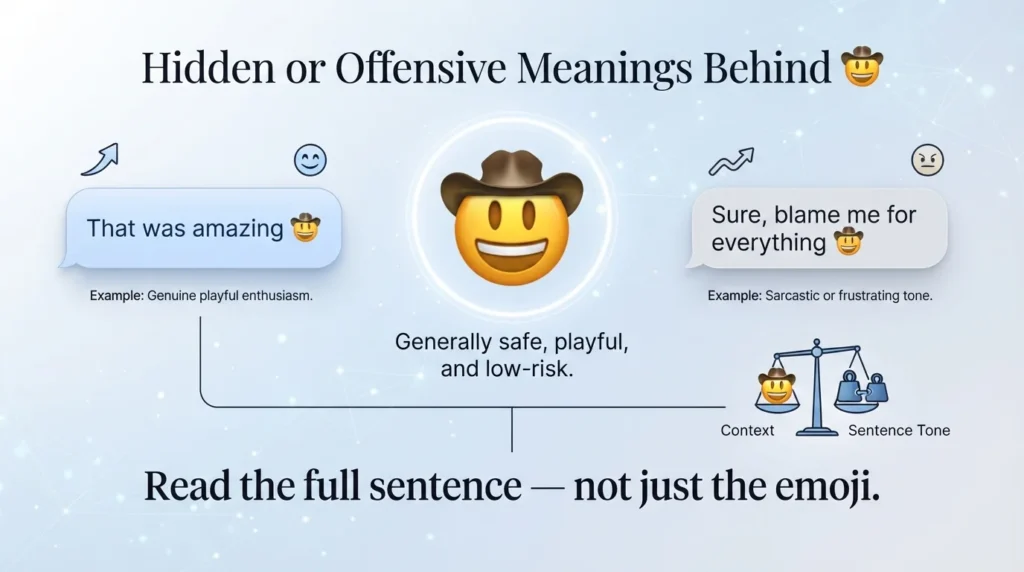
There’s no widely recognized offensive or hidden meaning behind 🤠. Unlike some emoji that carry suggestive double meanings, the cowboy hat face is generally seen as safe, playful, and low-risk.
That said, context and tone still matter. In rare cases, someone might use it sarcastically to mock a situation rather than celebrate it.
Example (sarcastic use): “Sure, blame me for everything 🤠”
Here, the emoji doesn’t soften the message If it emphasizes frustration through exaggerated calm. Reading the full sentence, not just the emoji, is key to catching this kind of tone shift.
Suitability for Professional Communication
In most professional settings, 🤠 isn’t the best choice. It reads as very casual, and using it in formal emails or workplace chats can come across as unprofessional or out of place.
When it might be okay:
- Casual internal team chats with close coworkers
- Informal Slack channels focused on fun or team bonding
When to avoid it:
- Client-facing emails
- Formal reports or announcements
- Any communication with people you don’t know well professionally
Professional alternatives:
Instead of: “Landed the deal 🤠”
Try: “Excited to share we closed the deal.”
Instead of: “Let’s go 🤠”
Try: “Looking forward to getting started.”
FAQs
1. What does 🤠 mean in a text from a guy or girl?
It usually signals playful excitement or humor, not a serious romantic message on its own.
2. Is 🤠 flirty?
It can be, especially in casual conversations, but it’s more about fun energy than direct flirting.
3. Does 🤠 mean someone is joking?
Often, yes. It frequently softens or highlights sarcasm and humor.
4. Can I use 🤠 in a professional email?
It’s best avoided in formal communication. Stick to casual chats with close coworkers if at all.
5. Is 🤠 the same as 😎?
They’re similar in confidence, but 🤠 leans more playful and chaotic, while 😎 feels smoother and more composed.
6. Why do gamers use 🤠 so much?
It fits gaming culture’s love of hype, humor, and exaggerated reactions to wins or fails.
7. Does 🤠 have a negative meaning?
Generally no. It’s considered a safe, playful emoji without hidden offensive meanings.
Conclusion
The cowboy emoji 🤠 has come a long way from its literal Western roots. Today, it’s less about actual cowboys and more about energy If playful, bold, a little chaotic, and always ready to add personality to a message.
Whether it shows up in a text, a tweet, a gaming chat, or a dating app message, its meaning bends to fit the moment. It rarely means one single thing. Instead, it colors whatever’s already being said.
Understanding emoji like 🤠 helps you read tone more accurately and respond in a way that matches the conversation. Miss it, and you might misread a joke. Catch it, and you’ll keep the conversation flowing exactly the way it’s meant to.
Discover More Article

Hi, I’m Mahgull, a dedicated content writer with 2 years of experience in the meaning niche. I enjoy turning complex words, slang, abbreviations, and phrases into simple, informative content that helps readers understand their meanings clearly and quickly.