You’re playing a game with friends, and someone types “inv” in the chat. No further explanation. Are they asking to be invited to the party, or checking your inventory? Context clears it up fast but if you’re new to the term, it can feel like a small mystery.
“INV” is a short, functional abbreviation most commonly standing for “invite” or “inventory,” depending on the setting. It shows up constantly in gaming chat, group texts, Discord servers, and even casual social plans, where quick communication matters more than full words.
Understanding it matters because the two main meanings are used in very different contexts, and mixing them up can cause real confusion especially mid-game when speed matters. This guide breaks down exactly what “inv” means, where it came from, and how to use or respond to it naturally.
INV Meaning In Text: Definition & Meaning
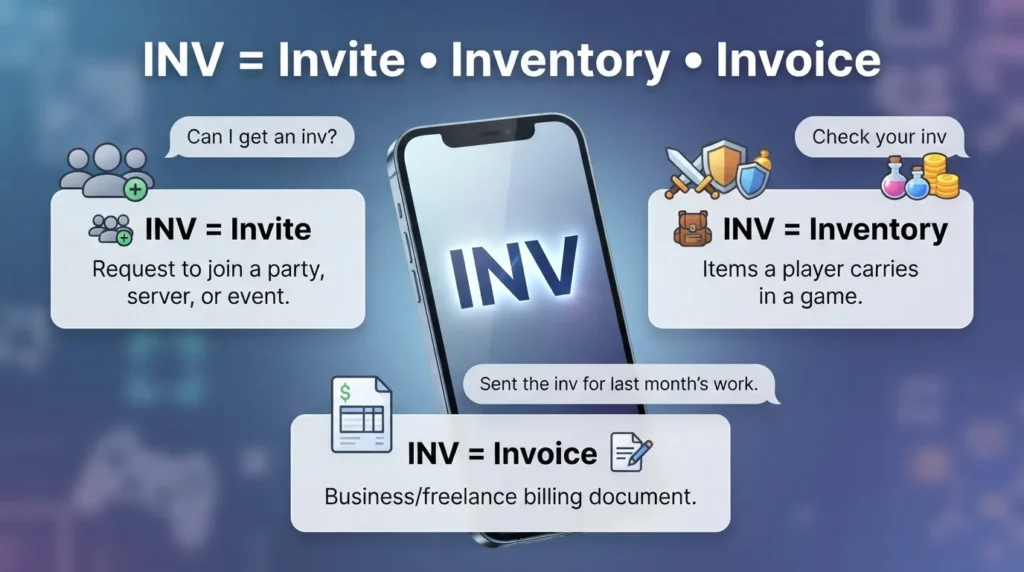
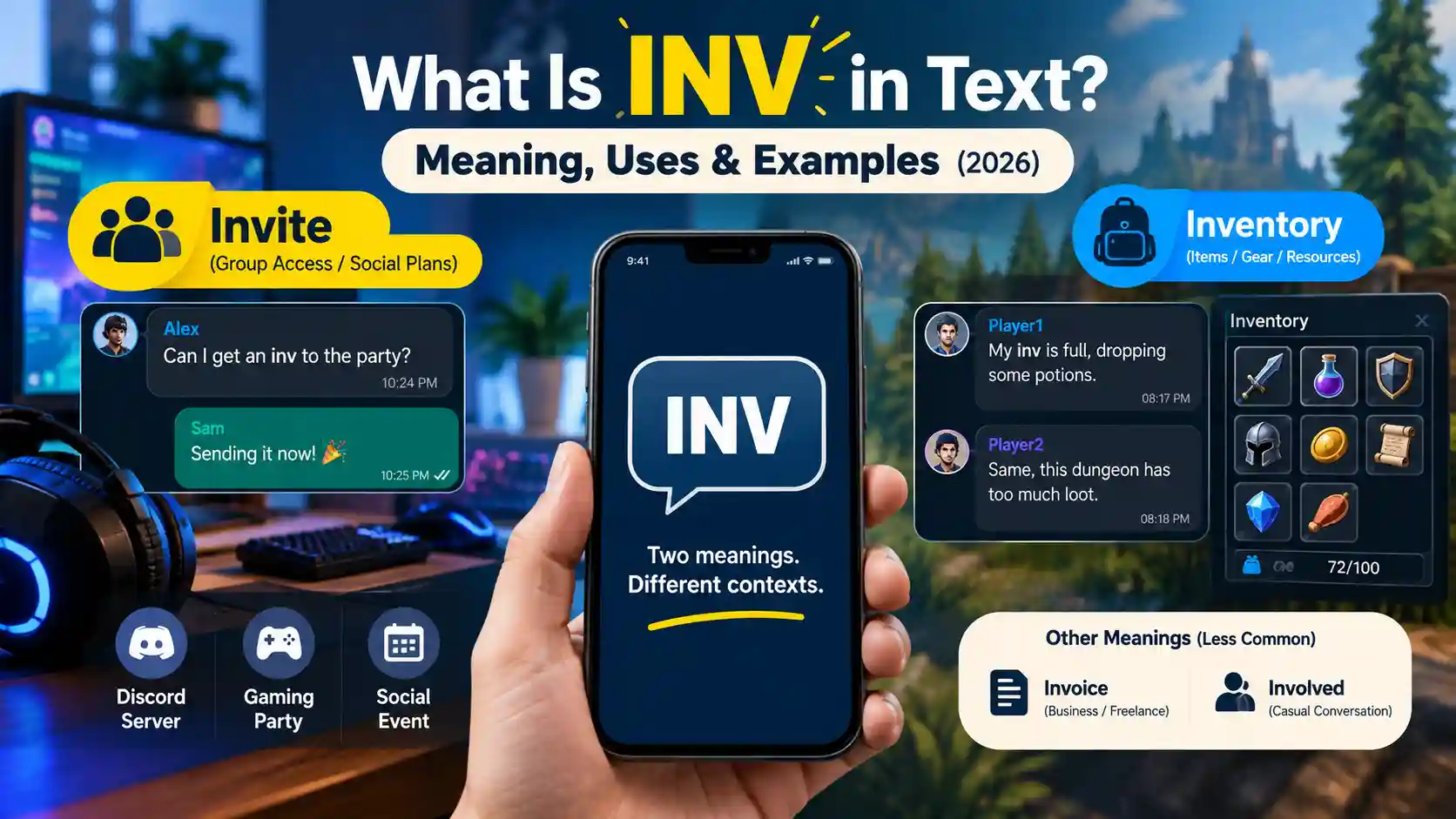
“INV” most commonly stands for “invite” a quick request or confirmation involving group access, whether that’s a Discord server, a gaming party, or a social event. In gaming specifically, it can also mean “inventory,” referring to the items a player is carrying.
Less commonly, “inv” can also abbreviate:
- “Invoice” used in business or freelance texting contexts.
- “Involved” a casual shorthand in some conversations.
Real-life examples:
Alex: can I get an inv to the party?
Sam: sending it now
Here, “inv” clearly means “invite” a request to join a game session.
Jordan: check your inv, I think you’re carrying too much
Priya: oh yeah, I need to drop some stuff
Here, it means “inventory” in a gaming context.
Casey: sent the inv for last month’s work, let me know if you got it
In this one, “inv” refers to “invoice” in a professional or freelance context.
Context especially the platform and surrounding words almost always makes clear which meaning applies within the first line or two.
Background & History of INV Meaning In Text
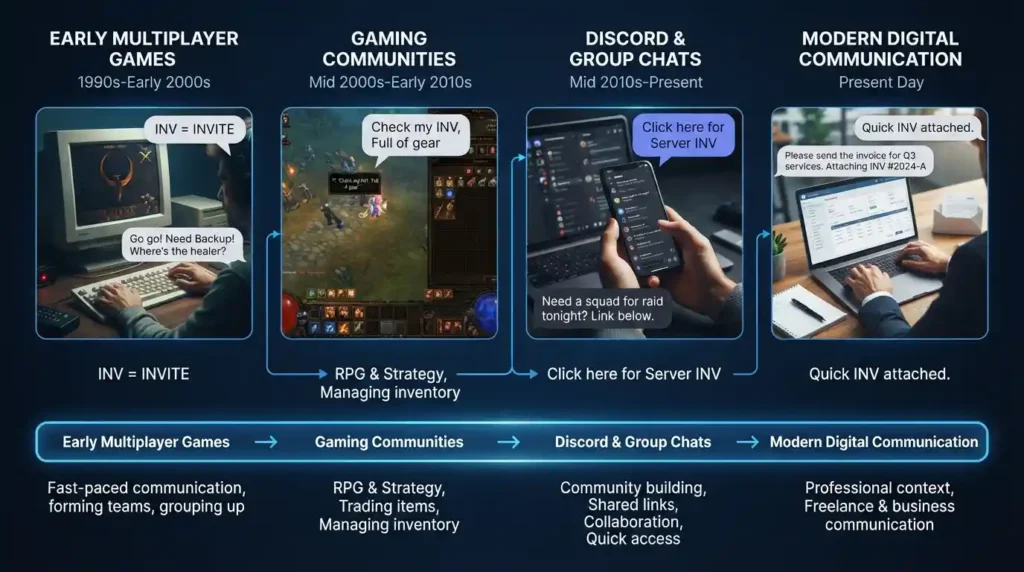
“INV” grew out of gaming culture, where speed and brevity in chat are essential during active gameplay. Early multiplayer games and online gaming communities relied heavily on abbreviated commands and shorthand to communicate quickly without breaking focus “inv” naturally emerged as shorthand for “invite,” a common and frequent action in multiplayer settings like inviting someone to a party, guild, or match.
Simultaneously, “inventory management” in role-playing and strategy games made “inv” a natural abbreviation for “inventory” as well, since players frequently referenced their carried items, weapons, or resources during gameplay discussions.
As gaming culture increasingly overlapped with mainstream texting and social platforms through Discord, group chats, and streaming communities “inv” carried over into broader digital communication, especially among people who game regularly or spend time in gaming-adjacent online spaces.
Separately, in business and freelance contexts, “inv” as shorthand for “invoice” has existed independently for much longer, common in professional email subject lines and quick internal messages.
Today, you’ll see “inv” most in:
- Gaming chat and Discord, for invites or inventory references
- Group texts, when arranging social plans or events
- Freelance and business messaging, referring to invoices
- Casual conversation, especially among people active in gaming communities
Understanding INV Meaning In Text Across Different Platforms
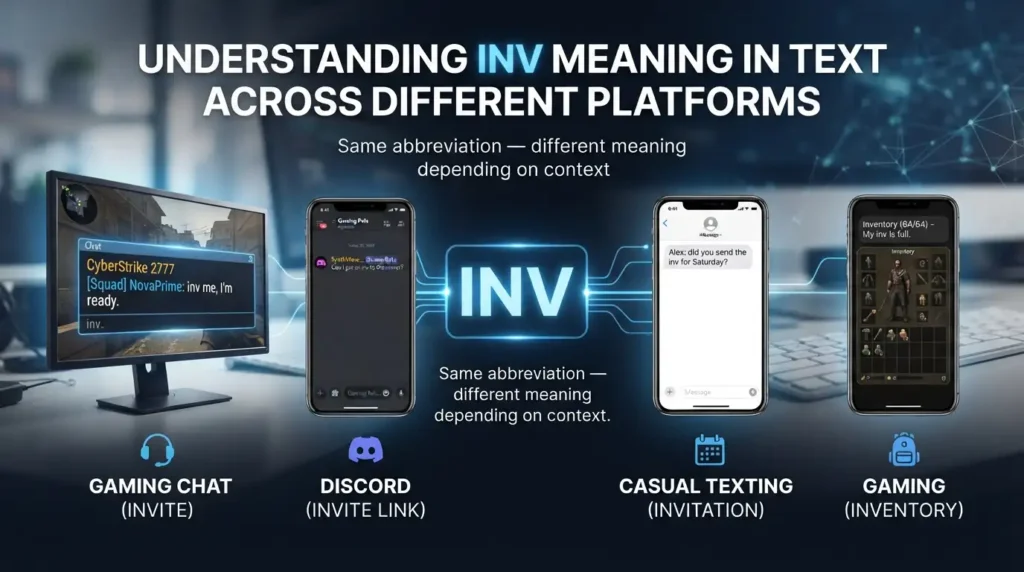
In gaming chat, “inv” is a staple for quick invites:
Player1: need one more for the raid
Player2: inv me, I’m ready
On Discord, it often requests access to a server or voice channel:
Message: hey can I get an inv to the server?
In inventory-related gaming contexts, it refers to carried items:
Player1: my inv is full, dropping some potions
Player2: same, this dungeon has too much loot
In casual texting outside gaming, it can refer to social event invitations:
Tia: did you send the inv for Saturday yet?
Nao: yep, everyone should have it by now
Across all these contexts, “inv” saves time in situations where speed and clarity matter more than full spelling.
Common Misconceptions About INV Meaning In Text
The biggest misconception is assuming “inv” always means the same thing regardless of context. In gaming spaces, it frequently swings between “invite” and “inventory” depending on the sentence someone unfamiliar with gaming terminology might not immediately catch which one applies.
Another common mix-up: confusing “inv” with “inb4” (“in before,” used to predict something) or other unrelated gaming abbreviations that share a similar short, clipped style.
It’s also worth clarifying: “inv” isn’t inherently rude or exclusionary. A quick “inv?” request is simply efficient communication, not a demand tone usually comes from surrounding punctuation or context rather than the abbreviation itself.
Similar Terms & Alternatives to INV Meaning In Text
| Term | Meaning | Typical Use |
| inv | invite / inventory | Gaming requests, event invitations |
| inv (business) | invoice | Freelance and professional messaging |
| rsvp | respond please | Formal event confirmation |
| plz inv | please invite | More explicit invite request |
| inb4 | in before | Predicting an outcome or comment |
| squad up | gather a group | Casual gaming invitation phrase |
If you want to avoid ambiguity, spelling out “invite,” “inventory,” or “invoice” fully removes any guesswork, especially in mixed personal/professional contexts.
How to Respond When Someone Uses INV Meaning In Text
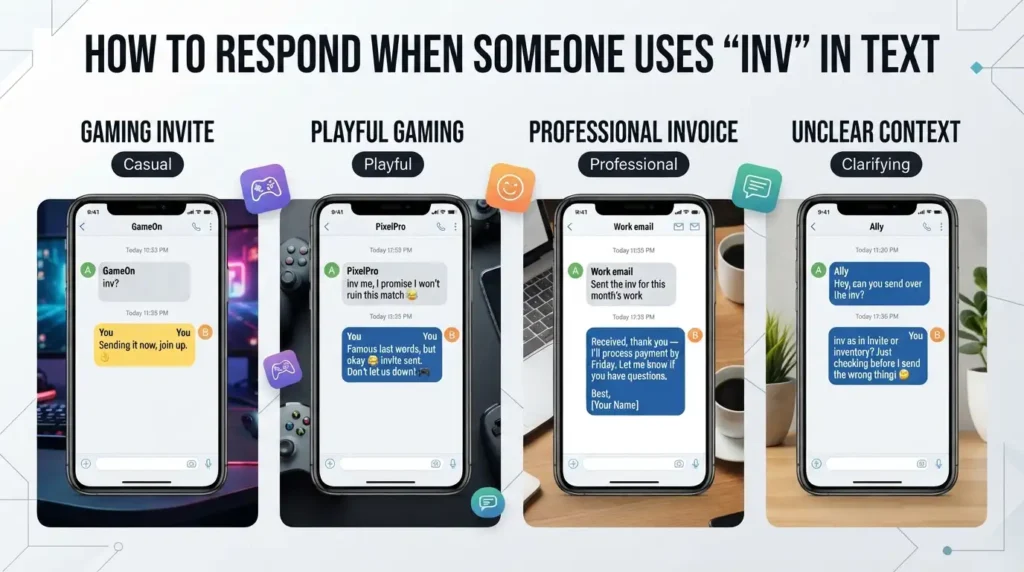
Casual reply (gaming invite):
Them: inv?
You: sending it now, join up
Funny/playful reply:
Them: inv me, I promise I won’t ruin this match
You: famous last words, but okay 😂
Professional context (invoice-related):
Them: sent the inv for this month’s work
You: Received, thank you I’ll process payment by Friday.
Privacy-conscious or unsure reply, if the meaning isn’t clear:
You: wait, inv as in invite or inventory? lol
Since “inv” can mean different things depending on setting, a quick clarifying question is completely normal, especially in gaming chats with new players.
Regional & Cultural Differences in INV Meaning In Text
“INV” is most common in global gaming culture, where English-based gaming terminology tends to dominate regardless of a player’s native language, since many popular multiplayer games and platforms use English as a default interface and community language.
It doesn’t carry strong regional slang variations, since it functions more as a universal gaming and messaging shorthand than culturally specific slang. The business meaning (“invoice”) is similarly consistent across English-speaking professional contexts worldwide.
Outside gaming and business communication, “inv” is less commonly recognized, so context remains essential when texting with people unfamiliar with gaming terminology.
Usage in Online Communities & Dating Apps
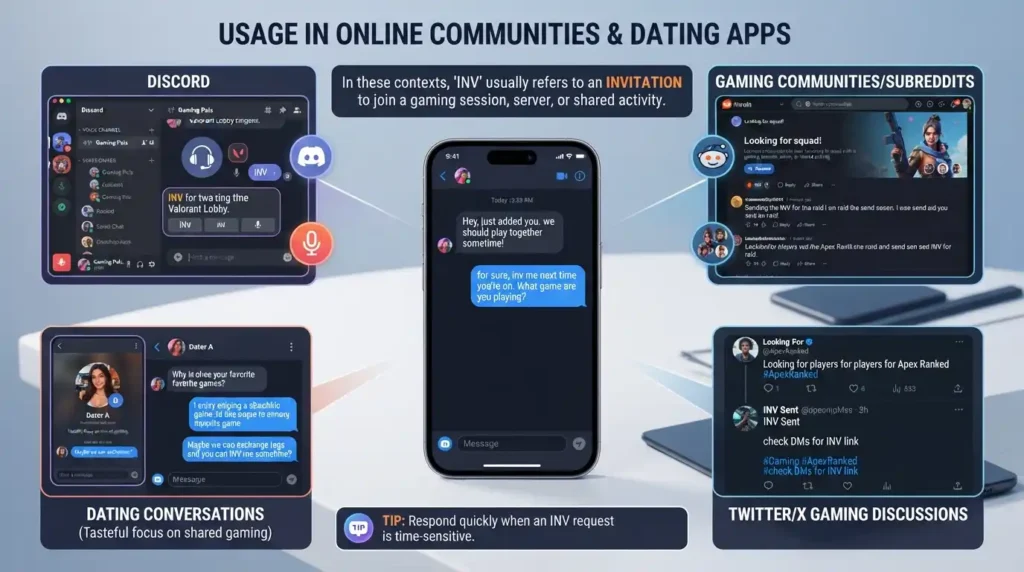
On Discord and gaming-adjacent dating spaces, “inv” occasionally shows up when someone wants to join a shared activity or gaming session together:
Match: we should play together sometime
You: for sure, inv me next time you’re on
On Twitter/X, “inv” appears less frequently outside gaming-specific conversations. In gaming communities, it remains a constant, functional part of everyday chat, especially in team-based or multiplayer games.
Tip for responding appropriately: in gaming and Discord contexts, respond quickly and directly “inv” requests are usually time-sensitive, especially during active matches or party formations.
Hidden or Offensive Meanings Behind INV
“INV” doesn’t carry any widely recognized offensive or hidden meaning. It’s a neutral, functional abbreviation across gaming, business, and casual contexts.
Tone still matters in gaming spaces, though an ignored or delayed “inv” request can occasionally cause frustration during time-sensitive gameplay, but that reflects the situation rather than any inherent negativity in the term itself.
Is INV Suitable for Professional Communication?
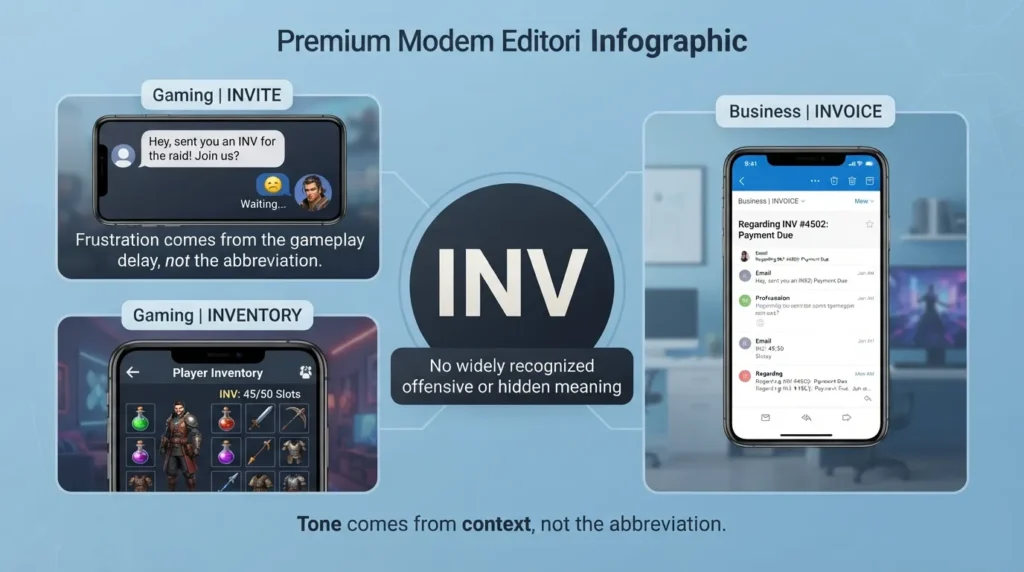
“INV” is only appropriate in professional settings when referring to “invoice.” The gaming meanings (“invite,” “inventory”) are far too casual for business emails or formal correspondence.
Professional alternatives depending on intended meaning:
- Instead of “inv” (invite) → “Please send over the invitation” or “Could you add me to the group?”
- Instead of “inv” (inventory) → “inventory” spelled out fully in reports or business contexts
- “inv” (invoice) → generally acceptable in quick internal messages, though spelling out “invoice” on first mention avoids confusion
FAQs
1. What does “inv” mean in a text message?
Most commonly “invite,” though it can also mean “inventory” or “invoice” depending on context.
2. Does “inv” always relate to gaming?
No in business contexts, it often means “invoice,” unrelated to gaming terminology.
3. Is “inv” the same in every game?
The general meaning stays consistent (invite or inventory), though specific games may have slightly different chat conventions.
4. Is “inv” rude or demanding?
Not inherently it’s simply efficient shorthand, especially useful during fast-paced gaming.
5. Can I use “inv” in a professional email?
Only when referring to “invoice,” and even then, spelling it out fully is often clearer.
6. How do I know if “inv” means invite or inventory?
Context almost always clarifies it check whether the conversation is about joining something or managing items.
7. Is “inv” common on Discord?
Yes, extremely common, especially when requesting access to servers or gaming sessions.
Conclusion
“INV” is a practical, efficiency-driven abbreviation most commonly meaning “invite” or “inventory” in gaming contexts, with a separate professional meaning as “invoice” in business messaging. It grew out of the fast-paced nature of multiplayer gaming chat, where quick communication matters more than full spelling, and it remains a staple in Discord, gaming communities, and casual group texts today. Context almost always makes clear which meaning applies, and while it’s fine for casual gaming chat, spelling things out remains the safer choice for professional communication.
Discover More Article

Hello, I’m Insha, a passionate content writer with 2 years of experience creating clear, engaging, and helpful content. I specialize in the meaning niche, explaining words, slang, phrases, and online terms in simple language that readers can easily understand and use.