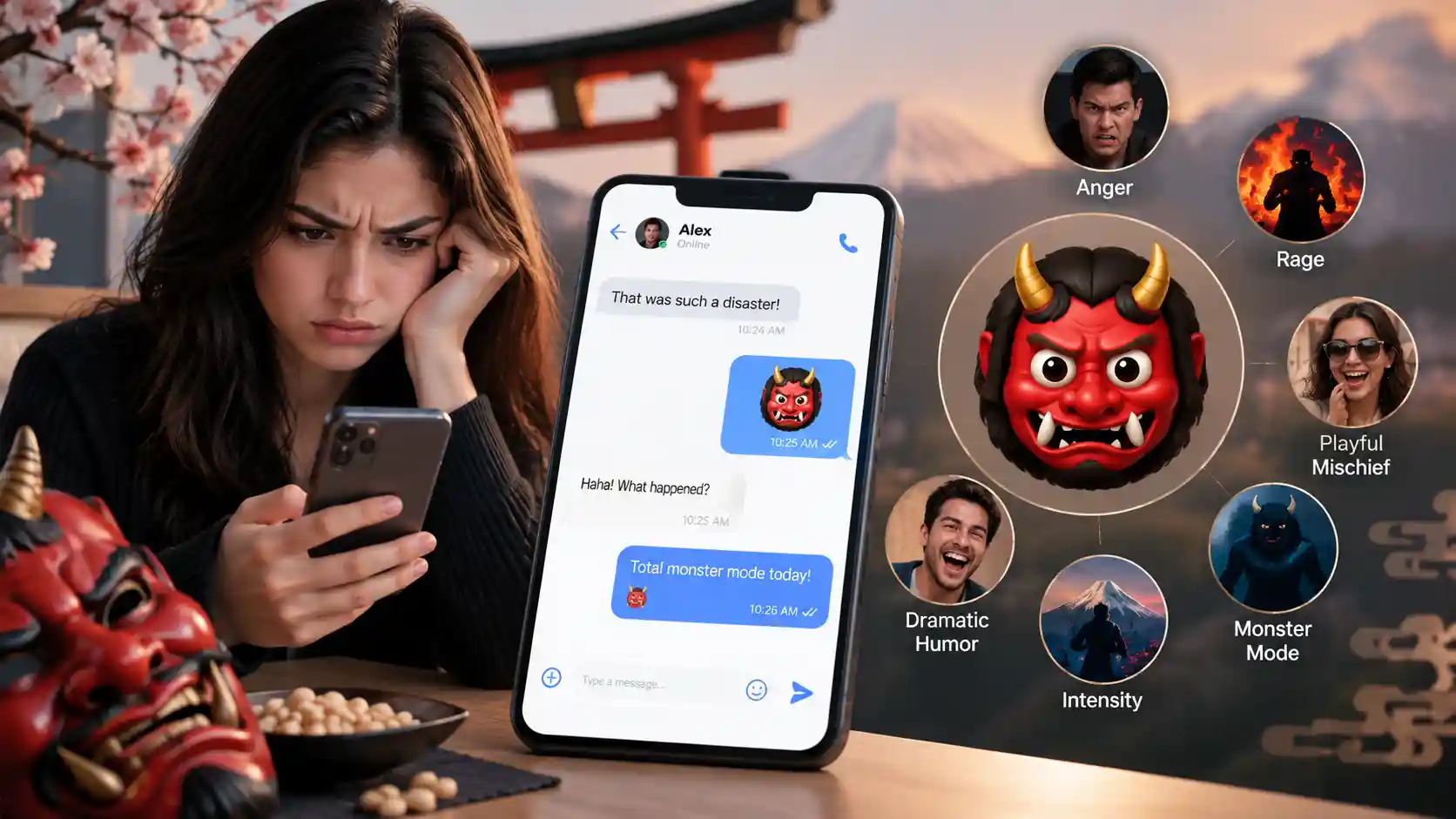
You are texting a friend. They send back one emoji: 👹. No words. Just a red, angry face with horns and fangs. What does it mean?
This little icon is called the ogre emoji. It shows up in texts, tweets, gaming chats, and comments all the time. Most people use it to show anger, mischief, or “monster mode.” Some use it as a joke. Some use it to tease a friend who is being extra.
Emojis like this one carry a lot of weight in short messages. A single symbol can change the tone of a whole conversation. That is why knowing what 👹 means matters. It helps you read a text the right way. It also helps you use it the right way, so your friends do not misread you.
In this guide, we will break down what 👹 means, where it comes from, and how to use it well.
Definition & Meaning
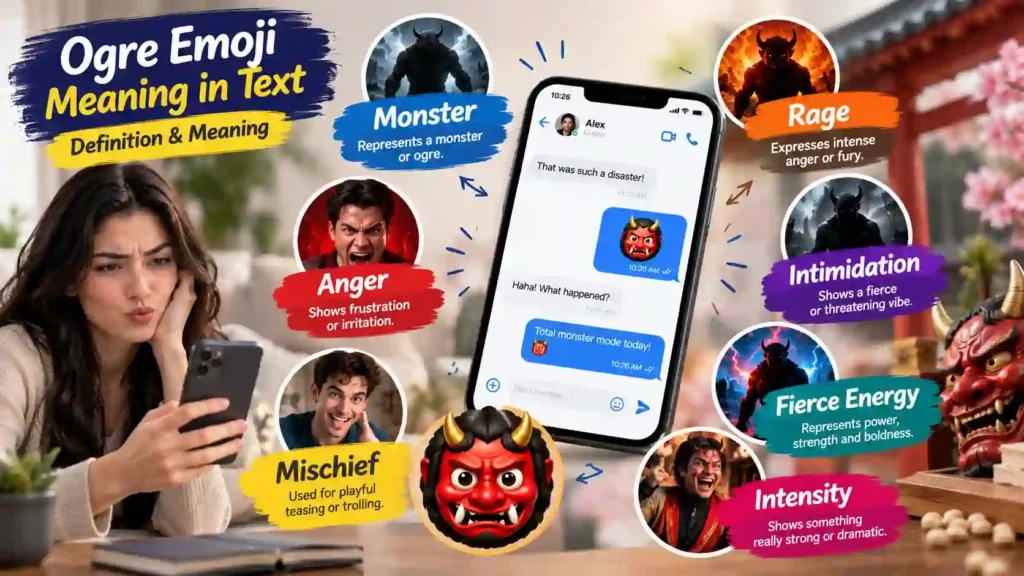
The 👹 emoji is officially called the “Ogre” emoji. Its full technical name in the Unicode standard is “Japanese Ogre.” It shows a grotesque red or blue face with horns, sharp fangs, wide eyes, and messy hair.
What it stands for:
- A monster or demon, often tied to Japanese folklore
- Anger or rage, like “I am turning into a monster right now”
- Mischief or trolling, like a playful villain
- Something intimidating or fierce, like a tough opponent
In real texts, people rarely use 👹 to talk about actual folklore. They use it to show a feeling. Here are a few real-life examples:
Example 1 showing anger:
Maya: ugh my boss just added another meeting to my calendar Sam: 👹👹👹
Example 2 playful mischief:
Jordan: I ate the last slice of pizza you were saving Riley: 👹 you’re dead when I get home
Example 3 describing a tough situation:
Coach: That team’s defense is a 👹 out there. Be ready.
In each case, the emoji is doing the same job: turning up the emotional volume. It says “this is intense,” without needing extra words.
Background & History
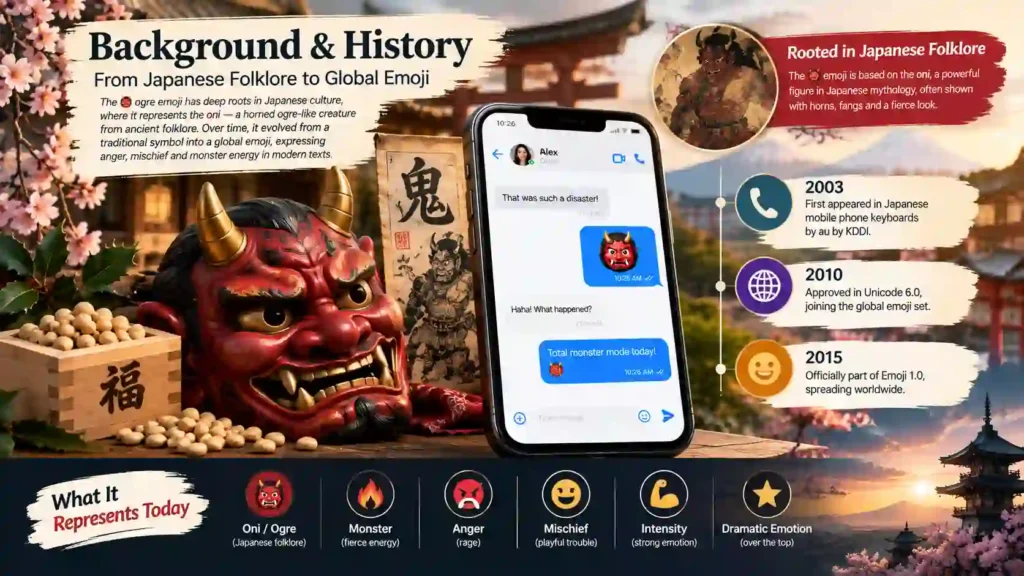
The ogre emoji has roots that go back further than most people think.
It first appeared in 2003, added to early Japanese mobile phone keyboards by the carrier au by KDDI. This was years before emojis became a global feature on smartphones.
The design is based on the oni, a demon or ogre from Japanese folklore. Oni are large, fierce creatures with horns and fangs. In Japanese tradition, men sometimes wear oni masks and straw coats on New Year’s Eve. They dress up as a figure called namahage to scare children into behaving, or to chase away bad luck.
In 2010, the ogre symbol was approved as part of Unicode 6.0, the technical standard that lets emojis work across different phones and apps. It officially joined the global emoji set in 2015, as part of Emoji 1.0.
Once it spread outside Japan, the emoji picked up new meaning. People who did not know the oni folklore still understood the face. A snarling, horned monster face reads as “angry” or “scary” in almost any culture. So today, 👹 is used less for folklore and more as a stand-in for rage, mischief, or intensity.
Usage in Various Contexts
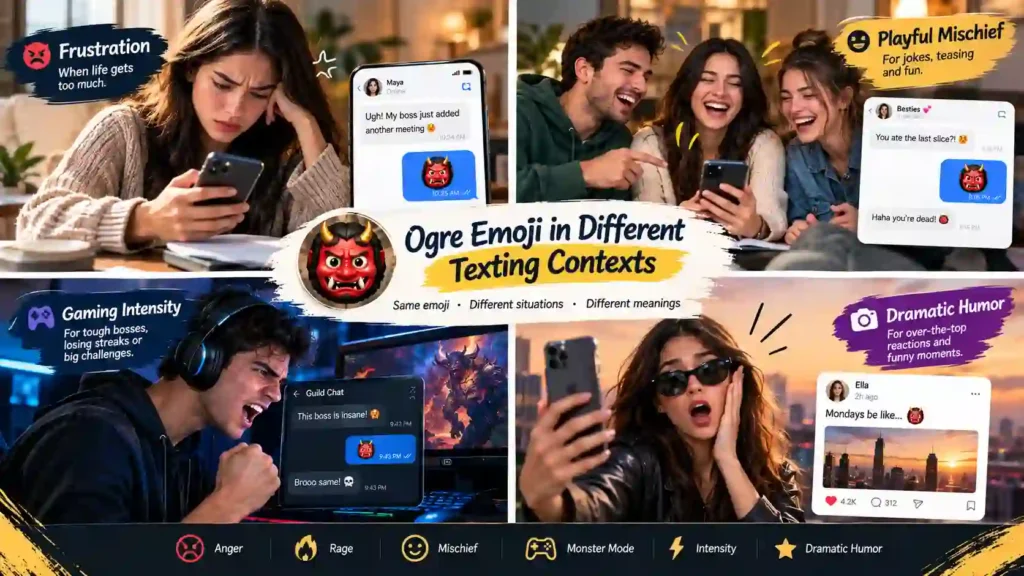
The 👹 emoji shows up in many corners of digital life. Here is how it plays out.
In texting: People use it to react to something annoying or frustrating.
Alex: my flight got delayed 4 hours Priya: 👹 that’s so unfair
On social media: People caption posts with it to add drama or humor.
Caption on a photo of a messy kitchen: “when the recipe said ‘quick and easy’ 👹”
In gaming: Gamers use it to describe a hard boss, a rage-quit moment, or a fierce rival.
Player 1: that final boss is a 👹, I died 12 times Player 2: same lol
In casual group chats: It works as a joke reaction to teasing or roasting.
Dana: you told everyone I forgot the tickets 😭 Leo: 👹 revenge is coming
In professional settings (rare, but happens in casual work chats): Some coworkers use it lightly to describe a tough deadline or a chaotic day.
Coworker: the client added 3 new requests an hour before launch You: 👹 today has been a whole ogre of a day
Across all these contexts, the meaning stays close to the same idea: something intense, frustrating, fierce, or mischievous is happening.
Common Misconceptions & Clarifications
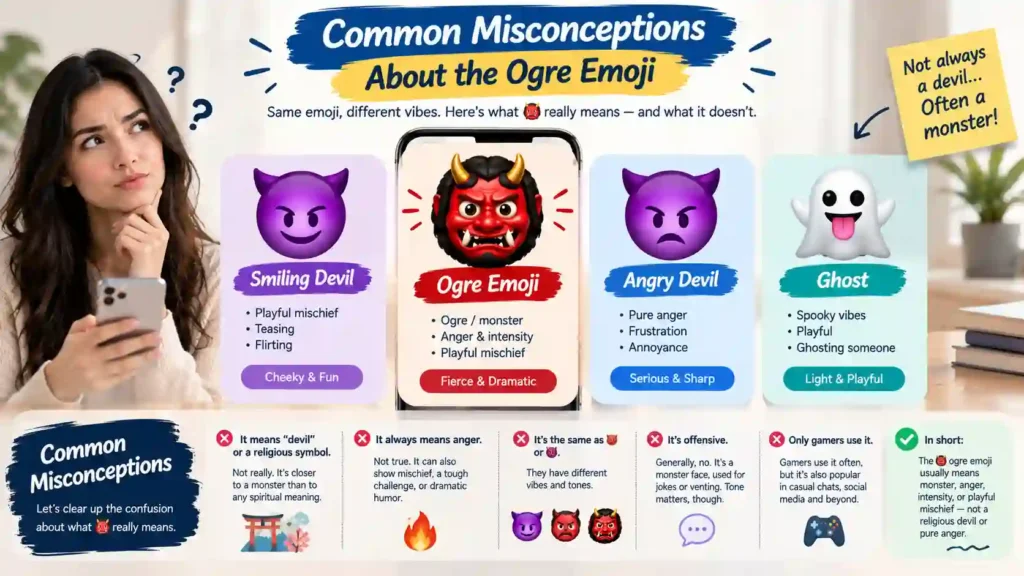
A few mix-ups happen with this emoji. Let’s clear them up.
Misconception 1: It means “devil” or “demon” in a religious sense. Not really. While 👹 does depict a demon-like creature, most casual use has nothing to do with religion. It is closer to “monster” than to any spiritual meaning.
Misconception 2: It always means anger. Not true. It often shows anger, but it can also mean playful mischief, a tough challenge, or dramatic humor. Context decides the tone.
Misconception 3: It is the same as 😈 (smiling devil) or 👿 (angry devil). These are different emojis with different vibes:
- 😈 usually means flirty mischief or teasing
- 👿 usually means pure anger or frustration
- 👹 usually means “monster mode,” something bigger and more dramatic than either
Misconception 4: It is offensive. In most everyday use, it is not offensive. It is a monster face, used for jokes or venting. It is rarely aimed to insult a real person directly, though tone still matters (more on that later).
Misconception 5: Only gamers use it. Gamers use it often, but so do casual texters, social media posters, and people venting about their day. It has spread far beyond gaming culture.
Similar Terms & Alternatives
People often reach for related emojis or phrases when they want a similar effect. Here is how 👹 compares.
| Emoji / Term | Core Meaning | Typical Tone |
| 👹 Ogre | Monster, rage, intensity | Dramatic, mischievous, or angry |
| 😈 Smiling Devil | Playful mischief, flirting | Cheeky, teasing |
| 👿 Angry Devil | Pure anger, frustration | Serious annoyance |
| 👻 Ghost | Spooky, playful, or “ghosting” someone | Light, sometimes ominous |
| 🤬 Face with symbols on mouth | Swearing, extreme anger | Very angry, censored cursing |
| 🔥 Fire | Something amazing or “lit” | Excited, impressed |
| 💀 Skull | “I’m dead” from laughing, or shock | Humor, disbelief |
Word alternatives people type instead of the emoji:
- “monster mode”
- “I’m turning into a gremlin”
- “beast mode”
- “rage mode”
Each of these carries a similar spirit to 👹: something has shifted from calm to intense.
How to Respond to This Term
If someone sends you 👹, your reply depends on the vibe you want.
Casual response:
“lol what happened 👹”
Funny response:
“who unleashed the ogre today 😂”
Professional response (in a work chat):
“Sounds like a rough one. Want to talk through it?”
Privacy-conscious response (if you’d rather not share details):
“Long story, I’ll fill you in later!”
If it’s aimed at you playfully (like a joke threat):
“😭 I’m sorry, truce?”
If the tone feels off or unclear:
“Haha wait, are you actually upset?”
Asking directly is always a safe move when a single emoji leaves you guessing. It clears up confusion fast.
Regional or Cultural Differences
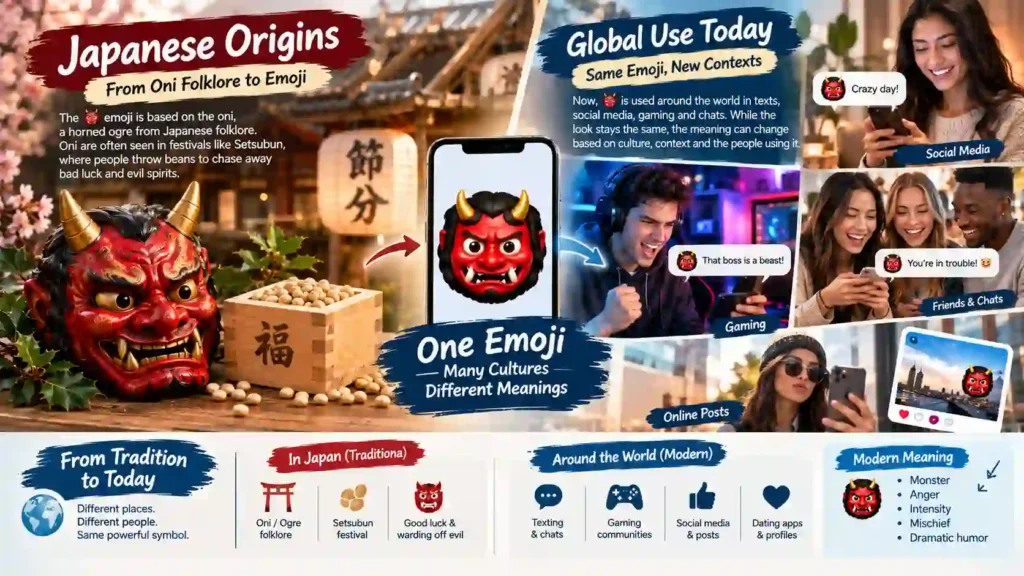
The 👹 emoji started in Japan, tied to the oni figure from Japanese folklore. In Japan, it can still carry that cultural weight, especially around festivals like Setsubun, where people throw beans to chase away oni and bad luck.
Outside Japan, most people do not know the folklore. They just read the face: red or blue skin, horns, fangs, angry look. So the meaning becomes more universal: “monster,” “anger,” or “intensity.”
Some regional patterns:
- In East Asia, the folklore connection is stronger. People may reference oni directly in jokes or festival posts.
- In Western countries, the emoji is mostly used for humor, venting, or gaming.
- In gaming communities worldwide, it is often shorthand for “difficult boss” or “tough opponent,” regardless of region.
There is no major slang variation across English-speaking regions. The core meaning monster, rage, or drama stays fairly consistent globally.
Comparison with Similar Terms
Here is a closer look at how 👹 stacks up against emojis people sometimes confuse it with.
| Feature | 👹 Ogre | 👿 Angry Devil | 😈 Smiling Devil | 👻 Ghost |
| Core feeling | Monster, rage, intensity | Frustration, anger | Playful mischief | Spooky, playful |
| Common use | Venting, gaming, jokes | Venting about anger | Teasing, flirting | Halloween, “ghosting” someone |
| Tone | Dramatic | Serious | Cheeky | Light |
| Offensive risk | Low | Low | Low (unless sexual context) | Low |
| Cultural root | Japanese oni folklore | Western devil imagery | Western devil imagery | Western ghost folklore |
The key difference: 👹 is bigger and more dramatic. 👿 is sharper anger. 😈 is playful and flirty. 👻 is light and spooky.
Usage in Online Communities & Dating Apps
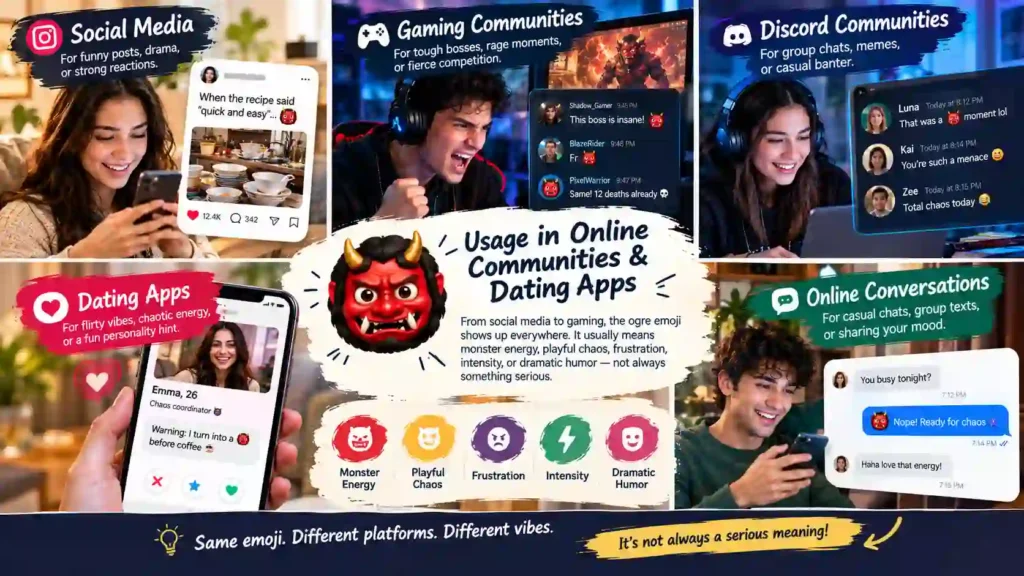
On Twitter/X: People use 👹 to react to chaotic news, drama, or frustrating events. It often pairs with venting threads or sarcastic jokes.
On Tinder and other dating apps: It shows up less often here than emojis like 😏 or 🔥, but some people use it in bios to signal a fun, “chaotic energy” personality, like:
“Warning: I turn into a 👹 before coffee ☕”
If someone sends you 👹 on a dating app, it is usually a joke about their mood or personality, not a red flag. A light response works well:
“Haha noted, I’ll bring snacks to keep the ogre calm 😄”
On gaming platforms (Discord, Twitch chat, etc.): It is extremely common here. Players use it to react to a tough boss fight, an unfair loss, or a fierce rival player.
Chat: that boss fight was 👹 status, no mercy
Tip for responding on any platform: Match the energy. If the tone is playful, reply playfully. If it seems like real frustration, a caring check-in works better than a joke.
Hidden or Offensive Meanings
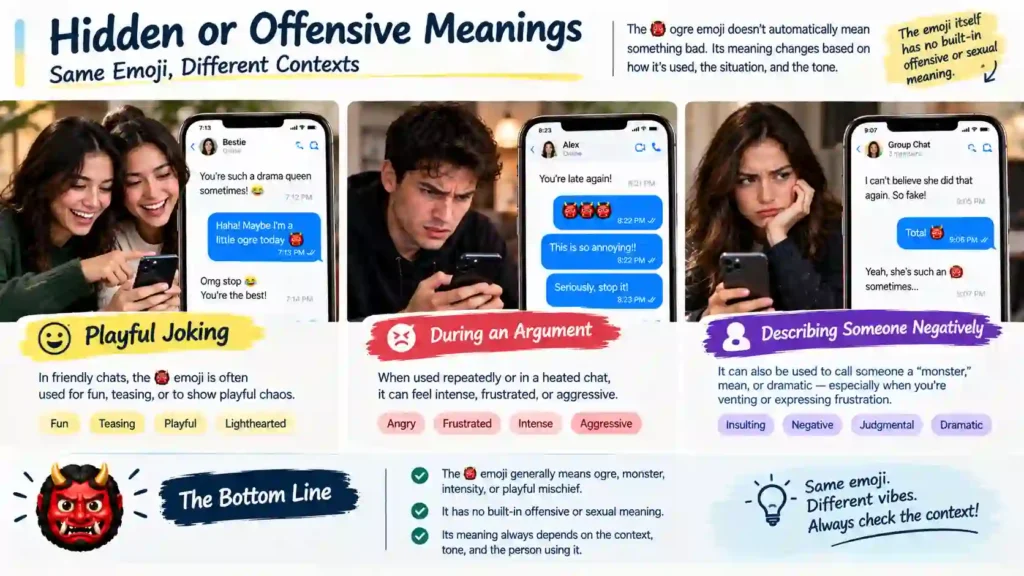
Most of the time, 👹 is harmless. It is a monster face used for jokes, venting, or gaming banter.
There are a few situations where tone matters more:
- If sent repeatedly during an argument, it can feel aggressive rather than playful. Three or four 👹 in a row after a disagreement can read as “I am furious,” not “haha.”
- If used to describe a real person in a negative way (“she’s a 👹”), it can come across as an insult, similar to calling someone a monster.
- In cross-cultural contexts, someone unfamiliar with the playful, casual use might read it as more hostile than intended.
The emoji itself carries no built-in slur or hidden sexual meaning, unlike some other emojis people worry about (like 🍆 or 🍑). Its “hidden” meaning is really just about emotional intensity, and reading that intensity depends on the words around it, the relationship between the people texting, and the overall conversation tone.
Suitability for Professional Communication
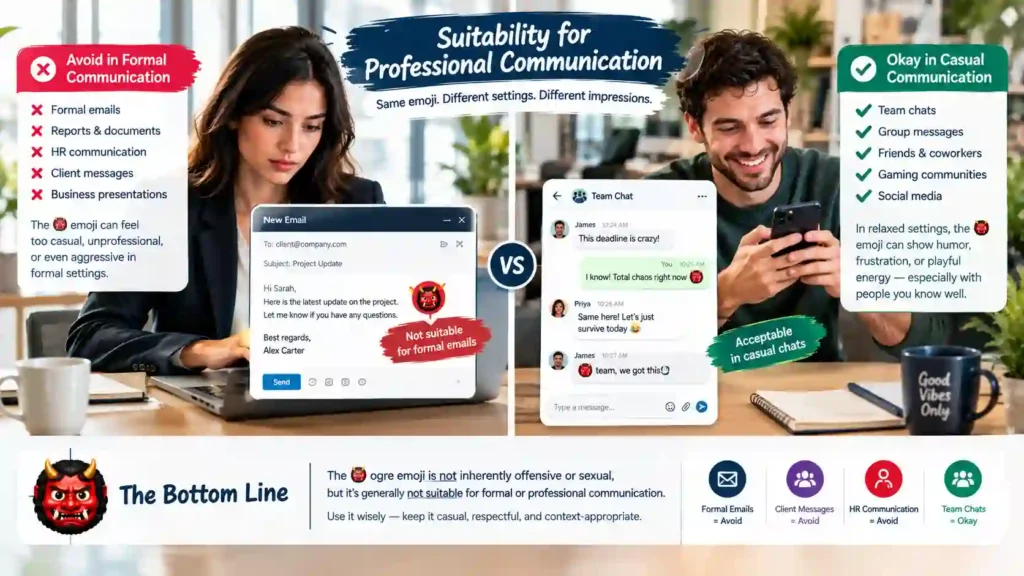
In formal settings client emails, official reports, HR communication 👹 is not appropriate. It reads as too casual and, in some cases, too aggressive for a professional tone.
In casual workplace chats a relaxed team Slack, a group chat with close coworkers it can work in small doses, especially to joke about a stressful day.
Professional alternatives:
- Instead of “👹 today has been rough,” try: “Today’s been a lot. Thanks for your patience.”
- Instead of “that client is a 👹,” try: “That client account has been challenging to manage.”
- Instead of “👹 deadline,” try: “This deadline is tight, but we’re on track.”
Rule of thumb: if you would not say “I feel like a monster right now” out loud in a meeting, skip the emoji version too.
FAQs
1. What does 👹 mean in a text from a friend? It usually means they are joking around, venting about something frustrating, or being playfully dramatic.
2. Is 👹 the same as the devil emoji? No. 👹 is an ogre, based on Japanese oni folklore. 😈 and 👿 are devil emojis with different tones playful mischief and pure anger.
3. Can 👹 be used in a flirty way? Rarely, but yes. Some people use it to describe their own “chaotic” personality in a fun, self-aware way, especially in dating app bios.
4. Is the ogre emoji offensive? Generally, no. It becomes less friendly only when aimed at a real person in a mean-spirited way or spammed during a real argument.
5. Why does the emoji look like a demon if it’s called “ogre”? It is based on the Japanese oni, a folklore creature that blends traits of demons, ogres, and monsters. English translations settled on “ogre.”
6. Should I use 👹 at work? Only in casual, relaxed chats with people you know well. Avoid it in formal emails or client communication.
7. What is a good response if someone sends me 👹 out of nowhere? A simple “haha what happened?” or “uh oh, what’s going on?” works well and invites them to explain.
Conclusion
The 👹 ogre emoji started as a symbol of Japanese folklore and grew into a global shorthand for rage, mischief, and drama. In texts, social media, and gaming chats, it usually signals a strong feeling: frustration, playful chaos, or facing something intense.
It is rarely offensive, but tone and context still matter, especially in arguments or when describing a real person. Save it for casual, friendly conversations, and skip it in formal or professional writing.
Next time you see 👹 pop up in your messages, you will know exactly what your friend, teammate, or match is really saying.
Discover More Article

Hello, I’m Insha, a passionate content writer with 2 years of experience creating clear, engaging, and helpful content. I specialize in the meaning niche, explaining words, slang, phrases, and online terms in simple language that readers can easily understand and use.


1 thought on “👹 Meaning in Text: What the Ogre Emoji Really Means(2026)<p class="post-updated-date">🕓 <span class="updated-label">Last updated on</span> <time datetime="2026-09-20T15:11:44+00:00">September 20, 2026</time></p><script type="application/ld+json"> { "@context": "https://schema.org", "@type": "BlogPosting", "mainEntityOfPage": { "@type": "WebPage", "@id": "https://outreachnexa.com/%f0%9f%91%b9-meaning-in-text/" }, "datePublished": "2026-09-16T12:51:11+00:00", "dateModified": "2026-09-20T15:11:44+00:00" } </script>”