You ask a friend for a small favor, and they reply with “ofc!” Just three letters, but the answer is clear. What does it mean?
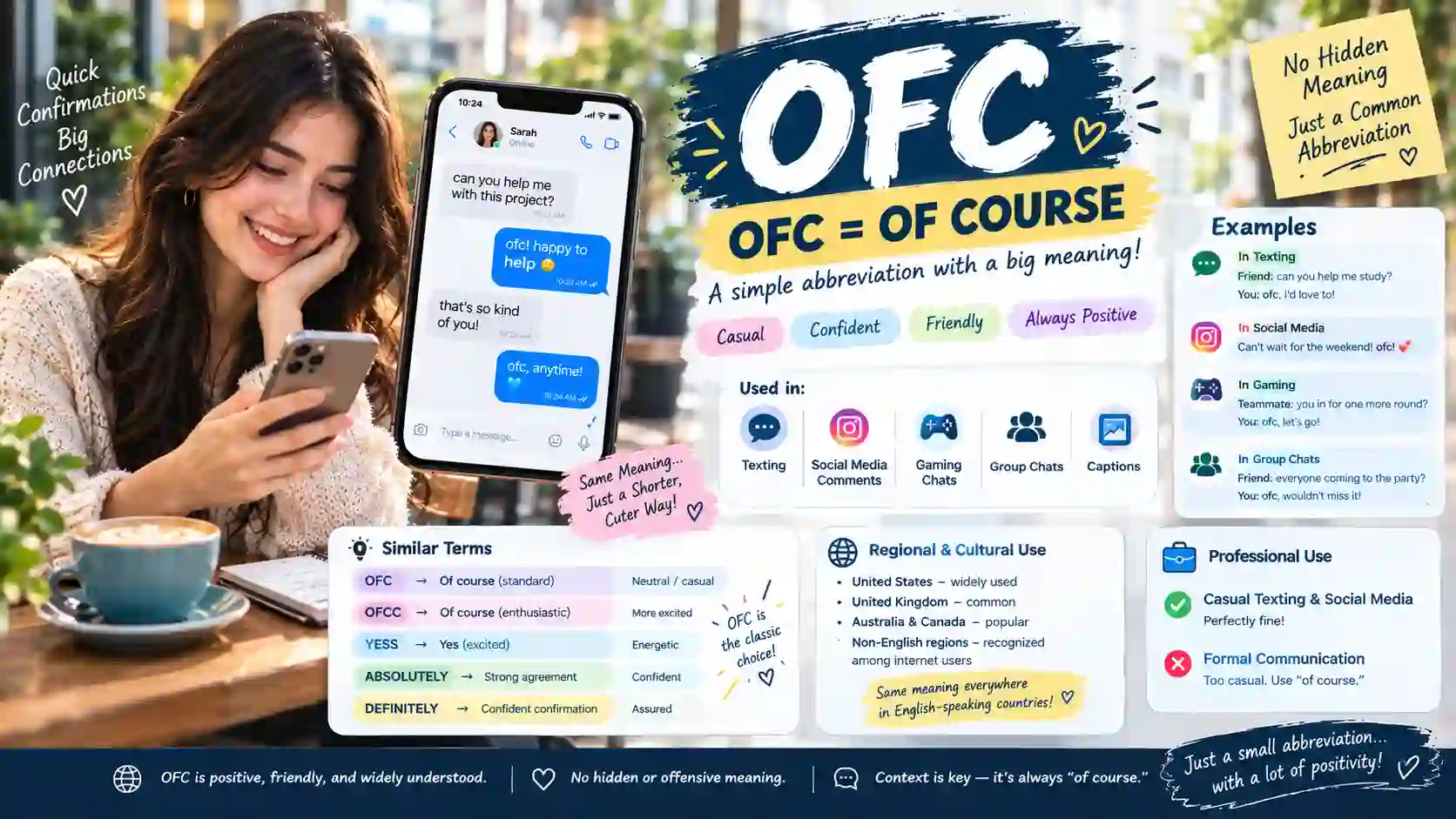
“OFC” stands for “Of Course.” It’s one of the most common texting abbreviations, used to confirm agreement, show willingness, or respond to a question with certainty. You’ll see it everywhere, in texting, social media comments, gaming chats, and casual conversations, especially when someone wants to quickly confirm something without typing the full phrase.
Understanding “ofc” matters because it’s a staple of everyday digital communication. Knowing how and when people use it helps you read tone correctly and respond naturally, without overthinking a simple confirmation. This guide breaks down everything about “ofc” its meaning, history, and how it’s used across texting and social platforms today.
OFC Meaning in Text: Definition & Explanation
“OFC” stands for “Of Course.” It’s used to confirm agreement, express willingness, or answer a question with confidence and certainty.
Example in dialogue:
Friend: can you help me study for the exam this weekend?
You: ofc, just let me know what time works
Here, “ofc” confirms willingness to help, similar to saying “of course” or “absolutely.”
It’s also used to confirm plans or agreements:
Friend: are we still meeting at 7?
You: ofc, see you then
In this case, “ofc” quickly confirms the plan without needing a longer response.
Sometimes it’s used to reassure someone:
Friend: do you think I made the right decision?
You: ofc you did, trust yourself
Across these examples, “ofc” functions as a quick, confident way to confirm agreement, willingness, or certainty, without needing to type the full phrase “of course.”
Background & History of OFC Meaning
The phrase “of course” has long been used in spoken English to confirm agreement or express certainty. As texting became popular in the early 2000s, character limits and the desire to type quickly encouraged people to abbreviate common phrases, and “of course” naturally shortened to “ofc.”
This abbreviation fit perfectly into the broader trend of texting shorthand that emerged during this period, alongside similar abbreviations like “idk” (I don’t know) and “btw” (by the way). As texting and social media evolved throughout the 2010s, “ofc” became one of the most widely recognized and used confirmation abbreviations in digital communication.
Unlike some abbreviations that remain niche or regional, “ofc” achieved near-universal recognition across English-speaking texting culture, becoming a staple in everyday conversations regardless of age group or platform.
Today, “ofc” appears constantly in:
- Casual texting confirming plans or agreements
- Social media comments expressing agreement or support
- Gaming communities confirming readiness or strategy
- Group chats answering questions with certainty
While it started as a simple way to save time typing, “ofc” has become one of the most universally understood pieces of texting shorthand in modern digital communication.
OFC Meaning in Text: Usage in Various Contexts
The term “ofc” shows up across many types of digital conversations.
In Texting
Friend: can I borrow your charger?
You: ofc, here you go
In Social Media Comments
Under a friend’s exciting post, someone might comment: “ofc I’ll be there to celebrate!”
In Gaming Communities
Teammate: you ready for the next round?
You: ofc, let’s go
In Casual Group Chats
Friend 1: is everyone coming to the reunion?
Friend 2: ofc, wouldn’t miss it
In each case, “ofc” adds a quick, confident confirmation, helping conversations move smoothly without needing a longer explanation.
Common Misconceptions & Clarifications
One common misconception is that “ofc” always sounds overly confident or even slightly sarcastic. In reality, tone depends heavily on context.
Misconception 1: It always sounds sarcastic.
Not true. While it can occasionally carry a sarcastic tone in certain contexts, it’s most commonly used sincerely to confirm genuine agreement or willingness.
Misconception 2: It’s only used by younger generations.
Not entirely accurate. While especially popular among younger texters, “ofc” is widely recognized and used across many age groups in casual digital communication.
Misconception 3: It’s too casual to use in any semi-formal context.
Partially true. While too casual for formal writing, it’s completely normal and acceptable in everyday texting and relaxed conversations.
Clarification: The tone of “ofc” depends on context and punctuation. Without additional context suggesting sarcasm, it almost always reflects genuine, sincere agreement.
Similar Terms & Alternatives
Several related terms carry similar meanings to “ofc.” Here’s how they compare:
| Term | Meaning | Tone |
| Ofc | “Of course” | Confident, casual |
| Ofcc | “Of course” (enthusiastic) | Warm, eager |
| Sure | General agreement | Neutral |
| Absolutely | Strong confirmation | Confident |
| Definitely | Strong agreement | Confident |
While these terms overlap, “ofc” stands out as one of the most universally recognized and widely used confirmation abbreviations, making it a go-to choice for quick, casual agreement.
How to Respond to This Term
If someone texts you “ofc,” your response should match the confident, casual tone of the conversation.
Casual Response
“awesome, thanks!”
Playful/Funny Response
“ofc you’d say that lol”
Professional Response (in relaxed workplace chats)
“Great, thank you for confirming.”
Privacy-Conscious Response (if you’d rather keep things brief)
“Perfect, appreciate it.”
Since “ofc” is meant to confirm agreement, most responses can stay brief and appreciative, matching its confident, straightforward tone.
Regional or Cultural Differences
“OFC” is widely used across English-speaking texting culture, without major regional restrictions, since it directly mirrors the universally understood phrase “of course.”
- United States: Extremely common in casual texting and social media, used across nearly all age groups.
- United Kingdom: Used similarly, often in relaxed, everyday conversations.
- Australia and Canada: Common in casual texting, following similar patterns as the U.S.
- Non-English-speaking regions: Often recognized among internet-active users and English learners worldwide, since “of course” is a commonly taught phrase.
The core meaning of “ofc” stays consistent wherever it’s used, making it one of the more globally understood texting abbreviations.
Comparison with Similar Terms
To clarify how “ofc” differs from related expressions:
| Expression | Primary Use | Formality Level | Common Setting |
| Ofc | Casual confirmation | Casual | Texting, social media |
| Ofcc | Enthusiastic confirmation | Very casual | Texting |
| Sure | Neutral agreement | Casual to neutral | All settings |
| Absolutely | Formal confirmation | Neutral to formal | Professional, casual |
The key difference is that “ofc” offers a quick, efficient way to confirm agreement, while alternatives like “absolutely” carry a slightly more formal or emphatic tone.
Usage in Online Communities & Dating Apps
On dating apps like Tinder, Bumble, or Hinge, “ofc” frequently appears in casual conversations confirming plans or shared interests.
Example:
Match: want to grab coffee this weekend?
You: ofc, sounds great
On Twitter/X, “ofc” is extremely common in replies expressing agreement or support for a post.
In gaming communities, it’s used constantly to confirm readiness, strategy, or agreement during gameplay.
Tips for responding appropriately:
- On dating apps, use “ofc” to confirm plans in a casual, friendly tone.
- In social media replies, it works well for quick, genuine agreement.
- In gaming chats, it’s a fast way to confirm readiness without slowing down the conversation.
Hidden or Offensive Meanings
“OFC” carries no hidden or offensive meaning in its common usage. It’s a straightforward, widely understood way to confirm agreement or willingness.
The only minor consideration is tone: in rare cases, if used dismissively in a serious conversation, it could come across as slightly flippant rather than genuinely engaged.
Friend: are you sure you’re okay with this?
You: ofc
Without additional reassurance, this brief response might feel slightly dismissive in an emotionally sensitive conversation.
Why tone and context matter: Since “ofc” is inherently neutral and confident, its biggest risk is feeling too brief during serious conversations, rather than carrying any inherently negative meaning.
Suitability for Professional Communication
“OFC” is generally too casual for formal professional communication, such as client emails or official business messages. However, it may occasionally appear in relaxed internal workplace chats among close colleagues.
Professional alternatives:
- “Of course, happy to help.”
- “Absolutely, I’ll take care of that.”
- “Certainly, consider it done.”
- “Yes, I’d be glad to.”
If communicating in a formal setting, it’s best to use the complete phrase “of course” or a similarly polished alternative rather than the abbreviated “ofc.”
FAQs
1. What does “ofc” mean in texting?
It stands for “of course,” used to confirm agreement or willingness.
2. Is “ofc” always sincere?
Mostly yes, though context can occasionally add a slightly sarcastic tone.
3. Is “ofc” appropriate for professional settings?
No, it’s better suited for casual conversations rather than formal communication.
4. Where did “ofc” come from?
It developed from the phrase “of course,” shortened through casual texting abbreviation trends in the early 2000s.
5. Is “ofc” used internationally?
Yes, it’s widely recognized across English-speaking countries and among internet-active users worldwide.
6. What’s the difference between “ofc” and “ofcc”?
“Ofcc” adds extra enthusiasm through its stretched spelling, while “ofc” remains the more standard, neutral version.
7. Can “ofc” be used sarcastically?
Occasionally, depending on context, though it’s most commonly used sincerely.
Conclusion
“OFC” stands for “of course,” one of the most widely recognized and used texting abbreviations to confirm agreement, willingness, or certainty. It reflects how digital communication often favors quick, efficient confirmations over longer phrases.
Understanding “ofc” helps you read tone correctly and respond naturally, If you’re confirming plans, agreeing with a statement, or reassuring a friend. Its near-universal recognition makes it one of the easiest pieces of texting shorthand to understand and use confidently.
Discover More Article

Hi, I’m Mahgull, a dedicated content writer with 2 years of experience in the meaning niche. I enjoy turning complex words, slang, abbreviations, and phrases into simple, informative content that helps readers understand their meanings clearly and quickly.


1 thought on ““OFC” in Text Meaning: What It Really Stands For<p class="post-updated-date">🕓 <span class="updated-label">Last updated on</span> <time datetime="2026-10-14T13:50:33+00:00">October 14, 2026</time></p><script type="application/ld+json"> { "@context": "https://schema.org", "@type": "BlogPosting", "mainEntityOfPage": { "@type": "WebPage", "@id": "https://outreachnexa.com/ofc-in-text-meaning/" }, "datePublished": "2026-10-14T13:50:32+00:00", "dateModified": "2026-10-14T13:50:33+00:00" } </script>”