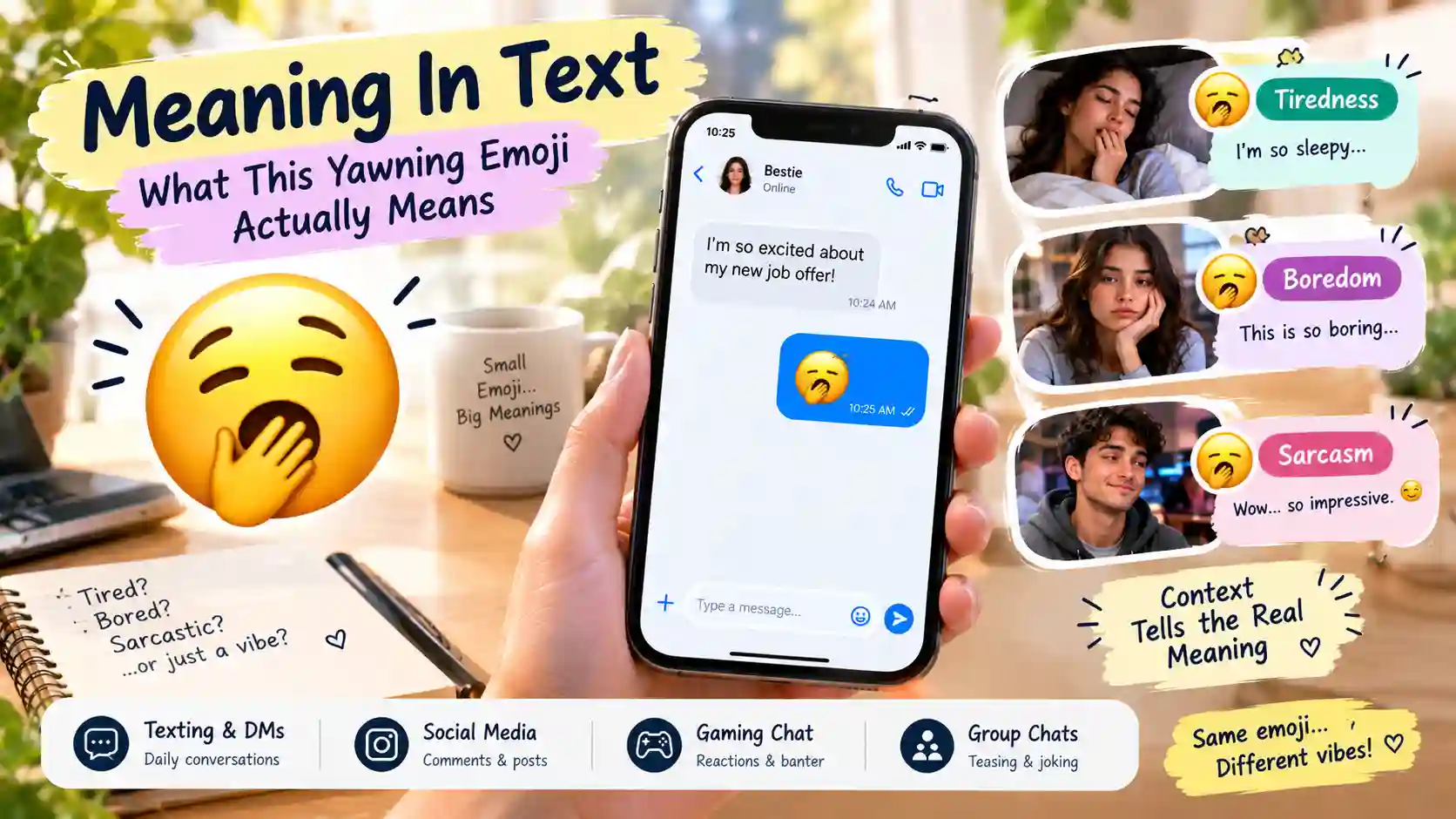
You send an exciting update to a friend, and they reply with just 🥱. No words, just a tired little face. Is it a joke? Genuine exhaustion? Or a subtle way of saying your news wasn’t that thrilling?
🥱 is the yawning face emoji, and it’s become one of texting’s most versatile reaction symbols showing up in daily conversations, social media comments, gaming chats, and casual banter. On the surface, it simply represents tiredness. But in practice, it carries several shades of meaning depending on who sends it and when.
Understanding this emoji matters because its tone can shift dramatically from genuine sleepiness to playful sarcasm to outright boredom. This guide breaks down exactly what 🥱 means, where it came from, and how to use or respond to it appropriately.
🥱 Meaning In Text: Definition & Meaning
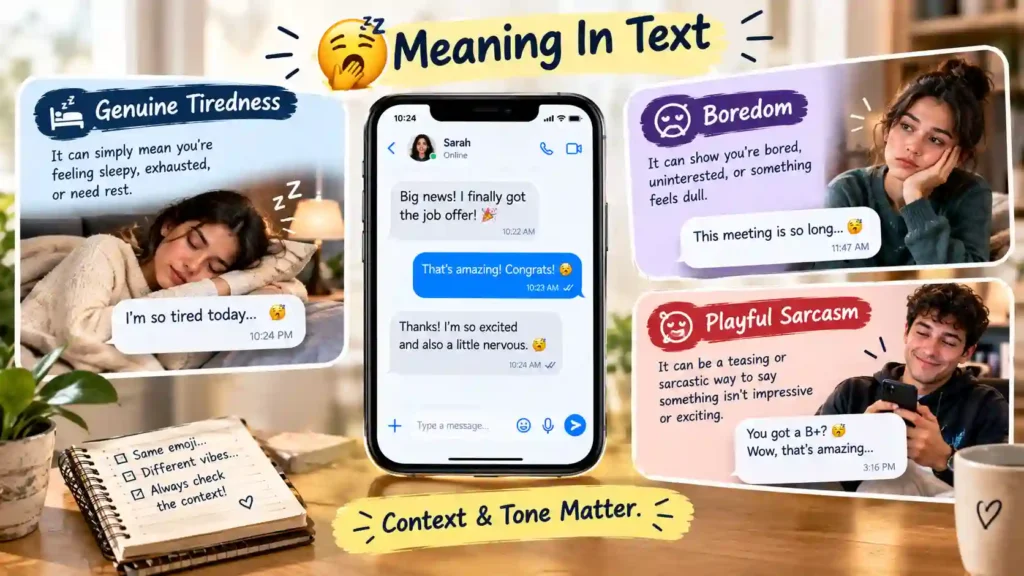
🥱 depicts a yawning face, typically shown with closed or squinting eyes and an open mouth, sometimes with a hand near the face. Officially, it represents tiredness, sleepiness, or boredom the same reaction you’d have physically when yawning.
In texting, it carries a few common meanings:
- Genuine tiredness literally feeling sleepy or exhausted.
- Boredom reacting to something dull or uneventful.
- Sarcastic dismissal playfully signaling that something isn’t impressive or interesting.
Real-life examples:
Alex: ugh it’s only 2pm and I already want to sleep
Sam: 🥱 same honestly
Here, 🥱 reflects genuine tiredness.
Jordan: the meeting ran three hours over today
Priya: 🥱 I felt that in my soul
Here, it reacts to boredom or exhaustion from a dull situation.
Casey: guess who got a B+ on the test they didn’t study for
Dev: 🥱 wake me up when it’s actually impressive
In this one, it’s playful sarcasm, downplaying the achievement jokingly.
Context and tone almost always clarify which meaning applies genuine tiredness reads differently from a teasing jab at someone’s “unimpressive” news.
Background & History of 🥱 Meaning In Text
The yawning face emoji was approved as part of Unicode 12.0 in 2019 and officially added to major platforms shortly after, filling a noticeable gap in emoji options despite emojis for sleep (😴) and tiredness (😪) existing earlier, there was no dedicated symbol for the act of yawning itself.
Once released, it quickly became a popular reaction emoji beyond its literal meaning. Much like how 😂 expanded beyond simple laughter, 🥱 evolved into shorthand for boredom and unimpressed reactions, especially in fast-moving social media conversations where a single emoji can replace an entire sarcastic comment.
Its rise paralleled a broader trend in internet culture: using facial expression emojis to convey tone that’s hard to capture in plain text. A dry “that’s not interesting” can come across as harsh, but 🥱 delivers the same sentiment with a lighter, more playful edge.
Today, you’ll see it most in:
- Texting and DMs, reacting to tiring days or dull updates
- Social media comments, dismissing something as unimpressive
- Gaming chat, reacting to slow matches or uneventful moments
- Group chats, playfully teasing a “boring” story or plan
Understanding 🥱 Meaning In Text Across Different Platforms
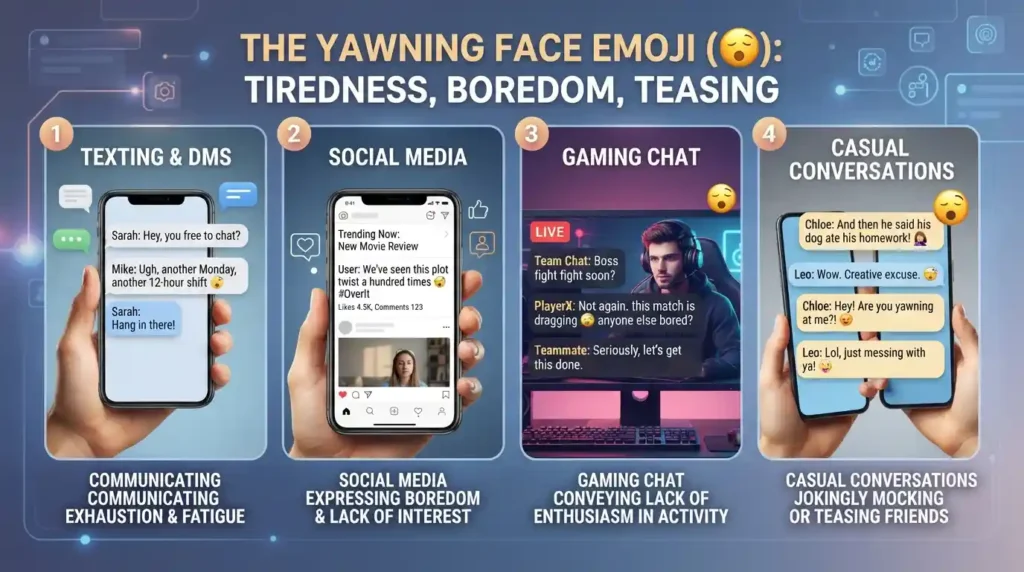
In texting, 🥱 usually reflects tiredness or mild boredom:
Tia: another Monday, another 12-hour shift
Nao: 🥱 sending you energy
On social media, it often dismisses something as underwhelming:
Comment: 🥱 we’ve seen this plot twist a hundred times
In gaming chat, it can react to a slow-paced match or uneventful round:
Player1: anyone else feel like this match is dragging?
Player2: 🥱 yeah nothing’s happening
In casual conversation more broadly, it can add a playful, teasing edge:
Dev: I finally beat my personal record today!
Sam: 🥱 jk that’s actually awesome, congrats
Across all these contexts, 🥱 softens whatever sentiment it’s paired with tiredness, boredom, or teasing without needing extra words.
Common Misconceptions About 🥱 Meaning In Text
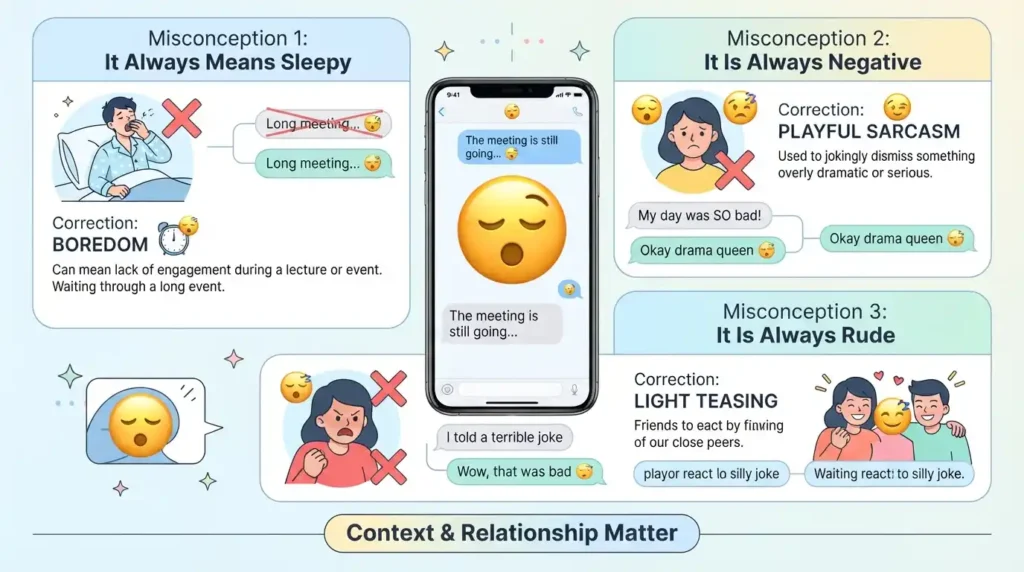
A common misconception is assuming 🥱 always means genuine tiredness. In casual texting and social media, it’s frequently used sarcastically to express that something feels unimpressive or predictable, rather than literal sleepiness.
Another misunderstanding: assuming 🥱 is always dismissive or negative. Often, it’s paired with playful teasing rather than genuine criticism the tone depends heavily on the relationship between the people texting and what came before it.
It’s also worth clarifying: 🥱 isn’t inherently rude, though it can come across that way if used carelessly in response to something someone is genuinely excited or proud about. Context and relationship matter more than the emoji itself.
Similar Terms & Alternatives to 🥱 Meaning In Text
| Emoji/Term | Meaning | Typical Use |
| 🥱 | Yawning, tired, bored | Genuine tiredness or playful dismissal |
| 😴 | Sleeping | Literal sleep or exhaustion |
| 😪 | Sleepy face | Drowsiness, tiredness |
| 😑 | Expressionless | Flat, unimpressed reaction |
| meh | Indifference | Casual dismissal in text form |
| snore | Boredom | Playful way to call something dull |
If you want the same tone without the emoji, “that’s a snooze” or “big yawn energy” capture a similar playful dismissiveness.
How to Respond When Someone Uses 🥱 Meaning In Text
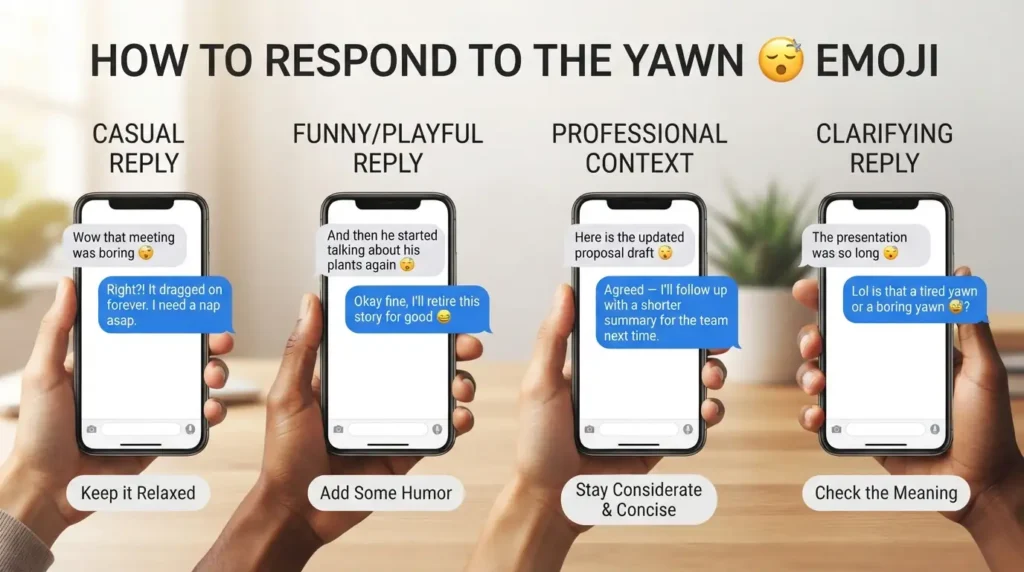
Casual reply:
Them: 🥱 long day?
You: the longest, I need a nap asap
Funny/playful reply:
Them: 🥱 that story again?
You: okay fine, I’ll retire this story for good 😂
Professional context (rare, best avoided, but if it appears informally at work):
Them: that meeting really dragged on
You: Agreed I’ll follow up with a shorter summary next time.
Privacy-conscious or unsure reply, if the tone feels ambiguous:
You: lol is that a “tired” yawn or a “boring” yawn 😅
Since 🥱 can read multiple ways, a lighthearted clarifying question keeps things friendly if the tone isn’t obvious.
Regional & Cultural Differences in 🥱 Meaning In Text
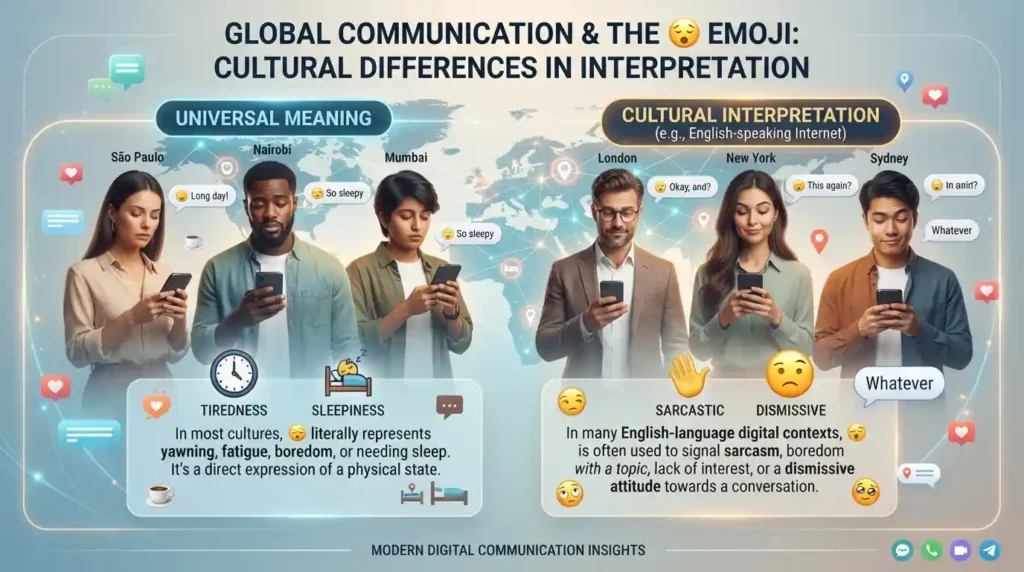
🥱 is a genuinely global emoji, since yawning is a universally recognized human expression that doesn’t require translation. Its core meaning tiredness or boredom transfers easily across cultures and languages.
That said, its sarcastic, dismissive usage (reacting to something as “unimpressive”) is more strongly associated with English-language internet and social media culture, particularly among younger users on platforms like Twitter/X and TikTok, where playful sarcasm through emojis is common.
Outside these spaces, 🥱 is still widely understood, but its extended sarcastic meaning may register less strongly in cultures or age groups less immersed in meme-driven digital communication.
Comparison with Similar Reaction Emojis
| Emoji | Emotional Tone | Best Used For |
| 🥱 | Tired, bored, playfully dismissive | Sleepiness or “that’s not impressive” |
| 😴 | Fully asleep | Literal exhaustion |
| 😑 | Flat, unimpressed | Deadpan reactions without tiredness |
| 🙄 | Annoyed, exasperated | Eye-rolling frustration |
| 😐 | Neutral, unmoved | Lack of strong reaction either way |
The key difference: 🥱 specifically ties boredom to physical tiredness, while emojis like 😑 or 🙄 express flatness or irritation without that sleepy undertone.
Usage in Online Communities & Dating Apps
On dating apps like Tinder or Bumble, 🥱 sometimes appears as a playful reaction to a cliché opening line or overused pickup line:
Match: are you a magician? because whenever I look at you everyone else disappears
You: 🥱 heard that one before, try again
On Twitter/X, it’s a common reply to predictable takes or repetitive content. In gaming communities, it reacts to slow matches or uneventful moments during gameplay.
Tip for responding appropriately: on dating apps, a playful 🥱 can actually invite banter rather than shut down conversation following up with a joke keeps the exchange light rather than dismissive.
Hidden or Offensive Meanings Behind 🥱
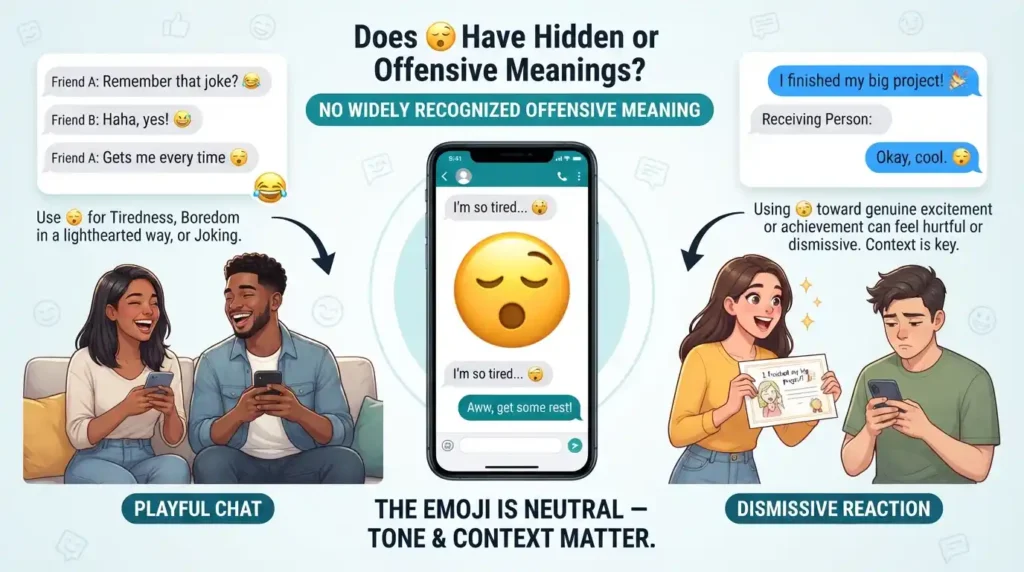
🥱 doesn’t carry a widely recognized offensive meaning. It’s a neutral reaction emoji, functioning consistently across most contexts as an expression of tiredness, boredom, or lighthearted dismissal.
That said, tone and relationship context still matter. Responding to someone’s genuine excitement or achievement with a bare 🥱 can come across as dismissive or hurtful if the relationship or context doesn’t support playful teasing. Reading the room before using it keeps the interaction friendly rather than deflating.
Is 🥱 Suitable for Professional Communication?
No 🥱 is not appropriate for formal or professional communication. Even used sincerely to express tiredness, it’s too casual for emails, official messages, or client-facing conversations.
Professional alternatives depending on intended meaning:
- Instead of 🥱 (tiredness) → “I’m feeling a bit worn out today.”
- Instead of 🥱 (boredom) → “This could use more engagement” or a more specific, constructive comment.
- Instead of 🥱 (dismissiveness) → best left out of professional communication entirely.
In professional settings, spelling out the sentiment clearly and constructively always reads as more appropriate.
FAQs
1. What does 🥱 mean in text?
It represents a yawning face, most commonly signaling tiredness, boredom, or playful dismissal.
2. Is 🥱 always about being sleepy?
No it’s often used sarcastically to suggest something is unimpressive or predictable.
3. Is 🥱 rude?
Not inherently, though it can come across as dismissive if used in response to something someone is genuinely excited about.
4. When was the yawning emoji added?
It was approved as part of Unicode 12.0 in 2019.
5. Can I use 🥱 in a professional email?
No, it’s too casual for formal communication.
6. What’s the difference between 🥱 and 😴?
🥱 signals yawning, tiredness, or boredom, while 😴 represents being fully asleep.
7. Is 🥱 common on dating apps?
Yes, often used playfully to react to cliché lines or predictable messages.
Conclusion
🥱 is a flexible, widely recognized emoji representing tiredness, boredom, or playful dismissal across texting, social media, and gaming chat. Since its addition to Unicode in 2019, it’s grown beyond its literal meaning to become a go-to way of reacting to dull moments or gently teasing something as “unimpressive.”
Its tone depends heavily on context and relationship, and like most casual emojis, it’s best kept out of professional communication. When you see it, the safest bet is simple: read the surrounding conversation, and you’ll know exactly which kind of yawn you’re dealing with.
Discover More Article

Hi, I’m Mahgull, a dedicated content writer with 2 years of experience in the meaning niche. I enjoy turning complex words, slang, abbreviations, and phrases into simple, informative content that helps readers understand their meanings clearly and quickly.