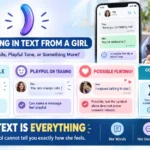
Have you received a text from a girl that says “)” and wondered what she means? You are not alone. Small symbols can carry different meanings in text messages. A single bracket may look confusing, especially when it comes without words.
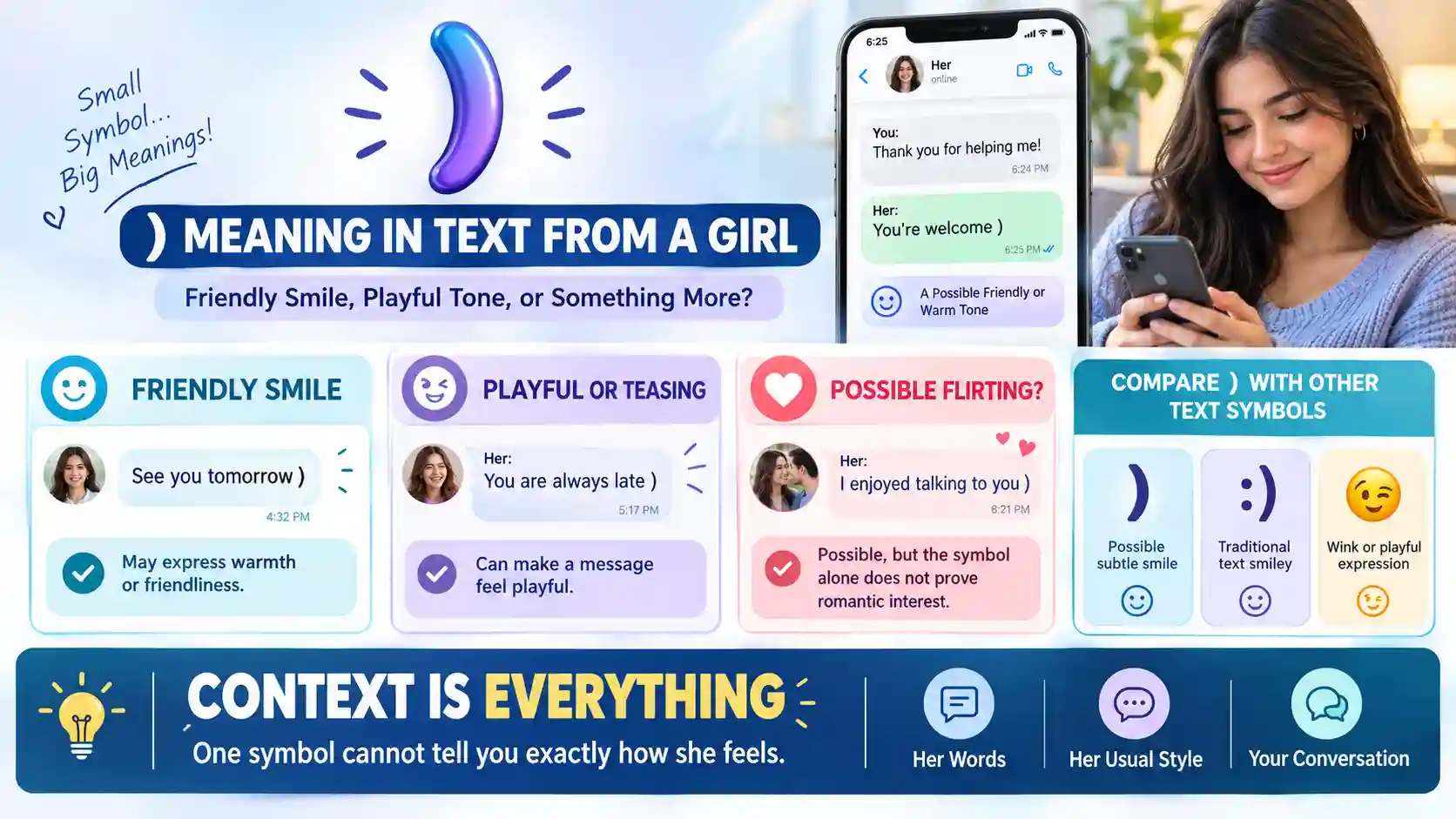
The “)“ symbol can be used as a simple smile or a friendly way to soften a message. In some texting styles, people use a closing parenthesis instead of a full smiley face like “:)”. It may show warmth, friendliness, happiness, or a playful tone.
For example, if a girl texts, “Thank you for helping me )”, she may be trying to sound kind and friendly. However, the symbol does not always mean she likes you romantically.
Its meaning depends on the conversation, her usual texting style, and your relationship with her. In this guide, you will learn what “)” can mean, how girls may use it in different situations, and how to respond without overthinking a tiny symbol.
What Does ) Mean in a Text Message From a Girl?
The symbol “)” is a closing parenthesis. In informal digital communication, it can also work as a minimal smiley or a soft, friendly expression.
A traditional text smiley looks like this: “:)”. Some people leave out the opening colon and type only “)”. This can happen because they prefer a shorter style of texting or because they use a regional messaging habit.
Still, there is no single meaning that applies to every girl or every message.
1. It Can Mean a Smile
A girl may use “)” to show a light, positive mood.
Example:
You: “I hope your exam went well.”
Her: “Yes, it went really well )”
The symbol may make her message feel warmer and more cheerful.
2. It Can Make a Message Sound Friendly
Some people add “)” to ordinary sentences to make them feel less serious.
Example:
You: “Thanks for sharing the notes.”
Her: “You’re welcome )”
She may simply be trying to sound friendly. This does not automatically mean she has romantic feelings for you.
3. It Can Show Playfulness
A girl may use the symbol after a joke or a teasing comment.
Example:
Her: “You always arrive late )”
Depending on your relationship, this could be playful teasing rather than criticism.
4. It May Be Part of Her Normal Typing Style
Some people use symbols in almost every message. Others rarely use them.
If she often writes “okay)”, “thanks)” or “good night)”, she may simply prefer that style.
The key point: A single “)” is not enough to tell whether a girl is flirting, smiling, being polite, or just typing in her usual way.
Background and History of the ) Symbol
The symbol “)” did not begin as a texting abbreviation. It is a punctuation mark called a closing parenthesis. Its main purpose in writing is to close a phrase or statement placed inside parentheses.
Over time, people began using punctuation marks to express feelings in electronic messages.
How Text Smilies Started
Early digital communication often relied on plain text. Users could not always send emojis or animated stickers, so they used keyboard characters to show facial expressions.
One familiar example is “:-)”, which combines a colon, a hyphen, and a closing parenthesis to represent a smiling face when viewed sideways.
A shorter version, “:)”, became common in chats, emails, and online forums.
People have also used other text faces, such as:
- 🙂 — a smile
- 🙂 — a traditional text smiley
- 😉 — a wink
- 🙁 — a sad face
- 😀 — a big smile or laughter
The exact tone of these symbols can vary by person and platform.
Why Do Some People Type Only )?
In some online communities, especially in parts of Eastern Europe and Russian-language internet culture, repeated closing parentheses have been used as a way to show friendliness, warmth, or laughter.
For example, someone might write “Thank you))” or “Hello)))”.
In these settings, more closing parentheses can sometimes suggest a stronger positive tone. However, this convention is not universal.
Some people elsewhere may use a single closing parenthesis in the same way, while others may see it as a typo or incomplete smiley.
How the Symbol Is Used Today
Modern messaging apps offer colorful emojis, GIFs, stickers, and animated reactions. Even so, many people still use keyboard symbols in everyday chats.
A girl may send “)” because it feels quick, natural, or familiar to her. She may also use it to soften a short reply.
The symbol has no fixed emotional meaning. Its interpretation depends on the person, the language community, and the conversation.
How Girls Use ) in Different Texting Situations
A single symbol can feel different depending on the message around it. Here are some common situations in which a girl might use “)”.
1. In Everyday Text Messages
A girl may use “)” to make a normal reply sound friendly.
Example:
You: “Did you get home safely?”
Her: “Yes, just got home )”
This may be a simple, friendly response. It does not necessarily suggest flirting.
2. When Saying Thank You
The symbol may soften a thank-you message.
Example:
You: “I sent you the photos.”
Her: “Thank you )”
She may be expressing gratitude in a warm or casual way.
3. When Joking With You
A girl might add “)” after a playful remark.
Example:
You: “I can cook better than you.”
Her: “Oh really? Prove it )”
The symbol may help keep the conversation light. The words themselves give you more information than the bracket alone.
4. On WhatsApp
On WhatsApp, a girl may use “)” in private chats, group messages, or status replies.
Example:
You: “See you tomorrow!”
Her: “See you )”
This may simply be her way of ending the conversation on a positive note.
5. On Instagram or TikTok
A girl might add “)” to a direct message or comment.
Example:
You: “That video was so funny.”
Her: “I know haha )”
This could signal an easygoing mood or be part of her regular typing style.
6. When Talking to Someone She Likes
A girl who likes someone may use friendly symbols to make her messages feel warm. But people also use the same symbols with friends, family, and classmates.
Example:
You: “I enjoyed talking to you today.”
Her: “Me too )”
This sounds positive, but it is not proof of romantic interest.
Look for a wider pattern, such as whether she starts conversations, asks questions, makes plans, and shows interest in spending time with you.
Common Misconceptions About ) From a Girl
The biggest mistake people make is assuming that one small symbol reveals someone’s feelings.
Here are some important points to remember.
Misconception 1: It Always Means She Likes You
No. A girl may use “)” to sound friendly, polite, or cheerful.
For example, “Thanks for your help)” may simply be a kind response.
A smile-like symbol does not prove romantic interest.
Misconception 2: It Always Means She Is Happy
Not always. She might use the symbol out of habit, even when the message itself is neutral.
The surrounding words and the wider conversation matter more than the symbol alone.
Misconception 3: One ) Is Always Flirting, but )) Means More
There is no universal rule for how many closing parentheses someone uses.
In some communities, repeated parentheses can make a message feel warmer. Elsewhere, the difference may mean nothing at all.
Misconception 4: It Is an Official Texting Acronym
Unlike LOL or BRB, “)” is not an acronym. It is a punctuation mark that can take on an expressive role in informal messages.
Misconception 5: A Short Reply Means She Is Not Interested
A brief message does not prove a lack of interest either. She may be busy, distracted, or simply prefer short messages.
Do not judge a relationship from one text. Pay attention to her overall communication and how she treats you over time.
Similar Symbols and Alternatives to )
Many text symbols and emojis can express a friendly or positive tone. However, they do not all communicate exactly the same thing.
| Symbol | Common meaning | Typical tone |
| ) | Minimal smile or friendly tone in some texting styles | Depends on context |
| 🙂 | Smiling face | Friendly or happy |
| 🙂 | Traditional text smiley | Cheerful |
| 😊 | Smiling face with smiling eyes | Warm or happy |
| 🙂 | Slightly smiling face | Mildly positive or polite |
| 😉 | Winking face | Playful or teasing |
| 😀 | Big smile | Excited or amused |
| ❤️ | Heart | Affection or care, depending on context |
| 😂 | Face with tears of joy | Laughter or amusement |
) vs. 🙂
The main difference is that “:)” includes the opening colon, making the smiley more recognizable.
A single “)” may carry a similar tone in some texting communities, but it can also look incomplete to someone unfamiliar with that style.
) vs. 😊
The emoji “😊” shows a clear smiling face. A closing parenthesis is more subtle and open to interpretation.
For example, “Thank you 😊” is more visibly warm, while “Thank you )” may feel understated or simply reflect the sender’s habits.
) vs. 😉
A wink often suggests teasing, humor, or a playful hint. A closing parenthesis does not carry that meaning by itself.
If a girl sends “Okay 😉”, the wink may add a teasing tone. If she sends “Okay)”, you should not automatically read it as flirting.
How Should You Respond When a Girl Sends )?
You do not need to decode the symbol before every reply. Respond to the actual message and keep your tone natural.
1. Casual Response
If she sends a friendly message, reply as you normally would.
Her: “Thanks for helping me )”
You: “You’re welcome! Glad I could help.”
This is warm without making the exchange awkward.
2. Funny Response
If you are already joking together, you can keep the humor going.
Her: “You are always late )”
You: “I’m not late. I’m just making a dramatic entrance 😂”
Use this style when you know she enjoys playful banter.
3. Friendly or Sweet Response
If you like talking to her, show interest without reading too much into the symbol.
Her: “I enjoyed our chat )”
You: “Me too! We should talk again soon.”
This expresses interest in a clear and relaxed way.
4. If You Are Confused
If the symbol appears in an unclear message, you can ask about the words rather than focusing on the punctuation.
Her: “Okay )”
You: “Great! Are we still meeting at six?”
This moves the conversation forward without making a small symbol seem like a major issue.
5. If You Want to Know Whether She Likes You
Do not ask, “Does your bracket mean you like me?” unless you are both already joking about it.
Instead, look at the bigger picture.
If you want clarity, you can be honest and respectful.
You: “I’ve really enjoyed getting to know you. Would you like to go out sometime?”
This gives her a clear chance to express how she feels.
6. If You Want to Keep Your Privacy
If the conversation becomes too personal, you can set a boundary politely.
Her: “Tell me who you like )”
You: “Haha, that’s a secret for now!”
You do not have to share anything you would rather keep private.
Regional and Cultural Differences in Using )
The meaning of “)” can change across languages, regions, and online communities.
Some people see it as a smile. Others may see it as an unfinished emoticon or an accidental keystroke.
In English-Speaking Communities
Many English-speaking users recognize “:)” as a smiley. However, using only “)” is less clear and may be unfamiliar to some people.
A recipient might understand the intended warmth from the sentence, while another might not notice the symbol at all.
In Russian-Language and Eastern European Online Chats
Repeated closing parentheses, such as “))” or “)))”, are a recognizable convention in some Russian-language online communication.
They may express a smile, friendliness, amusement, or laughter. The number of parentheses can sometimes add emphasis.
However, this style is not used by everyone in those regions, and meanings can vary.
In South Asian Conversations
People in Pakistan, India, and other South Asian communities often mix English, local languages, emojis, and internet slang in chats.
A girl might write a short message such as “Theek hai)” or “Okay)”. She may be using the symbol as a friendly sign-off, but the meaning depends on her personal style.
Not everyone in these communities uses the symbol in this way.
Across Different Platforms
WhatsApp, Instagram, Telegram, and other messaging platforms support many kinds of emojis and reactions. Still, some users prefer simple keyboard characters.
The safest approach is to consider the sender’s usual style rather than assuming the symbol has one cultural meaning everywhere.
) in Online Communities and Dating Apps
Dating apps and social platforms often encourage short, casual messages. Symbols can help make those messages feel warmer or more playful.
However, a closing parenthesis is not a reliable signal of romantic interest.
On Tinder and Other Dating Apps
A girl might use “)” when replying to a joke, saying hello, or ending a message.
Example:
You: “What’s your ideal weekend?”
Her: “Good food, music, and a long walk)”
This may be a casual typing habit or a friendly tone. It does not prove she is attracted to you.
To understand whether she is interested, consider how she engages with the conversation as a whole.
On Instagram and X
A closing parenthesis may appear in comments, direct messages, or replies.
For example:
You: “That was a great photo!”
Her: “Thank you)”
This is a positive response, but it may simply be polite.
In Gaming Communities
Players sometimes use text faces to express emotions quickly while gaming.
A girl might send “Nice job)” after a teammate wins a match. It could be a friendly compliment.
In other cases, the same symbol might be neutral or even sarcastic, depending on the message.
Tips for Responding Online
- Respond to what she says, not just the symbol.
- Avoid assuming that friendliness means attraction.
- Keep your replies respectful.
- Ask clear questions when you want to know something.
- Respect her boundaries if she does not want to continue a conversation.
Online messages offer clues, but they cannot tell you everything about another person’s feelings.
Hidden or Offensive Meanings of )
The closing parenthesis is not inherently offensive. Its usual role is punctuation, and its use as a smile-like symbol is informal.
Still, a message can feel sarcastic, cold, or unfriendly even when it ends with “)”.
Can ) Be Sarcastic?
Yes, in some conversations. The words around it may make the tone sound sarcastic.
Example:
You: “I forgot to send the file.”
Her: “Great job)”
Depending on the relationship and the situation, this could be sincere or sarcastic. The symbol alone cannot settle the question.
Does ) Have a Secret Romantic Meaning?
No universal secret meaning is attached to this symbol.
A girl may use it while flirting, but she may also use it with friends or in ordinary messages.
Avoid relying on online claims that every punctuation mark has a fixed romantic meaning.
Can It Be Misunderstood?
Yes. If someone is unfamiliar with this texting style, they may wonder whether the message is incomplete.
For example, “Okay)” could seem friendly to one person but unusual to another.
If the conversation is important, clear words are better than guessing.
Context matters more than punctuation. Consider the whole message, your relationship, and the sender’s normal way of texting.
Is ) Appropriate for Professional Communication?
The closing parenthesis is perfectly normal in formal writing when it is used correctly as punctuation.
For example:
“The meeting will take place on Monday (October 12).”
However, using “)” alone as a smile-like expression is informal and may confuse people in a professional setting.
In Workplace Messages
A coworker might write:
“Thanks for your help)”
They may intend a friendly tone. Still, not everyone will understand the symbol in the same way.
In professional communication, a clear sentence is usually better.
You could write:
- “Thank you for your help.”
- “Thanks again!”
- “I appreciate your support.”
- “Sounds good. See you tomorrow.”
In Emails
Avoid relying on an unexplained symbol to express your tone in a formal email.
Instead of ending a serious business message with “)”, use a polite closing such as “Best regards” or “Thank you.”
In Customer Service
Customer service messages should be easy to understand. If warmth is appropriate, use clear language rather than a symbol that some readers may not recognize.
Professional rule: Use “)” as punctuation when needed. If you want to show a smile in an informal chat, consider whether your audience will understand it.
FAQs
1. What does ) mean in a text message from a girl?
It may represent a small smile, warmth, or a friendly tone. Some people use it instead of the full smiley “:)”. Its exact meaning depends on the sender and the conversation.
2. Does ) mean a girl likes me?
Not by itself. It may make a message feel friendly, but it does not prove romantic interest. Look at how she communicates with you over time.
3. What is the difference between ) and :)?
The symbol “:)” is a recognizable text smiley with a colon and a closing parenthesis. A single “)” may be used similarly in some texting styles, but it is less clear to people who do not know that convention.
4. What does )) mean from a girl?
In some online communities, repeated closing parentheses can express warmth, amusement, or a stronger smile. However, the meaning is not universal and may simply reflect her usual typing style.
5. Is ) a flirty symbol?
It can appear in a flirty conversation, but it is not automatically flirtatious. The words, tone, and overall interaction provide better clues.
6. Why does a girl put ) after every message?
She may use it as a personal typing habit or to make her messages sound friendly. If she uses it consistently, it may not carry any special meaning.
7. How should I reply when a girl sends )?
Reply naturally to the message itself. You can be friendly, make a joke, or ask a question. There is no need to treat the symbol as a hidden message.
Conclusion
The “)“ meaning in a text message from a girl is usually best understood as a possible smile, friendly tone, or informal texting habit. Some people use a closing parenthesis instead of the more familiar “:)”, while others may use it as part of a regional or personal messaging style.
However, the symbol does not always mean the same thing. It may show warmth, make a sentence feel playful, or simply appear at the end of a message without any special intention.Most importantly, it does not prove that a girl likes you romantically. Her words, actions, and overall communication matter much more than one punctuation mark.
If you are unsure, read the full message and consider how she normally texts. When needed, ask a clear question instead of guessing.A small symbol can add feeling to a conversation, but understanding the person behind the message is far more important than trying to decode every character.
Discover More Article

Hello, I’m Insha, a passionate content writer with 2 years of experience creating clear, engaging, and helpful content. I specialize in the meaning niche, explaining words, slang, phrases, and online terms in simple language that readers can easily understand and use.