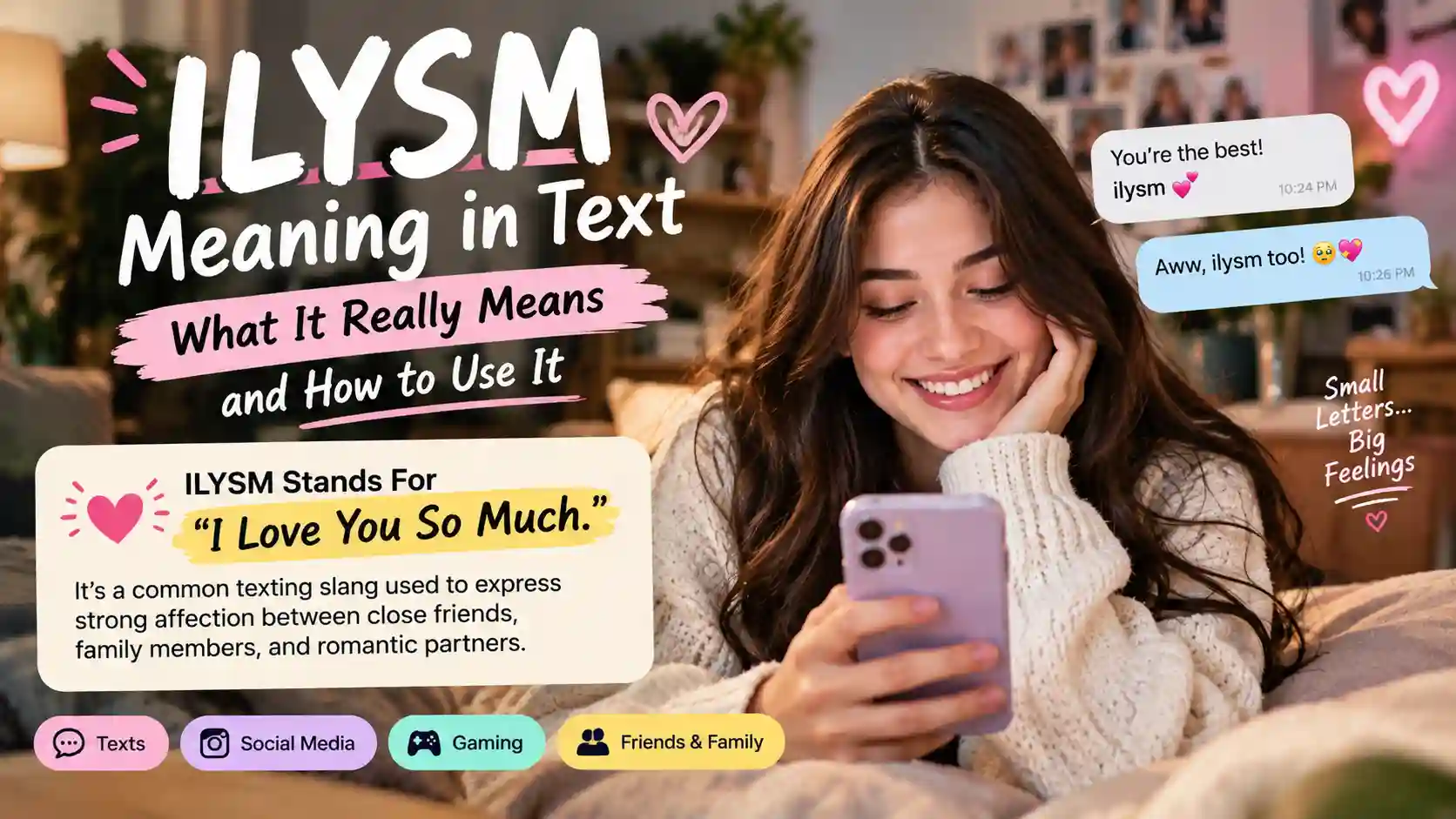
You’re texting someone close to you, and they reply with just: “ilysm.” No context, no explanation just five letters. If you’ve ever paused to figure out what that meant, you’re not alone.
ILYSM is texting slang for “I love you so much.” It’s one of the most common abbreviations used between close friends, family members, and romantic partners. You’ll see it in texts, Instagram comments, Snapchat streaks, and even in gaming chats between close teammates.
Understanding ILYSM matters because it carries real emotional weight. Knowing when it’s used casually versus sincerely helps you read tone correctly and respond the right way whether that’s with warmth, humor, or simple acknowledgment.
ILYSM Meaning in Text: Definition & Meaning
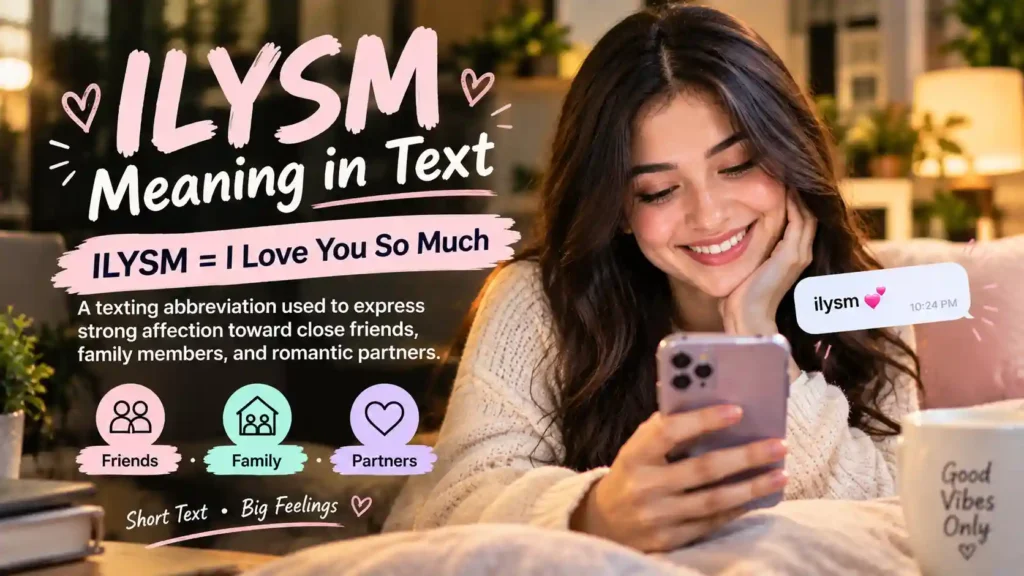
ILYSM stands for “I Love You So Much.” It’s a shortened, faster way to express strong affection without typing the full phrase every time.
It’s most often used between:
- Close friends
- Family members
- Romantic partners
- Sometimes pets (jokingly, in captions)
Real-life examples:
Text message:
Mom: proud of you today, ilysm 💕
You: ilysm too mom
Instagram comment on a friend’s photo: “ilysm this pic is everything 😭”
Snapchat caption: “3 years of friendship, ilysm bestie”
The core meaning stays consistent across contexts it’s a quick, heartfelt way to say “I love you,” just with more emphasis than a plain “ily.”
Background & History of ILYSM Meaning in Text
Text abbreviations for affection go back to the earliest days of SMS and instant messaging, when character limits and slow typing pushed people toward shortcuts. ILY (“I love you”) was one of the first to catch on, widely used in AIM and early texting in the 2000s.
As texting culture matured, people wanted more intensity than a plain “ily” could carry. ILYSM emerged as a natural extension adding “so much” to express deeper feeling without much extra typing.
The term grew alongside social media platforms like Instagram, Twitter, and later TikTok and Snapchat, where quick, emotionally expressive comments became the norm. Today, ILYSM remains one of the most recognizable love-related abbreviations, especially popular among teens and young adults, though people of all ages use it in close relationships.
ILYSM Meaning in Text: Usage in Various Contexts
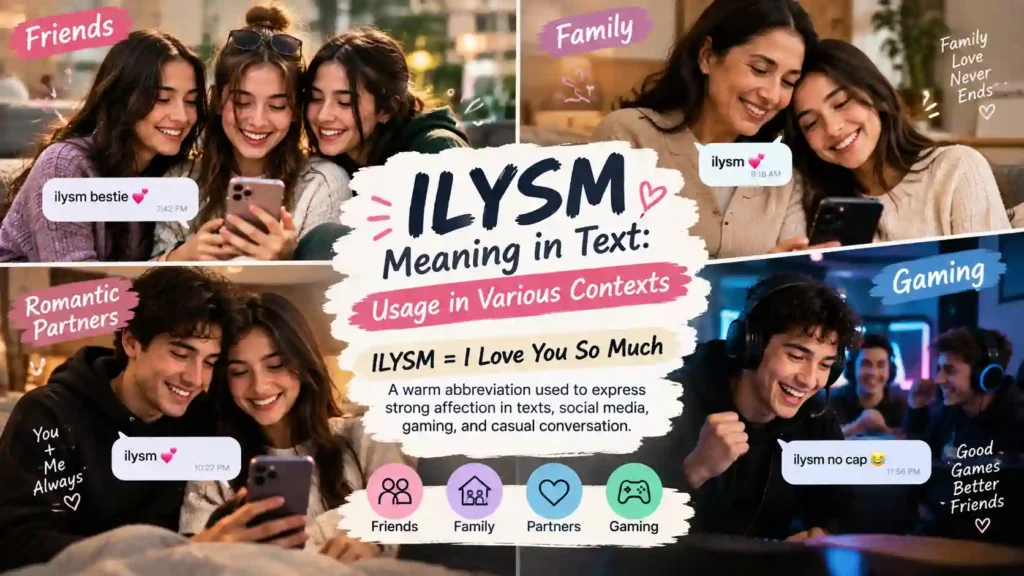
In texting, ILYSM often appears as a warm sign-off or spontaneous message:
Jess: thank you for helping me today
Ryan: anytime, ilysm
On social media, it’s common in comments and captions:
Comment: “ilysm happy birthday queen 👑”
In gaming, close friends sometimes use it jokingly after a good match or funny moment:
Player1: carried that whole game
Player2: ilysm no cap 😂
In casual conversation, people sometimes say it out loud, spelling the letters or saying “I love you so much” directly after texting it, blending spoken and written affection.
Across all contexts, ILYSM signals genuine warmth though tone (and emojis) often show whether it’s deeply sincere or lightly affectionate.
Common Misconceptions About ILYSM Meaning in Text
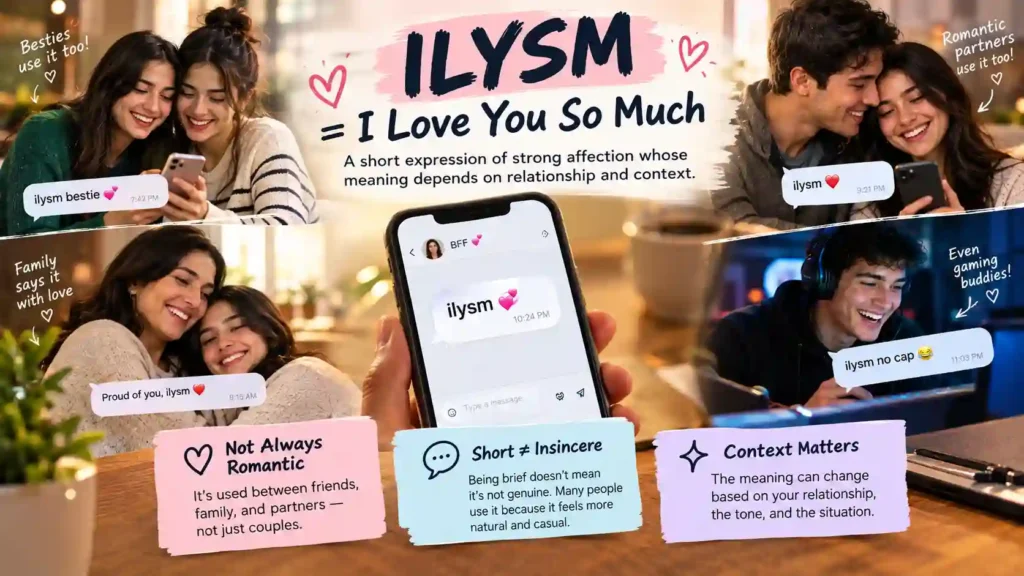
Misconception 1: ILYSM is always romantic. Not true. It’s used just as often maybe more between friends and family members. Context, not the abbreviation itself, determines the type of love being expressed.
Misconception 2: It’s insincere because it’s short. Brevity doesn’t equal lack of feeling. Many people use ILYSM specifically because typing the full phrase feels too formal or intense for a quick text.
Misconception 3: Using it means something more serious than intended. In casual friend groups, ILYSM can simply mean “I appreciate you” rather than a deep declaration. Overthinking it can create unnecessary awkwardness.
Is it ever inappropriate? It’s rarely offensive, but it can feel too intense too soon in a new romantic relationship or professional setting. Sending “ilysm” to someone you just started dating, or to a coworker, can come across as overly familiar or confusing.
Similar Terms & Alternatives to ILYSM Meaning in Text
| Term | Meaning | Typical Use |
| ILY | I Love You | Simple, common baseline |
| ILYSM | I Love You So Much | Stronger emphasis |
| ILYSFM | I Love You So Freaking Much | Even more intense, playful |
| ILU | I Love You | Older, less common variant |
| Love you lots | I love you a lot | Spelled-out alternative |
| TYSM | Thank You So Much | Different meaning, often paired with ILYSM |
Each variant adjusts intensity ILY is casual and quick, ILYSM adds emphasis, and ILYSFM (or similar longer versions) pushes it further, often used humorously among close friends.
How to Respond When Someone Uses ILYSM in Text
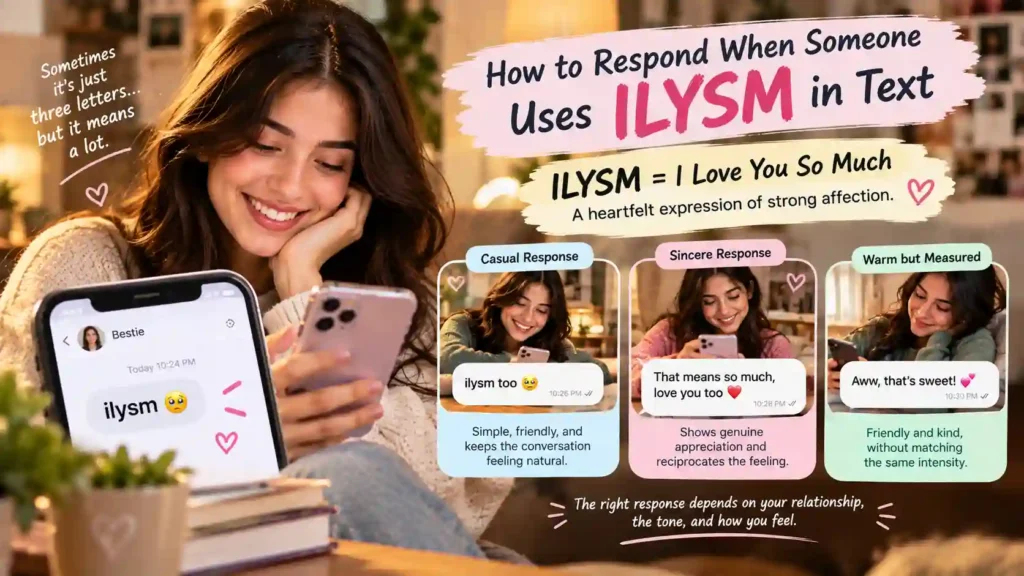
Casual:
“ilysm too 🥹”
Funny:
“ilysm… now venmo me back tho 💀”
Sincere:
“that means so much, love you too”
If it feels unexpected or too soon (new relationship):
“aww that’s sweet!” warm but doesn’t mirror the same intensity, keeping things comfortable.
Professional/privacy-conscious setting:
If a coworker or acquaintance says it jokingly, a simple “haha, love the energy!” keeps things light without escalating the tone.
Regional & Cultural Differences in ILYSM Meaning in Text
ILYSM is primarily an English-language texting term, popular across the United States, United Kingdom, Canada, Australia, and increasingly worldwide through social media exposure.
It doesn’t have strong regional slang variations in English-speaking countries it’s fairly universal in meaning. However, non-English-speaking cultures typically use their own direct equivalents rather than adopting the English abbreviation, such as:
- Spanish: “te amo mucho” (or informally “tqm”)
- French: “je t’aime tellement”
- Urdu/Hindi: “mujhe tum se bohat pyar hai,” sometimes typed casually as “ILU” in mixed-language texting among younger users
Because English slang spreads heavily through TikTok and Instagram, younger, internet-active users in non-English-speaking countries including Pakistan often mix ILYSM into local-language conversations casually.
ILYSM Meaning in Text vs. Similar Terms (Comparison)
| Term | Intensity | Common Relationship | Platform |
| ILY | Mild | Friends, family, partners | Universal |
| ILYSM | Strong | Friends, family, partners | Texting, Instagram, Snapchat |
| ILYSFM | Very strong | Close friends, partners | Texting, casual chat |
| Love you lots | Strong, spelled out | Family, partners | Texting, cards |
The key difference is intensity level, not meaning all these terms express love, just with varying degrees of emphasis.
ILYSM Meaning in Text: Online Communities & Dating Apps
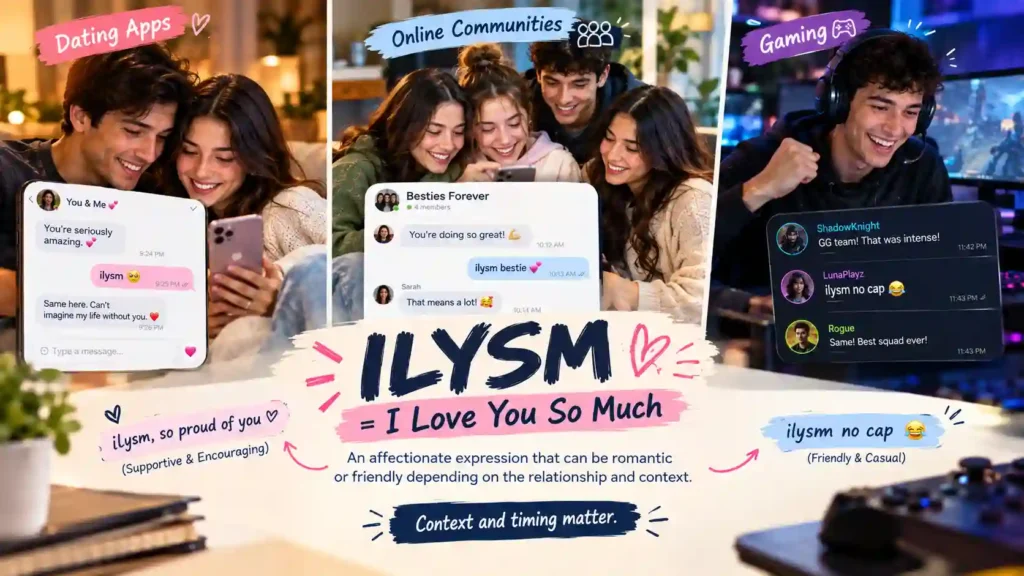
On Tinder and dating apps, ILYSM rarely appears early in conversations using it too soon can feel overwhelming or insincere. It typically shows up much later, once a real emotional connection has formed.
On Twitter/X, ILYSM often appears in replies celebrating someone’s achievement, birthday, or supportive post: “ilysm, so proud of you.”
In gaming communities (Discord, Twitch chat), it’s used casually and often jokingly among close online friends after a fun session or kind gesture.
Tips for responding appropriately:
- On dating apps, don’t panic if someone uses it early gauge whether it’s genuine or just enthusiastic texting style.
- In gaming or online friend groups, treat it as friendly appreciation, not a serious declaration.
- If unsure of someone’s intent, a warm but measured response keeps things comfortable.
Hidden or Offensive Meanings of ILYSM in Text
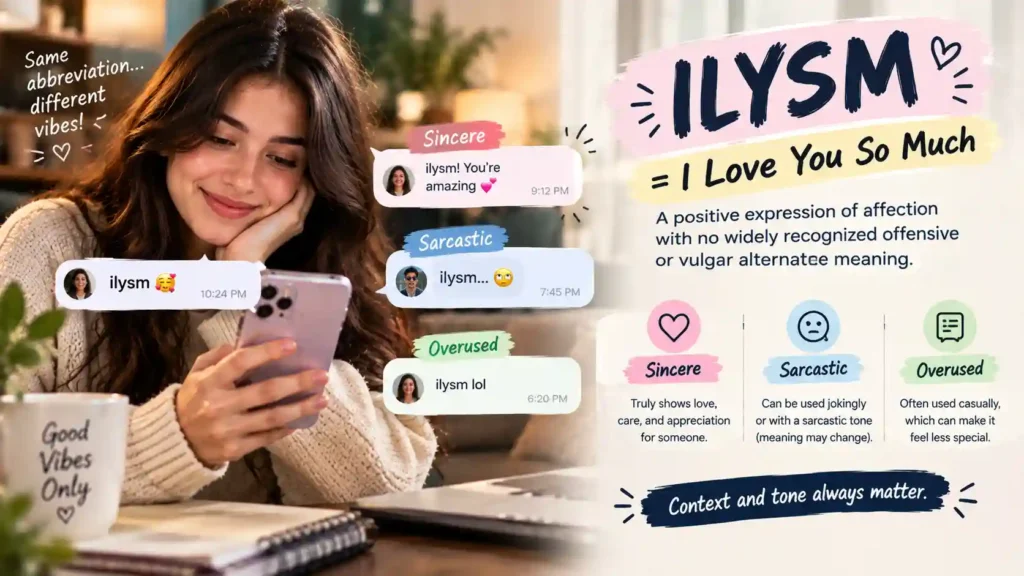
ILYSM doesn’t carry any offensive or vulgar alternate meaning. It’s a straightforward, positive expression of affection.
That said, tone and context still matter:
- Sarcasm can flip its meaning: “wow ilysm for that” after someone does something annoying is clearly ironic.
- Overuse can dilute sincerity using it in every message may make it feel automatic rather than heartfelt.
- Mismatched context (using it with someone you barely know) can feel confusing or overly familiar rather than offensive.
There’s no hidden negative meaning the biggest risk is timing and appropriateness, not offense.
Is ILYSM Meaning in Text Suitable for Professional Use?
ILYSM is not appropriate for professional communication. It’s an intimate, casual expression meant for close personal relationships, and using it in a work email or client message would feel out of place.
Professional alternatives:
| Instead of… | Use… |
| “ilysm” | “I really appreciate you” |
| “ilysm for this” | “thank you so much for this” |
| “ilysm bestie” | “thanks so much, this means a lot” |
If a coworker sends it playfully in an informal team chat, it’s fine to respond warmly without adopting the same phrasing yourself.
FAQs
1. What does ILYSM stand for?
“I Love You So Much.”
2. Is ILYSM only used romantically?
No, it’s commonly used between friends and family too.
3. What’s the difference between ILY and ILYSM?
ILYSM carries more emphasis and emotional intensity than the simpler ILY.
4. Is it okay to send ILYSM to a new partner early on?
It can feel too intense too soon; it’s more common once a relationship is established.
5. Can ILYSM be used sarcastically?
Yes, tone and context can flip it into a joking or ironic statement.
6. Should I use ILYSM in a work message?
No, it’s too casual and personal for professional settings.
7. Is ILYSM used outside English-speaking countries?
Yes, especially among younger, internet-active users who mix English slang into their own language.
Conclusion
ILYSM simply means “I love you so much,” a warm, common way to express strong affection quickly in texts, social media, and casual conversation. It’s used across friendships, family relationships, and romantic partnerships, with intensity that sits above a simple “ily.”
While it’s rarely offensive, it’s best kept out of professional communication and used thoughtfully in new relationships. Understanding it helps you read emotional tone accurately and respond in a way that matches the moment.
Discover More Article

Hi, I’m Mahgull, a dedicated content writer with 2 years of experience in the meaning niche. I enjoy turning complex words, slang, abbreviations, and phrases into simple, informative content that helps readers understand their meanings clearly and quickly.
2 thoughts on “ILYSM Meaning in Text: What It Really Means and How to Use It<p class="post-updated-date">🕓 <span class="updated-label">Last updated on</span> <time datetime="2026-09-23T13:57:29+00:00">September 23, 2026</time></p><script type="application/ld+json"> { "@context": "https://schema.org", "@type": "BlogPosting", "mainEntityOfPage": { "@type": "WebPage", "@id": "https://outreachnexa.com/ilysm-meaning-in-text/" }, "datePublished": "2026-09-22T14:06:26+00:00", "dateModified": "2026-09-23T13:57:29+00:00" } </script>”