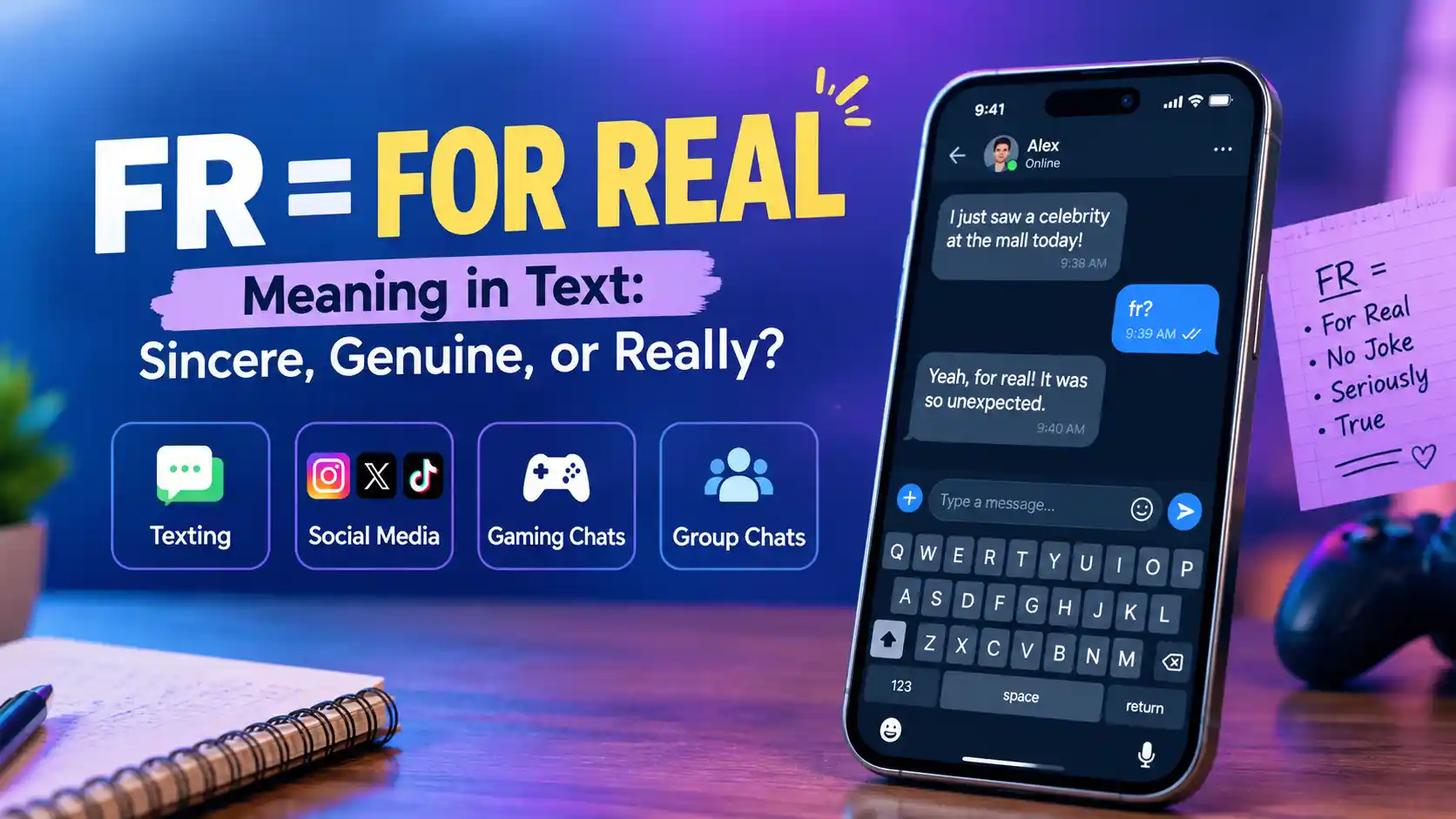
You’re texting a friend about something wild that happened, and they reply with “fr?” Just two letters, but they carry a lot of weight. What does it mean?
“FR” stands for “For Real.” It’s used to confirm something is genuinely true, or to ask if someone is being serious. You’ll see it everywhere, in texting, social media comments, gaming chats, and casual conversations, especially when someone wants to emphasize sincerity or check if a statement is accurate.
Understanding “fr” matters because it’s one of the most common pieces of modern texting shorthand. Knowing how and when people use it helps you read emotional tone correctly and respond naturally, without confusion. This guide breaks down everything about “fr” its meaning, history, and how it’s used across texting and social platforms today.
FR Meaning in Text: Definition & Explanation
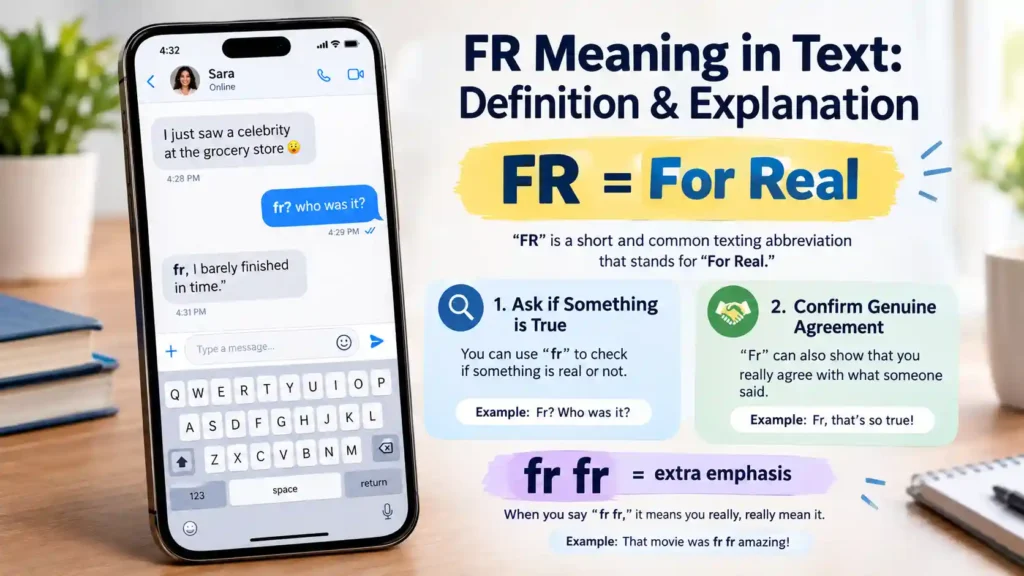
“FR” stands for “For Real.” It’s used to emphasize that something is true, genuine, or sincere, or to ask someone if they’re being serious about what they just said.
Example in dialogue:
Friend: I just saw a celebrity at the grocery store
You: fr? who was it?
Here, “fr” works as a quick way to ask if the statement is actually true.
It’s also used to add emphasis to your own statement:
Friend: this exam was so hard
You: fr, I barely finished in time
In this case, “fr” confirms genuine agreement, similar to saying “seriously” or “no joke.”
Sometimes people double it up for extra emphasis:
Friend: this is the best pizza I’ve ever had
You: fr fr, no cap
Across these examples, “fr” functions as a way to stress sincerity, whether confirming your own statement or questioning someone else’s.
Background & History of FR Meaning
The phrase “for real” has been part of casual spoken English for decades, used to express sincerity or confirm truthfulness in everyday conversation. It became especially popular in African American Vernacular English (AAVE) and hip-hop culture throughout the late 20th century, where it was commonly used to emphasize honesty or ask for confirmation.
As texting became widespread in the 2000s, “for real” naturally shortened to “fr,” fitting the broader trend of abbreviating common phrases to save time and keystrokes. Social media and texting culture helped spread this abbreviation even further, especially as platforms like Twitter and Instagram popularized short, punchy reactions.
By the 2010s and into the 2020s, “fr” became a staple of internet slang, often paired with other popular terms like “no cap” (no lie) to form phrases like “fr fr no cap,” emphasizing maximum sincerity. This combination became especially popular among younger users on TikTok and other social media platforms.
Today, “fr” appears constantly in:
- Casual texting confirming or questioning statements
- Social media comments expressing genuine agreement
- Gaming chats reacting to impressive or surprising moments
- Group chats emphasizing sincerity in everyday conversation
While rooted in spoken language with deep cultural history, “fr” has become one of the most universally recognized abbreviations in modern digital communication.
FR Meaning in Text: Usage in Various Contexts
The term “fr” shows up across many types of digital conversations.
In Texting
Friend: I think I failed that test
You: fr? I thought you studied a lot
In Social Media Comments
Under a post about a surprising event, someone might comment: “fr this is amazing”
In Gaming Communities
Teammate: that was the best clutch I’ve ever seen
You: fr, that was incredible
In Casual Group Chats
Friend 1: traffic today was unbearable
Friend 2: fr, took me an hour longer than usual
In each case, “fr” adds emphasis and sincerity, helping the reader understand the statement is genuine, not exaggerated or joking.
Common Misconceptions & Clarifications
One common misconception is that “fr” always asks a question. In reality, it’s just as often used to confirm or agree with a statement.
Misconception 1: It’s always a question.
Not true. While “fr?” can ask if something is true, “fr” without a question mark often simply agrees with or emphasizes a statement.
Misconception 2: It’s only used by younger generations.
Not entirely accurate. While especially popular among younger texters, “fr” has become widely recognized and used across many age groups in casual digital communication.
Misconception 3: It’s interchangeable with “really” in every context.
Mostly true, though “fr” often carries a slightly stronger emphasis on sincerity, especially in casual or emotionally charged conversations.
Clarification: The meaning of “fr” depends on punctuation and context. With a question mark, it asks for confirmation. Without one, it typically agrees with or emphasizes what was just said.
Similar Terms & Alternatives
Several related terms carry similar meanings to “fr.” Here’s how they compare:
| Term | Meaning | Tone |
| Fr | “For real” | Sincere, emphatic |
| No cap | “No lie” | Sincere, emphatic |
| Fr fr | “For real, for real” (extra emphasis) | Very sincere |
| Deadass | “Seriously” | Sincere, blunt |
| Ngl | “Not gonna lie” | Honest, direct |
While these terms overlap, “fr” stands out as one of the most versatile and widely recognized sincerity markers, often combined with other terms like “no cap” for even stronger emphasis.
How to Respond to This Term
If someone texts you “fr,” your response should match the sincerity and tone of the conversation.
Casual Response
“yeah fr, it was wild”
Playful/Funny Response
“fr fr, I couldn’t believe it either lol”
Professional Response (in relaxed workplace chats)
“Yes, that’s accurate, it really happened.”
Privacy-Conscious Response (if you’d rather not elaborate)
“Yeah, for real, long story though”
Since “fr” is meant to confirm sincerity, most responses can stay genuine and straightforward, matching its emphatic tone.
Regional or Cultural Differences
“FR” has roots in African American Vernacular English (AAVE) and has since spread into mainstream English-speaking internet culture worldwide.
- United States: Extremely common across all casual texting and social media, with deep cultural roots in hip-hop and AAVE.
- United Kingdom: Widely used as well, especially among younger texters influenced by American internet culture.
- Australia and Canada: Common in casual texting, following similar patterns as the U.S.
- Non-English-speaking regions: Often adopted directly into local internet slang, since “fr” has become a globally recognized piece of English-language texting culture through social media.
While “fr” has specific cultural origins, its meaning and usage remain fairly consistent across most English-speaking regions today, especially online.
Comparison with Similar Terms
To clarify how “fr” differs from related expressions:
| Expression | Primary Use | Can Stand Alone? | Common Platform |
| Fr | Confirming sincerity or asking for truth | Yes | Texting, social media |
| No cap | Confirming no exaggeration | Yes | Texting, social media |
| Deadass | Blunt confirmation | Yes | Texting |
| Ngl | Honest admission | Rarely | Texting, social media |
The key difference is that “fr” works both as a standalone confirmation and a question, making it more flexible than terms like “ngl,” which almost always leads into a statement rather than standing alone.
Usage in Online Communities & Dating Apps
On dating apps like Tinder, Bumble, or Hinge, “fr” often appears in casual, genuine exchanges to express sincerity.
Example:
Match: I actually love hiking too
You: fr? that’s awesome, we should go sometime
On Twitter/X, “fr” is extremely common in replies expressing genuine agreement or shock about relatable or surprising content.
In gaming communities, it’s frequently used to react to impressive plays or confirm surprising in-game moments.
Tips for responding appropriately:
- On dating apps, use “fr” to show genuine interest and sincerity in the conversation.
- In social media replies, it works well for authentic reactions to relatable or surprising posts.
- In gaming chats, it’s a quick way to express genuine excitement or disbelief.
Hidden or Offensive Meanings
“FR” carries no hidden or offensive meaning in its common usage. It’s a straightforward way to express sincerity or ask for confirmation.
The only consideration is its cultural origin in AAVE, meaning the term carries cultural significance and history. Using it respectfully, without mocking or exaggerating its use in ways that stereotype the culture it originated from, matters for thoughtful communication.
Why tone and context matter: Since “fr” is inherently sincere, there’s little risk of misinterpretation in casual use. Its biggest consideration is respecting its cultural roots rather than any inherent negative meaning.
Suitability for Professional Communication
“FR” is generally too casual for formal professional communication, such as client emails or official business messages. However, it may occasionally appear in relaxed internal workplace chats among close colleagues.
Professional alternatives:
- “That’s accurate.”
- “Seriously, that’s true.”
- “I can confirm that.”
- “Genuinely, that happened.”
If communicating in a formal setting, it’s best to use complete phrases rather than casual texting shorthand like “fr.”
FAQs
1. What does “fr” mean in texting?
It stands for “for real,” used to confirm sincerity or ask if something is true.
2. Is “fr” always a question?
No, it can also be a statement confirming agreement or sincerity, depending on punctuation and context.
3. Where did “fr” come from?
It developed from the phrase “for real,” with roots in African American Vernacular English (AAVE) and hip-hop culture.
4. Is “fr” appropriate for professional settings?
No, it’s better suited for casual conversations rather than formal communication.
5. What does “fr fr” mean?
It’s an emphasized version of “fr,” meaning “for real, for real,” used for extra sincerity.
6. Is “fr” used internationally?
Yes, it’s widely recognized across English-speaking countries and has spread globally through social media.
7. Can “fr” be used sarcastically?
Rarely. It’s generally a sincere expression, though tone and context can occasionally add a layer of sarcasm.
Conclusion
“FR” stands for “for real,” a widely used texting abbreviation that confirms sincerity or asks if something is true. It reflects how digital communication often emphasizes genuine, authentic reactions in a quick, efficient way.
Understanding “fr” helps you read emotional tone correctly and respond naturally, whether you’re confirming your own statement or checking if someone else is being serious. Its deep cultural roots and widespread modern usage make it one of the most recognizable pieces of texting shorthand today.
Discover More Article

Hi, I’m Mahgull, a dedicated content writer with 2 years of experience in the meaning niche. I enjoy turning complex words, slang, abbreviations, and phrases into simple, informative content that helps readers understand their meanings clearly and quickly.

1 thought on ““FR” Decoded: Meaning, Origin, and How to Use It (2026)<p class="post-updated-date">🕓 <span class="updated-label">Last updated on</span> <time datetime="2026-10-09T16:01:11+00:00">October 9, 2026</time></p><script type="application/ld+json"> { "@context": "https://schema.org", "@type": "BlogPosting", "mainEntityOfPage": { "@type": "WebPage", "@id": "https://outreachnexa.com/fr-in-text-meaning/" }, "datePublished": "2026-10-09T16:01:09+00:00", "dateModified": "2026-10-09T16:01:11+00:00" } </script>”