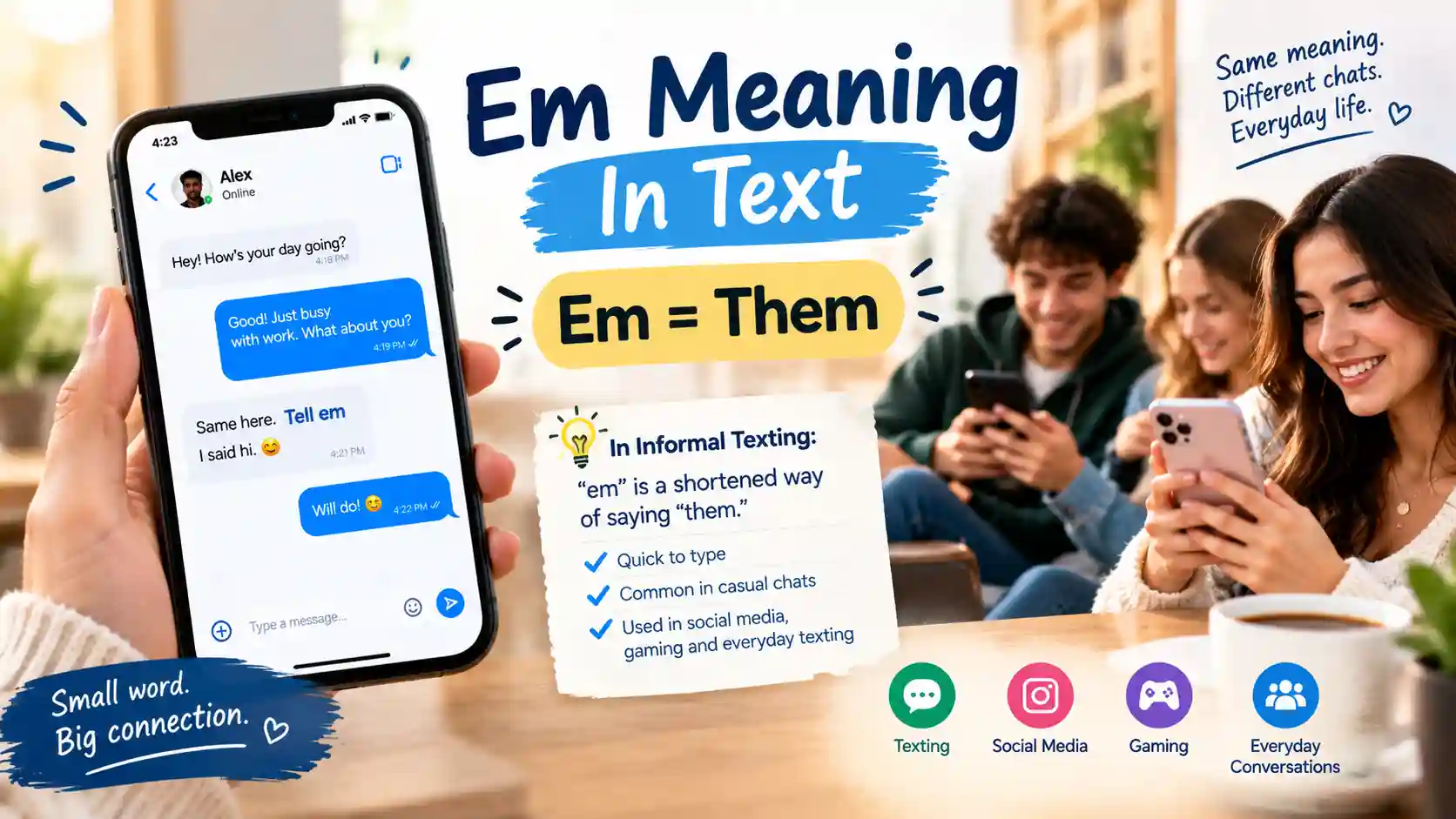
You’re texting a friend about weekend plans, and they reply: “just tell em where to meet.” No, that’s not a typo. “Em” is a common shorthand for “them,” used constantly in texting, social media, and casual speech.
It’s small, quick, and easy to miss if you’re not used to it. But once you notice it, you’ll see it everywhere in texts, tweets, gaming chats, and everyday conversation.
“Em” isn’t new slang either. It’s actually been around for centuries, tucked into casual English long before smartphones existed. Today, it just gets typed instead of spoken.
Understanding “em” matters because it shows up so naturally that people rarely explain it. Knowing what it means, where it came from, and when to use it helps you read texts correctly and write your own messages with the right tone.
Let’s break it down.
Definition & Meaning
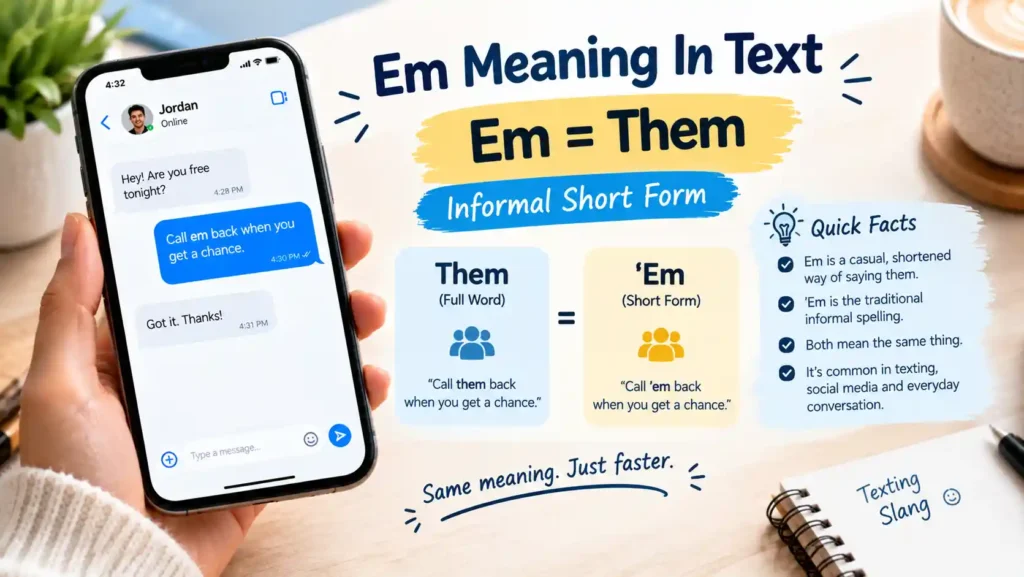
“Em” is an informal, shortened way of writing “them.” It’s typically written as ’em, with an apostrophe standing in for the missing “th” sound, though in casual texting the apostrophe often gets dropped entirely.
Examples:
“Call em back when you get a chance.”
“I saw em at the party last night.”
“Tell em I said hi.”
In every case, “em” simply replaces “them.” It doesn’t change the meaning of the sentence at all it just makes it faster and more casual to type or say.
Real-life examples of usage:
- “Where’s my keys? Did you move em?”
- “Grab those chips and bring em over here.”
- “I texted em an hour ago, still no reply.”
- “The twins are asleep, don’t wake em up.”
You’ll also see “em” used less commonly in a few other, unrelated ways, and it helps to know these exist so you don’t mix them up:
- Em dash ( ): a punctuation mark used to show a pause or break in a sentence.
- EM: an abbreviation for “electromagnetic” in science and engineering.
- <em> tag: an HTML tag used to italicize or emphasize text on websites.
But in day-to-day texting and social media, “em” overwhelmingly means “them.” The other meanings almost never come up in casual conversation, so context makes it easy to tell them apart.
Background & History
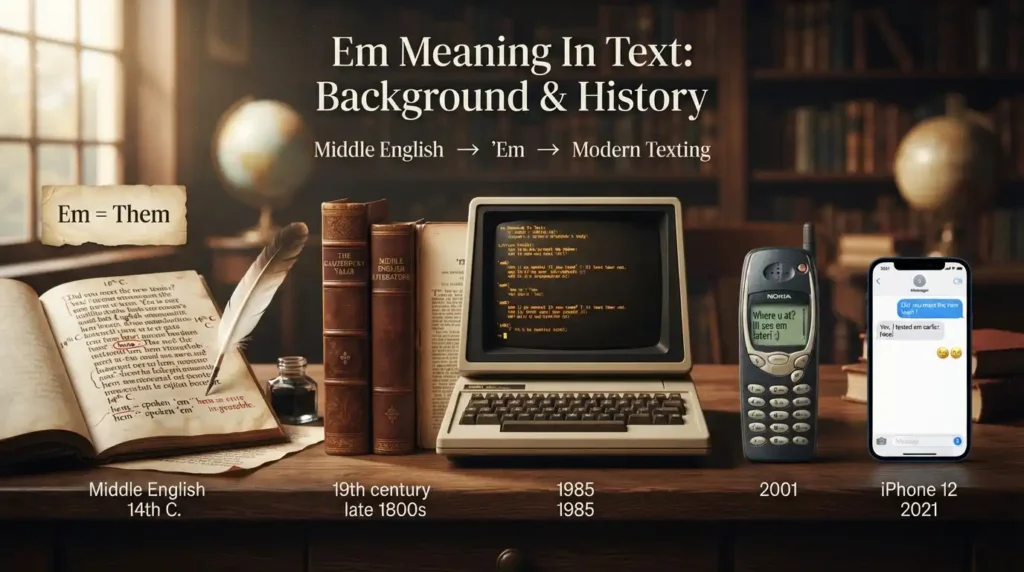
Unlike most texting slang, “’em” isn’t a modern invention. It actually goes back hundreds of years in English.
Linguists trace it to Middle English “hem,” an old form of “them” that survived in casual speech long after “them” became the standard written word. Over time, “hem” shortened further into “’em,” with the apostrophe marking the dropped letters.
For centuries, “’em” lived mainly in spoken English used in conversation, plays, and informal writing, but avoided in formal documents. It sounded relaxed and natural, the same way people today say “gonna” instead of “going to.”
When texting and instant messaging became popular in the 2000s, “’em” moved naturally from speech into text. People already said it out loud, so typing it the same way felt effortless.
As phone keyboards and texting habits evolved, many people dropped the apostrophe entirely, turning “’em” into a plain “em.” This mirrors a broader texting trend: apostrophes disappear when they don’t affect how easily a message is understood.
Today, “em” is common across texting, social media captions, gaming chat, and casual writing. It’s rarely used in formal writing, but almost everyone recognizes it instantly in an informal message.
Usage in Various Contexts
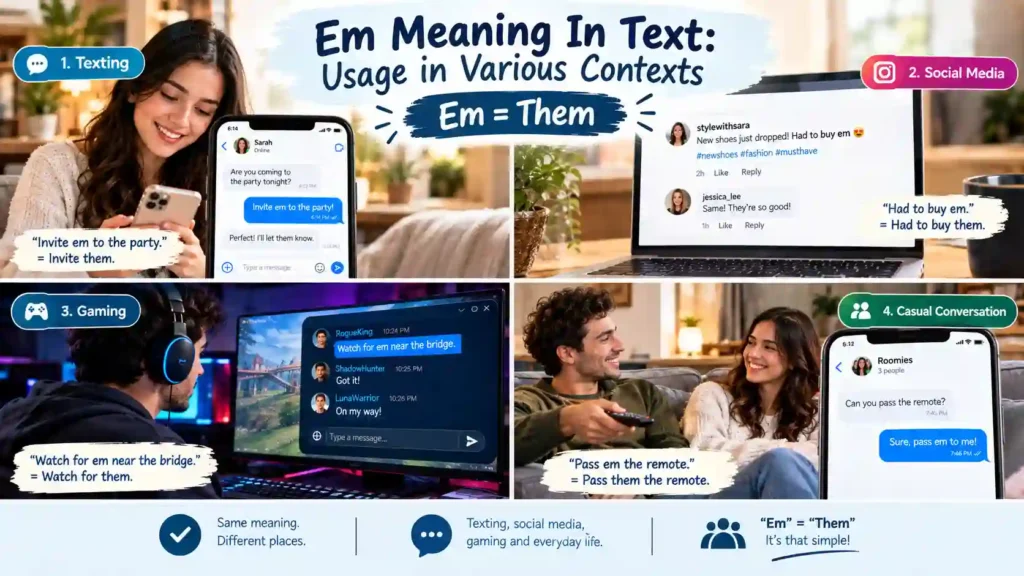
In Texting
This is the most common place you’ll see “em.”
Friend 1: “Should I invite the neighbors?”
Friend 2: “yeah invite em, more the merrier”
On Social Media
“Em” pops up constantly in captions, comments, and quick replies.
“New shoes just dropped, had to cop em immediately”
“saw them memes, they’re sending me 😭”
In Gaming
Gamers use “em” to talk about opponents, items, or teammates quickly during fast-paced matches.
“enemies are near the bridge, watch for em”
“grab the loot and bring em to base”
In Casual Conversation (spoken and written)
“Em” often shows up when giving quick instructions or reacting to something.
“Just leave em alone, they’ll figure it out.”
“Pass em the remote, would you?”
In Professional or Formal Writing
You won’t typically see “em” here. Professional writing sticks with the full word “them.”
Across all these contexts, “em” works the same way every time it’s simply a faster, more relaxed way to say “them.”
Common Misconceptions & Clarifications
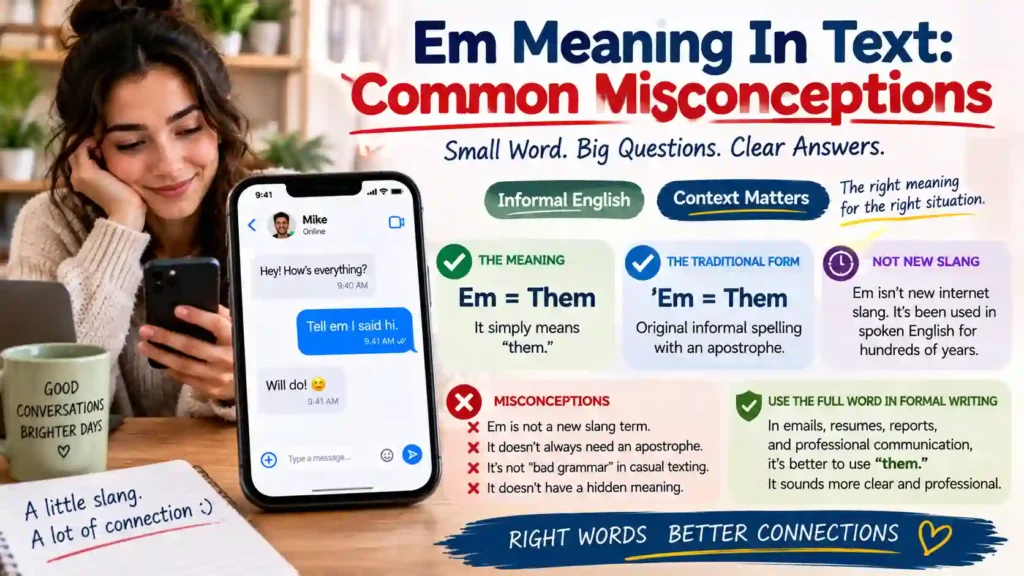
Misconception 1: “Em” is new internet slang.
Not true. As covered above, “’em” predates texting by centuries. Texting just made it more visible in writing.
Misconception 2: “Em” always needs an apostrophe.
Historically, yes ’em is the “correct” informal spelling, since it marks dropped letters. But in modern texting, people frequently skip the apostrophe and just write em. Both are understood the same way.
Misconception 3: “Em” is bad grammar.
In casual conversation, it’s not really “incorrect” it’s a long-standing informal contraction, much like “gonna” or “kinda.” It becomes a problem only in formal writing, where “them” should always be spelled out fully.
Misconception 4: “Em” always means “them.”
Almost always in casual texting, yes. But remember the exceptions: em dash, EM (electromagnetic), and the HTML <em> tag. Context makes the difference obvious. If someone’s talking about people or objects, “em” means “them.” If they’re talking about punctuation, science, or code, it means something else entirely.
Can “em” cause confusion?
Rarely. Since it always sits inside a full sentence, the meaning is almost always clear from context. Confusion is more likely for someone unfamiliar with the abbreviation, especially non-native English speakers seeing it for the first time.
Similar Terms & Alternatives
Several other words and shortcuts serve a similar purpose to “em.”
| Term | Meaning | Common Setting |
| Em / ‘Em | Informal short form of “them” | Texting, casual speech |
| Them | Full, grammatically correct form | Formal and informal writing |
| Ppl | Short for “people” | Texting |
| U | Short for “you” | Texting |
| Dem | Slang/dialect variant of “them” | Regional dialects, casual speech |
A few notes on these alternatives:
- “Dem” functions almost identically to “em” in some dialects and regional speech patterns, though it more directly mimics pronunciation (“dem guys” = “them guys”).
- “Ppl” and “U” aren’t related in meaning but belong to the same broader texting habit of shortening common words.
- None of these fully replace “em” it has its own specific, longstanding role as shorthand for “them.”
How to Respond to This Term
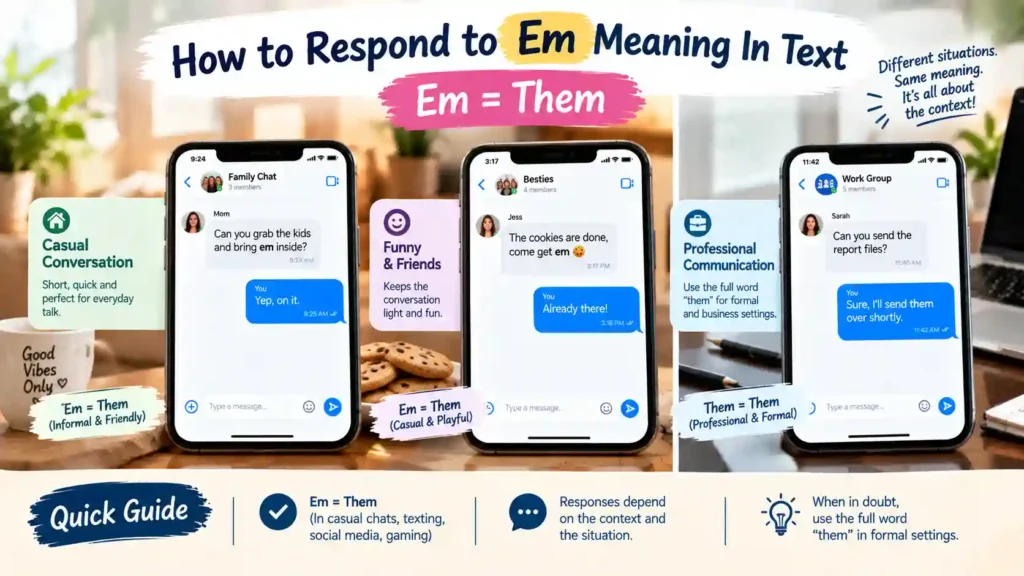
Responding to “em” is simple, since it just means “them.” The tone of your reply depends on the conversation, not the word itself.
Casual response:
Them: “Can you grab the kids and bring em inside?”
You: “yep, on it”
Funny response:
Them: “The cookies are done, come get em”
You: “already there, don’t test me”
Professional response:
If a coworker slips into casual phrasing like “send em over,” it’s fine to reply naturally, though you’d typically use the full word in your own reply.
Them: “Can you forward em when you get the files?”
You: “Sure, I’ll send them over shortly.”
Privacy-conscious response:
If “em” refers to people you don’t want to discuss, it’s okay to redirect.
Them: “What’d you tell em about the plan?”
You: “I’d rather not get into details right now.”
General tip: You almost never need to comment on “em” itself. Just respond to the meaning of the sentence, the same way you would if “them” were spelled out.
Regional or Cultural Differences
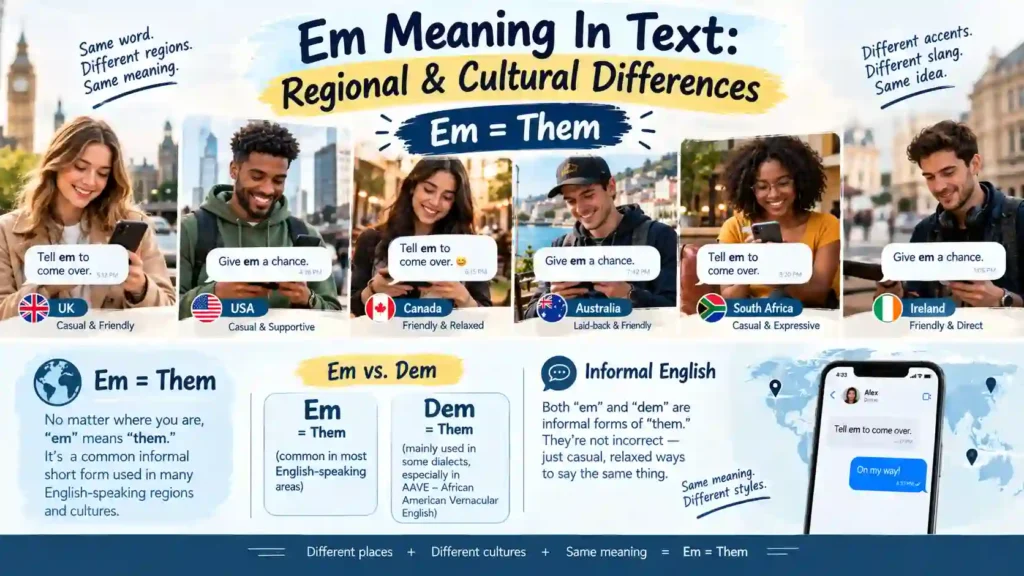
“‘Em” is a feature of informal English specifically, and it doesn’t have a direct equivalent shortcut in most other languages, since it comes from the historical evolution of the English word “them.”
That said, the habit of shortening common pronouns exists in many languages and dialects, even if the specific letters differ.
Within English, there are some regional flavors worth noting:
- American English uses “em” heavily in casual texting and speech across most regions.
- British English also uses “’em” frequently, often in phrases like “give ’em a chance” or “tell ’em off.”
- African American Vernacular English (AAVE) and Southern U.S. dialects often favor “dem” in similar contexts, reflecting different pronunciation patterns.
- Caribbean English dialects also use “dem” as a natural variant, sometimes even functioning as a plural marker rather than just replacing “them.”
Despite these regional flavors, the core meaning stays consistent everywhere English is spoken: it always points back to “them.”
Comparison with Similar Terms
| Term | Full Meaning | Formality | Typical Use |
| Em / ‘Em | Them | Very informal | Texting, casual speech |
| Them | Them | Neutral to formal | All writing |
| Dem | Them (dialect variant) | Very informal | Regional dialects, casual speech |
| Ppl | People | Informal | Texting |
Key differences:
- “Em” is purely a contraction it doesn’t add new meaning, just shortens an existing word.
- “Dem” carries dialect and regional identity along with the shortened spelling.
- “Them” is the only version appropriate for formal or professional writing.
Usage in Online Communities & Dating Apps
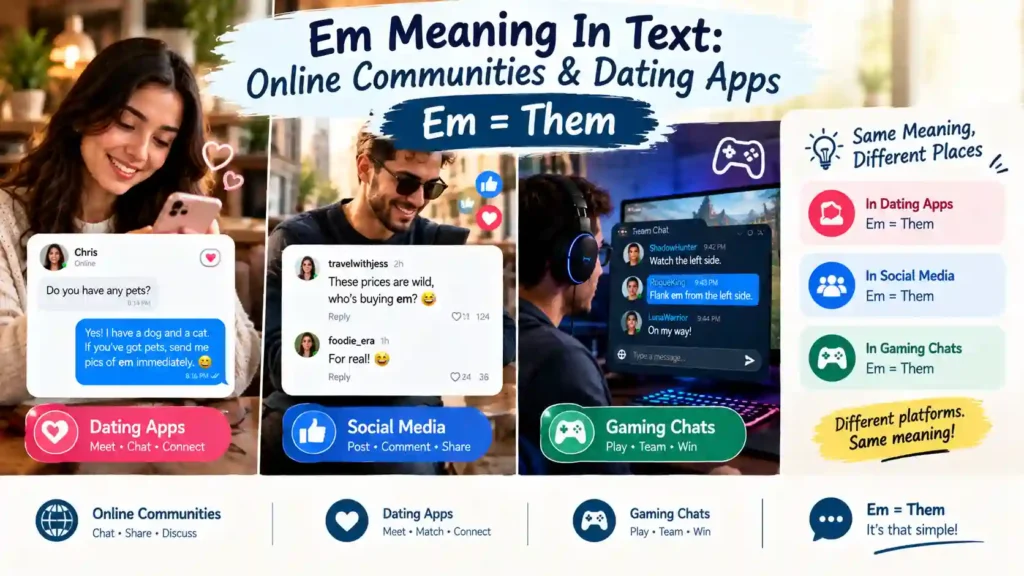
On dating apps like Tinder or Bumble, “em” shows up in the same casual way it does in regular texting.
“If you’ve got pets, send me pics of em immediately”
“My friends are wild, wait till you meet em”
It’s not a dating-specific term it’s just part of how people write casually across the app.
On Twitter/X, “em” appears constantly in quick, informal posts.
“these prices are wild, who’s buying em at that rate”
In gaming communities and Discord servers, “em” often refers to enemies, items, or teammates during fast conversations.
“flank em from the left side”
Tips for responding appropriately:
- On dating apps, respond to the meaning naturally there’s no special etiquette tied to “em” itself.
- In gaming chats, keep pace with short, quick replies rather than full sentences.
- If “em” refers to people in a sensitive context (like an ex or a conflict), respond thoughtfully rather than reflexively.
Hidden or Offensive Meanings
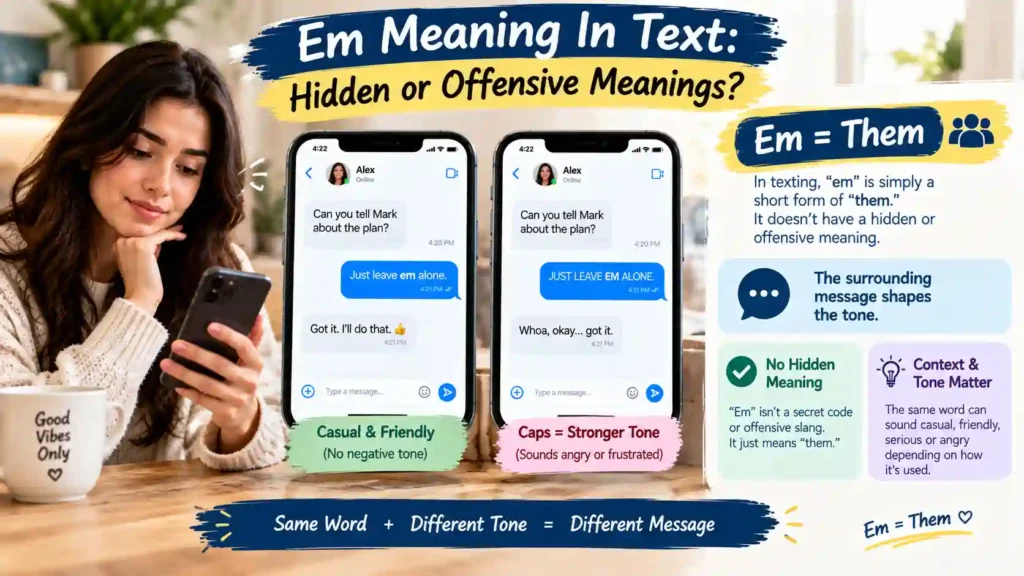
“Em” does not have a hidden or offensive meaning when used as shorthand for “them.” It’s neutral and widely accepted in casual English.
There’s no coded slang definition behind it, unlike some abbreviations that carry double meanings depending on context.
Why tone still matters:
While “em” itself is harmless, the sentence around it can carry different emotional weight.
“just leave em alone” (neutral, practical)
“just LEAVE EM ALONE” (capital letters suggest frustration or anger)
As with most short texting words, the punctuation, capitalization, and surrounding words shape the tone far more than “em” does on its own.
Suitability for Professional Communication
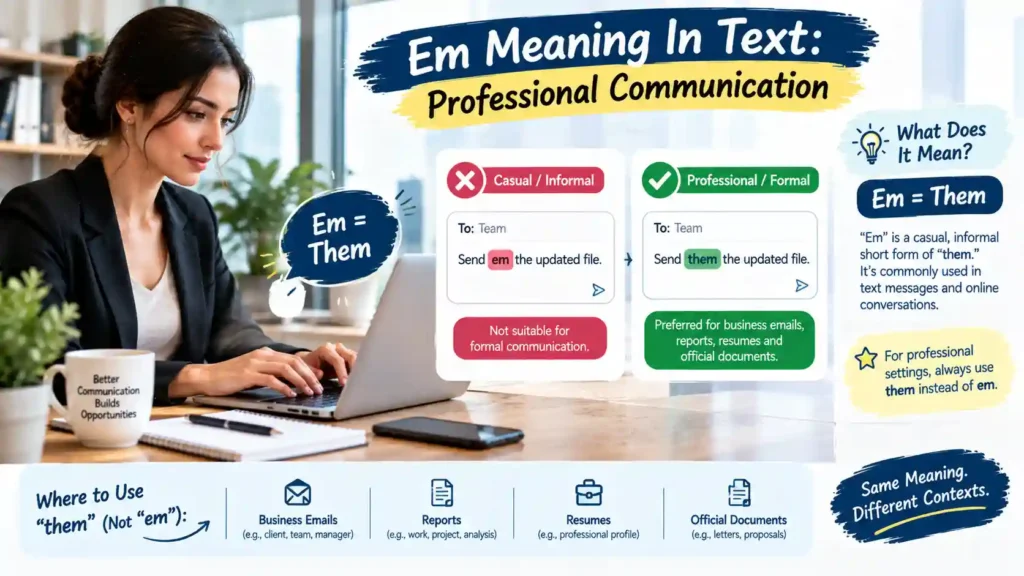
“Em” is not appropriate in professional or formal writing. This includes:
- Business emails
- Reports and official documents
- Cover letters and resumes
Professional alternative: Always use the full word “them.”
Instead of: “Send em the updated file when ready.”
Use: “Send them the updated file when ready.”
General rule: Save “em” for texting, casual chat, and informal conversation. In any formal context, spell out “them” completely to keep your writing polished and clear.
FAQs
1. What does “em” mean in a text message?It’s an informal short form of “them.”
2. Should I write “em” or “’em” with an apostrophe?Both are used and understood. The apostrophe version (’em) is technically more traditional, but plain “em” is common in modern texting.
3. Is “em” slang, or is it grammatically correct?
It’s an informal contraction, not slang in the modern sense it’s been part of English for centuries, though it’s avoided in formal writing.
4. Can “em” mean something other than “them”?
Rarely, in casual texting. In other contexts, “EM” can refer to “electromagnetic,” an em dash, or an HTML emphasis tag but these are unrelated to texting slang.
5. Is “em” appropriate for work emails?
No. Use the full word “them” in professional writing.
6. Is “dem” the same as “em”?
They’re closely related. “Dem” is a dialect variant that also means “them,” often reflecting regional pronunciation.
7. Does “em” ever sound rude or offensive?
No, the word itself is neutral. Any harsh tone comes from the surrounding message, not from “em” itself.
Conclusion
“Em” is one of the simplest and oldest texting shortcuts around. It’s an informal way of writing “them,” rooted in centuries-old spoken English rather than modern internet slang. Whether you see it in a text, a tweet, or a gaming chat, it almost always means the same thing.
Knowing this helps you read casual messages naturally and know when to switch back to the full, formal word “them” in professional writing.
Small as it is, “em” is a good example of how everyday language quietly carries history most people never think twice about.

Hi, I’m Mahgull, a dedicated content writer with 2 years of experience in the meaning niche. I enjoy turning complex words, slang, abbreviations, and phrases into simple, informative content that helps readers understand their meanings clearly and quickly.
1 thought on ““Em” In Text : Meaning, Uses & Examples (2026)<p class="post-updated-date">🕓 <span class="updated-label">Last updated on</span> <time datetime="2026-09-19T14:14:14+00:00">September 19, 2026</time></p><script type="application/ld+json"> { "@context": "https://schema.org", "@type": "BlogPosting", "mainEntityOfPage": { "@type": "WebPage", "@id": "https://outreachnexa.com/em-meaning-in-text/" }, "datePublished": "2026-09-19T14:14:11+00:00", "dateModified": "2026-09-19T14:14:14+00:00" } </script>”