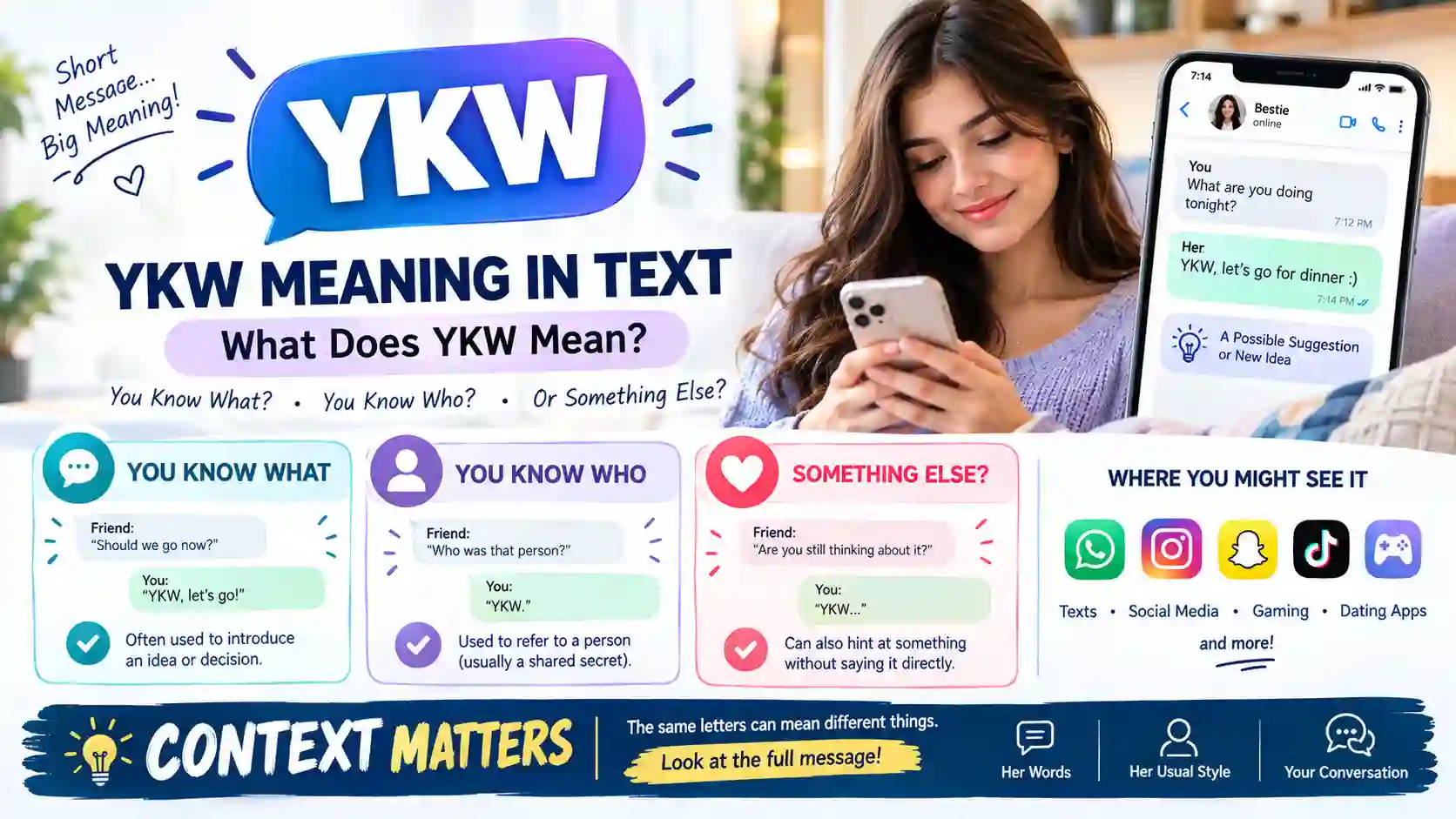
Have you ever received a text that says “YKW” and wondered what the person is trying to tell you? This short abbreviation can look confusing at first. But once you know its meaning, it becomes much easier to understand.
The most common YKW meaning in text is “You Know What.” People use it when they want to share an idea, change their mind, or talk about something they think the other person already understands. In some conversations, YKW can also mean “You Know Who.” The words around it help you find the right meaning.
You may see YKW on WhatsApp, Snapchat, Instagram, TikTok, and other social platforms. Friends may use it to share a secret, make a joke, or start a new thought. It can sound playful, serious, or even a little mysterious.
What Does YKW Mean in Text? Definition and Meaning
YKW most commonly stands for “You Know What.” It is a short form of a common English phrase. People use it in text messages when they want to introduce a thought, share a decision, or refer to something that may already be clear.
For example:
Emma: “Should we order pizza or cook dinner?”
Liam: “YKW, let’s just order pizza.”
Here, Liam uses YKW to introduce an idea. It works like saying, “You know what? Let’s just order pizza.”
The abbreviation makes the message shorter and gives it a natural, spoken feel.
1. YKW Means “You Know What”
This is the main meaning of YKW in texting. It often appears before a suggestion, opinion, or decision.
Example:
Mia: “I don’t think we should go out tonight.”
Sara: “YKW, you’re right. Let’s stay home.”
Sara uses YKW before changing or sharing her opinion.
You may also see it when someone wants to stop arguing or make a quick choice.
Example:
Alex: “We can’t agree on which movie to watch.”
Sam: “YKW? Let’s watch the comedy.”
Here, YKW introduces a new decision.
2. YKW Can Mean “You Know Who”
In some conversations, YKW means “You Know Who.” People use it when they want to refer to a person without saying that person’s name.
This meaning often appears when two people share a secret, an inside joke, or knowledge about someone.
Example:
Ava: “Who was asking about you today?”
Lily: “YKW.”
Ava and Lily may both know who the person is, so Lily does not need to say the name.
Another example:
Friend 1: “Did you see YKW at the party?”
Friend 2: “Yes! I wasn’t expecting that.”
In this case, YKW points to a person they both recognize.
3. YKW Can Refer to Something Left Unsaid
Sometimes, people use YKW when they do not want to explain a topic in full. They may expect the other person to understand the hint.
Example:
Mia: “Are you still thinking about yesterday?”
Noah: “YKW happened. I don’t want to talk about it here.”
The meaning depends on what both people know about the situation.
4. YKW Can Introduce Frustration or a New Decision
The abbreviation itself is not angry. However, the words that follow can show frustration, excitement, or a change of mind.
Example:
Friend: “We have been talking about this for hours.”
You: “YKW, let’s stop and talk tomorrow.”
Here, YKW introduces a decision to end the discussion.
Quick summary:
- YKW = You Know What: Usually introduces a thought, idea, or decision.
- YKW = You Know Who: Sometimes refers to a person whose identity is already known.
- Context matters: The full sentence helps you choose the right meaning.
Background and History of YKW
YKW comes from the English phrase “you know what.” People have used this phrase in everyday speech for a long time. It often appears when someone is about to share an idea, make a decision, or change the subject.
For example, someone might say:
“You know what? I think we should leave early.”
The phrase creates a small pause before the main point. It can show that the speaker has just had an idea or reached a decision.
When people began using text messages and online chat more often, they started shortening common phrases. Instead of typing every word, they used the first letters to make messages faster.
This is how many familiar texting abbreviations became common. For example, IDK means “I don’t know,” BRB means “be right back,” and TBH means “to be honest.”
YKW follows the same pattern. It uses the first letters of “you know what” to create a short form.
How Texting Helped Spread YKW
Early mobile messaging encouraged short replies. People often wanted to type quickly, especially when using phones with small keypads.
Online chat rooms and instant messaging also helped make abbreviations familiar. As texting grew, users began using short forms in everyday conversations, not just when they needed to save space.
YKW fits this style because it keeps a common spoken phrase short while preserving its meaning.
The Role of Social Media
Social media has made it easier for slang and abbreviations to spread between people and communities. Users share short messages, captions, comments, and private chats every day.
YKW can fit naturally into these conversations.
Example:
“YKW, I’m actually proud of myself 😂”
The sender uses the abbreviation to introduce a thought in a casual way.
People may also use YKW to refer to a shared event or person without explaining everything.
Example:
“YKW showed up again today 👀”
Depending on the conversation, this may mean “You know who showed up again today.”
Has the Meaning Changed?
The basic phrase has not changed. What has changed is how people use it in digital conversations.
YKW can now appear as a quick introduction to a thought, a hint about a shared secret, or a reference to a person. Emojis and punctuation can also affect how readers understand the message.
There is no single confirmed date when YKW first appeared in texting. It is best understood as part of the wider growth of online abbreviations.
Where Is YKW Used Today?
You may find YKW in:
- Text messages between friends.
- WhatsApp and other messaging apps.
- Instagram and Snapchat direct messages.
- TikTok comments and captions.
- Gaming chats and online communities.
- Informal conversations about relationships, plans, and daily life.
The key point: YKW grew from a familiar English phrase into a convenient digital abbreviation. Its meaning still depends on the sentence and the people using it.
How YKW Is Used in Different Contexts
YKW can appear in many kinds of online conversations. The meaning often depends on what comes before or after it.
1. YKW in Text Messages
Friends may use YKW when sharing an idea or making a sudden decision.
Example:
Ella: “Should we study together tonight?”
Jack: “YKW, let’s meet at the library instead.”
Jack uses YKW to introduce a suggestion.
2. YKW on WhatsApp
On WhatsApp, YKW may appear in private chats, family groups, and friend groups. It can refer to a known person or introduce a thought.
Example:
Friend: “Who told you about the surprise?”
You: “YKW 😂”
The reply may mean “You know who,” especially if the friend already knows the person involved.
3. YKW on Snapchat
Snapchat conversations often use short, casual messages. YKW can help people share hints or refer to something they have discussed before.
Example:
Mia: “Guess who I saw today?”
Zoe: “YKW?”
Mia: “Exactly 😭”
Here, YKW may point to a person known to both friends.
4. YKW on Instagram and TikTok
On Instagram and TikTok, YKW may appear in direct messages, comments, or captions. It can introduce an opinion or make a post feel more conversational.
Example:
“YKW, that was actually the best part of the video 😂”
The writer uses YKW before sharing an opinion.
5. YKW in Gaming Chats
Gamers often use short forms to keep communication quick. YKW may appear when a player shares an idea or refers to something already known by the team.
Example:
Player 1: “Should we try another route?”
Player 2: “YKW, let’s go through the tunnel.”
Here, YKW introduces a new plan.
The abbreviation is not a special gaming term by itself. Its usual meaning still depends on the conversation.
6. YKW in Friendships and Relationships
Friends and couples may use YKW when talking about shared memories, private jokes, or someone they both know.
Example:
Ava: “I think he likes you.”
Mia: “YKW? I was thinking the same thing 😭”
Here, YKW introduces a thought.
It may also be used to hint at something without saying it directly.
Example:
Friend: “Are you going to tell me what happened?”
You: “You know what I’m talking about 😂”
The surrounding conversation helps explain the reference.
7. YKW in Everyday Conversation
In spoken English, “you know what?” often introduces a decision or a new idea. YKW copies that pattern in writing.
For example:
“You know what? Let’s go tomorrow.”
In a text, this may become:
“YKW, let’s go tomorrow.”
Remember: YKW is flexible, but it is informal. Read the whole message before deciding what the sender means.
Common Misconceptions and Clarifications
YKW is short, so it can be easy to misunderstand. Here are some common mistakes and how to avoid them.
Misconception 1: YKW Always Means “You Know What”
“You Know What” is the most common interpretation in many texting contexts. However, YKW can also mean “You Know Who” when the message refers to a person.
Example:
“YKW is coming to the party.”
If the conversation is about a person, the intended meaning may be “You Know Who is coming to the party.”
The surrounding words help you decide.
Misconception 2: YKW Always Refers to a Secret
Sometimes, YKW is used to hint at something the other person already knows. But it can also introduce a simple idea.
Example:
“YKW, let’s get some ice cream.”
This message does not need a secret meaning. It simply introduces a suggestion.
Misconception 3: YKW Means Someone Is Angry
YKW does not automatically show anger. The tone depends on what follows.
Compare these examples:
“YKW, let’s watch a movie 😂”
This sounds casual and playful.
“YKW, I’m done arguing.”
This may show frustration.
The words after YKW give you more information than the abbreviation alone.
Misconception 4: YKW Is the Same as YK
The two abbreviations look similar, but they are different.
- YKW: Usually “You Know What.”
- YK: Usually “You Know.”
- YKWIM: “You Know What I Mean.”
Each form serves a different purpose, although their meanings may overlap in some conversations.
Misconception 5: YKW Is Always Flirty
YKW may appear in a conversation about a crush, but it is not a flirting abbreviation by itself.
Example:
Friend: “YKW, we should get lunch.”
This is simply a suggestion.
If the message includes romantic words, teasing, or personal hints, the overall conversation may feel flirty. But YKW alone does not prove romantic interest.
Misconception 6: Everyone Understands YKW
Not everyone uses the same texting slang. A person who rarely uses online abbreviations may not understand YKW right away.
If the meaning is important, write the full phrase or ask what the sender means.
The main lesson: Avoid guessing from three letters. Read the sentence, think about the situation, and ask for clarification when needed.
Similar Terms and Alternatives to YKW
Several texting abbreviations have meanings close to YKW. Knowing the difference can help you read messages more easily.
1. YK You Know
YK is a shorter form of “you know.” It often refers to something the other person already understands.
Example:
“YK how much I love that song.”
The sender assumes the other person already knows this.
2. YKWIM You Know What I Mean
YKWIM is used to check whether someone understands the point or feeling being discussed.
Example:
Alex: “The whole situation was awkward, YKWIM?”
Sam: “Yeah, I get it.”
3. WYM What You Mean?
WYM is often used to ask someone to explain what they mean.
Example:
Friend: “I don’t think you understand.”
You: “WYM?”
4. TBH To Be Honest
TBH introduces an honest opinion or personal view.
Example:
“TBH, I liked the first movie more.”
5. BTW By the Way
BTW introduces extra information or a new topic.
Example:
“BTW, the meeting starts at 3.”
6. IDK I Don’t Know
IDK expresses uncertainty or a lack of knowledge.
Example:
Friend: “What time does the shop close?”
You: “IDK. Let me check.”
7. NVM Never Mind
NVM is used when someone wants to drop a question or no longer needs help.
Example:
Friend: “What did you want to ask?”
You: “NVM, I figured it out.”
Comparison Table
| Abbreviation | Full form | Main purpose |
| YKW | You Know What | Introduces a thought or decision |
| YKW | You Know Who | Refers to a known person |
| YK | You Know | Refers to shared knowledge |
| YKWIM | You Know What I Mean | Checks understanding |
| WYM | What You Mean? | Asks for clarification |
| TBH | To Be Honest | Introduces an honest opinion |
| BTW | By the Way | Adds information |
| IDK | I Don’t Know | Shows uncertainty |
| NVM | Never Mind | Drops a topic |
Tip: If you want to introduce a thought, YKW may fit. If you want to ask for an explanation, WYM is a better choice.
How to Respond When Someone Texts YKW
Your response depends on what the person means by YKW. In most cases, you can reply in a simple and natural way.
1. Casual Response
If the sender uses YKW to introduce an idea, respond to the idea itself.
Example:
Friend: “YKW, let’s go out tomorrow.”
You: “Sounds good!”
This keeps the conversation easy and friendly.
2. Funny Response
If the conversation is lighthearted, you can use a joke.
Example:
Friend: “YKW, I need a vacation 😂”
You: “Same! Let’s book a trip to the moon.”
Use humor when you know the other person will understand it.
3. Curious Response
If YKW seems to refer to a secret or a person, ask for more information.
Example:
Friend: “YKW showed up again today.”
You: “Wait, who do you mean? 👀”
This is a natural way to check whether YKW means “You Know Who.”
4. Friendly Response
If someone uses YKW before sharing an opinion, you can show interest.
Example:
Friend: “YKW, I think you should try again.”
You: “Thanks. I might give it another try.”
5. Response When the Meaning Is Unclear
Do not feel that you must guess. Ask the sender what they mean.
Example:
Friend: “YKW about yesterday?”
You: “Not sure what you mean. Can you explain?”
This avoids confusion and helps keep the conversation clear.
6. Privacy-Conscious Response
If the sender uses YKW to hint at a private matter, you can choose how much you want to share.
Example:
Person: “YKW happened again, right?”
You: “I know what you mean, but I’d rather not discuss it here.”
You can be polite without sharing private details.
7. Professional Response
If a coworker uses YKW in a work chat, respond to the actual point. If the meaning is unclear, ask for a direct explanation.
Example:
Colleague: “YKW, we should change the plan.”
You: “Which part of the plan do you suggest changing?”
This keeps the conversation focused on the task.
Best advice: Reply to the message, not just the abbreviation. If you understand the idea, respond normally. If you do not, ask a clear question.
Regional and Cultural Differences
YKW is based on English words, so its meaning is easiest to understand in English-language conversations. However, people may use it in different ways depending on their language, age, and texting habits.
1. English-Speaking Countries
People who use English online may recognize YKW as a short form of “you know what.” It can appear in text messages, group chats, and social media conversations.
The way people interpret its tone can still vary. One person may use it to introduce an idea, while another may use it to refer to a person they both know.
There is no single texting rule that applies to everyone in the United States, the United Kingdom, Canada, or Australia.
2. Pakistan and India
In Pakistan and India, people who use English in online chats may encounter YKW on WhatsApp, Instagram, Snapchat, and other social platforms.
Some conversations mix English with Urdu, Hindi, or other local languages. In these chats, YKW may be used alongside local words and expressions.
Example:
Friend: “Kal ka plan kya hai?”
(What is the plan for tomorrow?)
You: “YKW, let’s go for dinner.”
Here, YKW introduces a suggestion in an informal, mixed-language conversation.
However, not every user will know this abbreviation. Writing the full phrase can help prevent confusion.
3. Different Age Groups
Some people use abbreviations often because they spend a lot of time texting or chatting online. Others prefer full words.
This does not mean that all younger people know YKW or that older people do not use it. Personal habits vary.
4. Online Communities
Different online groups may develop their own habits. Friends might use YKW to refer to a shared memory, while a gaming group might use it to introduce a new idea.
The meaning comes from the words and shared knowledge of the people in the conversation.
5. Translation and Language Differences
YKW does not translate directly into every language because it is built from English words. Someone who does not use English texting slang may need an explanation.
If you are chatting with someone who may not know the abbreviation, use “you know what” or explain what you mean.
The takeaway: The basic English meaning stays the same, but familiarity and tone vary from person to person. Never assume that everyone uses YKW in exactly the same way.
YKW Compared With Similar Text Expressions
YKW can look like other abbreviations, but each one has a different purpose. Here is a closer look at how to tell them apart.
| Expression | Meaning | Example | Main use |
| YKW | You Know What | “YKW, let’s leave.” | Introduces a thought |
| YKW | You Know Who | “YKW was there.” | Refers to a known person |
| YK | You Know | “YK what I mean.” | Refers to shared knowledge |
| YKWIM | You Know What I Mean | “It’s strange, YKWIM?” | Checks understanding |
| WDYT | What Do You Think? | “WDYT about this plan?” | Asks for an opinion |
| WYM | What You Mean? | “WYM by that?” | Requests clarification |
| TBH | To Be Honest | “TBH, I agree.” | Shares an honest view |
| BTW | By the Way | “BTW, call me later.” | Adds another point |
YKW vs. YK
YKW usually means “you know what,” while YK means “you know.”
Example:
“YKW, let’s try again.”
This introduces a decision.
“YK I always support you.”
This reminds someone of something they already know.
YKW vs. YKWIM
YKWIM is longer and more specific. It means “you know what I mean.”
Example:
Friend: “That was a strange day, YKWIM?”
You: “Yeah, I understand.”
YKW often introduces a thought, while YKWIM checks whether the other person understands it.
YKW vs. BTW
BTW means “by the way.” It is used to add information or introduce another topic.
Example:
“BTW, I sent you the pictures.”
YKW is more likely to introduce a thought or decision.
YKW vs. WYM
WYM asks someone to explain their words. YKW does not usually ask a direct question, even when followed by a question mark.
Example:
Friend: “I think we need a change.”
You: “WYM? What kind of change?”
Here, WYM asks for more detail.
Quick tip: Focus on the role the abbreviation plays in the sentence. Is the sender introducing a thought, asking a question, or checking understanding? That will help you choose the right meaning.
YKW in Online Communities and Dating Apps
YKW can appear in online communities, private messages, and dating app conversations. Its meaning depends on whether the sender is sharing an idea, hinting at a person, or referring to something both people know.
1. YKW on Dating Apps
On apps such as Tinder, people may use YKW in casual chats about plans, relationships, or shared interests.
Example:
Mia: “Do you want to meet this weekend?”
Alex: “YKW, let’s try that new café.”
Here, Alex uses YKW to introduce a suggestion.
If the abbreviation appears in a conversation about a person, it may mean “You Know Who.”
Example:
Mia: “Who was that person you mentioned?”
Alex: “YKW 😂”
Mia may need to ask a follow-up question if she does not know who Alex means.
Do not assume YKW is a romantic signal. The abbreviation itself does not show whether someone is attracted to you.
2. YKW on Instagram and Snapchat
On Instagram and Snapchat, YKW may be used in direct messages about friends, events, jokes, or shared memories.
Example:
Friend: “YKW liked your post again 👀”
You: “Wait, really?”
The phrase may point to a person both friends already know.
3. YKW on TikTok and X
Users may write YKW in comments or posts when introducing an opinion or referring to an event.
Example:
“YKW, that ending was better than I expected.”
This is a casual way to introduce a thought.
4. YKW in Gaming Communities
Gaming chats often rely on short messages. YKW may introduce a suggestion or refer to something the team has already discussed.
Example:
Player 1: “We should try another strategy.”
Player 2: “YKW, let’s defend first.”
The abbreviation is not limited to gaming. It simply fits a fast, informal chat.
5. How to Respond Online
- Ask for clarity: If you do not know who or what the sender means, ask.
- Keep your tone natural: You do not need to use slang if you do not normally use it.
- Avoid reading too much into it: YKW does not prove that someone is flirting or hiding something.
- Respect privacy: If the message concerns a private matter, you can choose not to discuss it.
- Use clear words for plans: If a date, meeting, or task depends on the answer, confirm the details.
Remember: Online slang can make a conversation feel familiar, but the full message matters more than the abbreviation alone.
Hidden or Offensive Meanings of YKW
YKW is not inherently offensive. Its common meanings are “You Know What” and, in some contexts, “You Know Who.” Neither meaning is automatically rude or inappropriate.
1. YKW as a Hint
Someone may use YKW when they do not want to say a topic or person’s name directly.
Example:
“YKW was asking about you again.”
Here, the sender may be referring to a person whose identity is known to both people.
This is not offensive by itself. It simply leaves out the name.
2. YKW in a Serious Conversation
A vague abbreviation can create confusion when the subject is important.
Example:
Friend: “We need to talk about YKW.”
You: “What do you mean? I want to understand.”
The sender may expect you to know the subject, but you may not have enough information.
3. Can YKW Sound Rude?
It can seem dismissive if the sender uses it to avoid explaining something. Still, the letters alone do not prove that the person is being rude.
Example:
Person A: “Why did you cancel the plan?”
Person B: “YKW. I don’t want to talk about it.”
The second person may sound upset, but the tone comes from the full reply.
4. Can YKW Have Other Meanings?
Abbreviations can have special meanings in specific groups, workplaces, or topics. If you see YKW in an unusual setting, do not assume the standard texting meaning is correct without checking the context.
There is no reason to treat YKW as an offensive term in ordinary texting.
5. How to Avoid Confusion
- Read the entire message.
- Consider what you and the sender have discussed before.
- Ask what they mean if the message is unclear.
- Avoid assuming that a hint has a secret or harmful meaning.
- Be direct when you want to prevent misunderstandings.
The key point: YKW is usually harmless slang. Its tone depends on the conversation, and an unclear message is not automatically an offensive one.
Is YKW Suitable for Professional Communication?
YKW is mainly an informal texting abbreviation. It may be fine in a relaxed chat with a coworker who knows your style, but it is usually better to write the full phrase in formal or important communication.
Professional messages should be clear and easy to understand. An abbreviation may confuse a reader who does not know the slang.
1. When YKW May Be Acceptable
In an informal team chat, YKW might appear when coworkers are discussing ideas.
Example:
Coworker: “YKW, we could move the meeting to Friday.”
If the team understands the abbreviation, the message may be clear enough. Still, writing the full phrase is often better.
2. When to Avoid YKW
Avoid using YKW in:
- Formal emails.
- Messages to clients.
- Reports and presentations.
- Academic writing.
- Important instructions.
- Conversations about deadlines or responsibilities.
In these settings, short slang forms can make the message less clear or less professional.
3. Professional Alternatives
“You know what?”
Use the full phrase when introducing a thought.
Example:
“You know what? I suggest we review the plan before Friday.”
“I suggest…”
This is direct and professional.
Example:
“I suggest we move the meeting to Friday.”
“I think…”
Use this to introduce an opinion.
Example:
“I think we should review the figures again.”
“For clarity…”
Use this when you want to explain a point.
Example:
“For clarity, the report is due by noon tomorrow.”
“Regarding this issue…”
This works when referring to a specific matter.
Example:
“Regarding this issue, I recommend that we speak with the project team.”
4. How to Reply if a Coworker Uses YKW
You do not need to correct a coworker’s texting style unless it causes confusion. Simply respond to the message.
Example:
Coworker: “YKW, we should update the schedule.”
You: “I agree. Which dates do you suggest changing?”
This keeps the discussion clear and focused.
Best practice: Use YKW with people who understand informal slang. For clients, managers, and formal documents, full words are safer and more professional.
FAQs
1. What does YKW mean in text messages?
YKW most commonly means “You Know What.” People use it to introduce a thought, opinion, suggestion, or decision. In some contexts, it can mean “You Know Who.”
2. What does YKW mean from a girl?
A girl may use YKW to introduce an idea or refer to a person you both know. It does not automatically mean she is flirting or hiding a secret. Read the full message to understand her meaning.
3. What does YKW mean from a guy?
A guy may use YKW in the same way as anyone else. It usually means “You Know What,” but it can also mean “You Know Who.” The surrounding conversation helps you decide.
4. What does YKW mean on Snapchat?
On Snapchat, YKW usually means “You Know What.” It may introduce a thought or refer to a person or event that both people know about.
5. Is YKW the same as YKWIM?
No. YKW usually means “You Know What,” while YKWIM means “You Know What I Mean.” YKW often introduces an idea, whereas YKWIM checks whether someone understands a point.
6. Is YKW rude or offensive?
YKW is not inherently rude or offensive. However, a message using it may sound vague, teasing, or frustrated depending on the words and situation.
7. How should I reply to YKW?
Reply to the meaning of the message. You can agree with a suggestion, ask who or what the sender means, or request clarification. If the message is unclear, a simple question is the best response.
Conclusion
The most common YKW meaning in text is “You Know What.” It is a casual abbreviation that people use to introduce ideas, share opinions, or make decisions. In some conversations, it can also mean “You Know Who,” especially when the sender refers to a person both people recognize.
You may see YKW in text messages, WhatsApp chats, Instagram DMs, Snapchat messages, gaming conversations, and dating apps. Its meaning can change with the sentence, the topic, and the relationship between the people chatting.
The main rule is simple: understand the context before you judge the message.
Discover More Article

Hello, I’m Insha, a passionate content writer with 2 years of experience creating clear, engaging, and helpful content. I specialize in the meaning niche, explaining words, slang, phrases, and online terms in simple language that readers can easily understand and use.