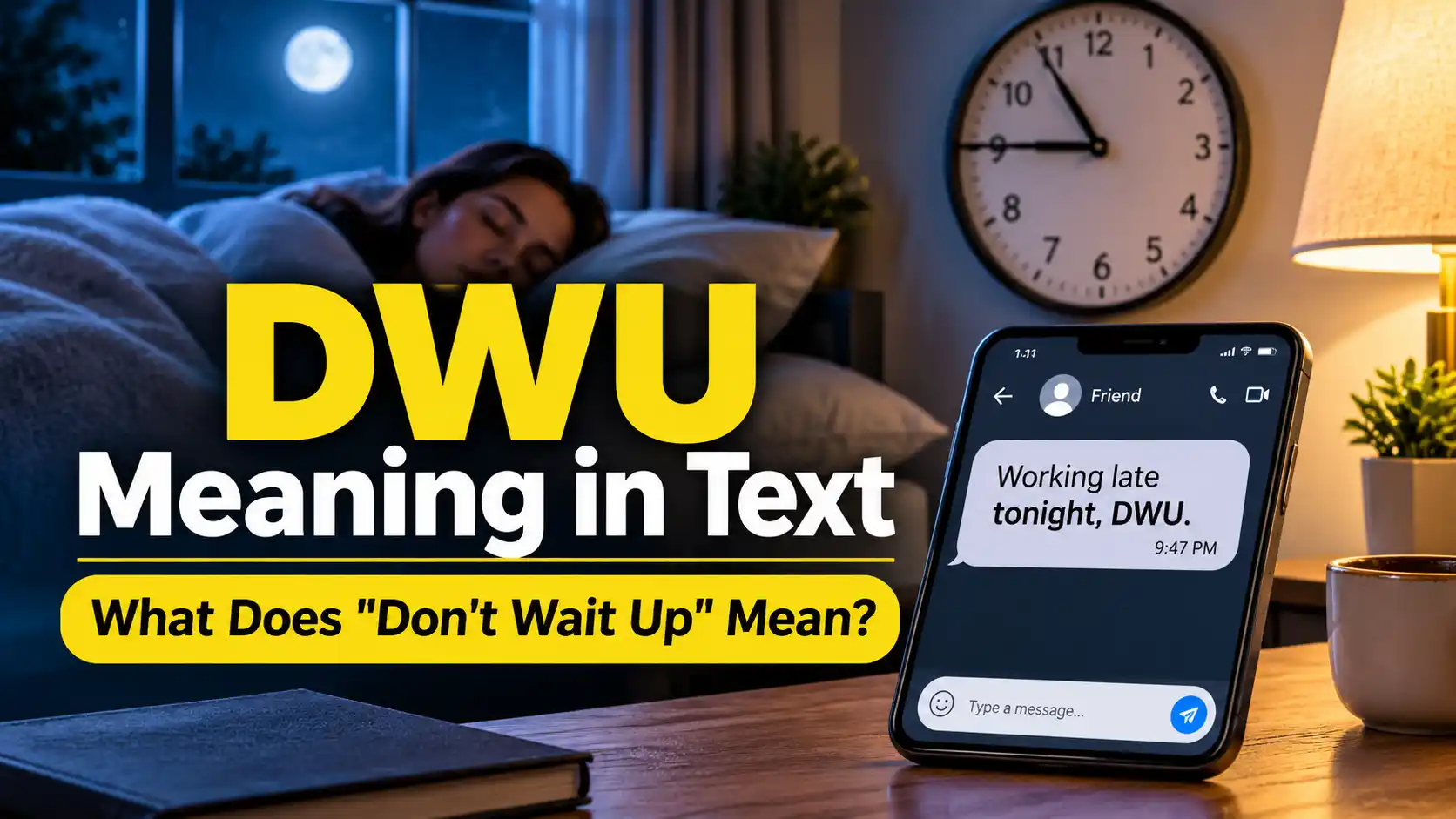
You’re scrolling through your messages when a friend sends a short reply: “Going out with the team tonight, DWU.” You pause. Is it a typo? A secret code? A new slang term you missed?
Good news: you’re not alone. Text abbreviations multiply faster than anyone can keep up with, and DWU is one that often leaves people guessing.
So, what is the DWU meaning in text? In most conversations, DWU stands for “don’t wait up.” It’s a quick way of telling someone they don’t need to stay awake or hold off on plans because you’ll be late. It’s casual, friendly, and common between friends, family members, and partners.
In this guide, you’ll learn exactly what DWU means, where it came from, how to use it in real messages, how it differs from DW, and which similar abbreviations are worth knowing so you never have to guess again. Let’s dive in.
Quick Answer: What Does DWU Mean?
DWU stands for “don’t wait up.” People use it in texts to tell friends, family, or partners they’ll be late and shouldn’t wait for them. Example: “Working late tonight, DWU.” It’s casual slang, best for informal chats rather than professional messages.
What Does DWU Stand For?
The Full Phrase Explained
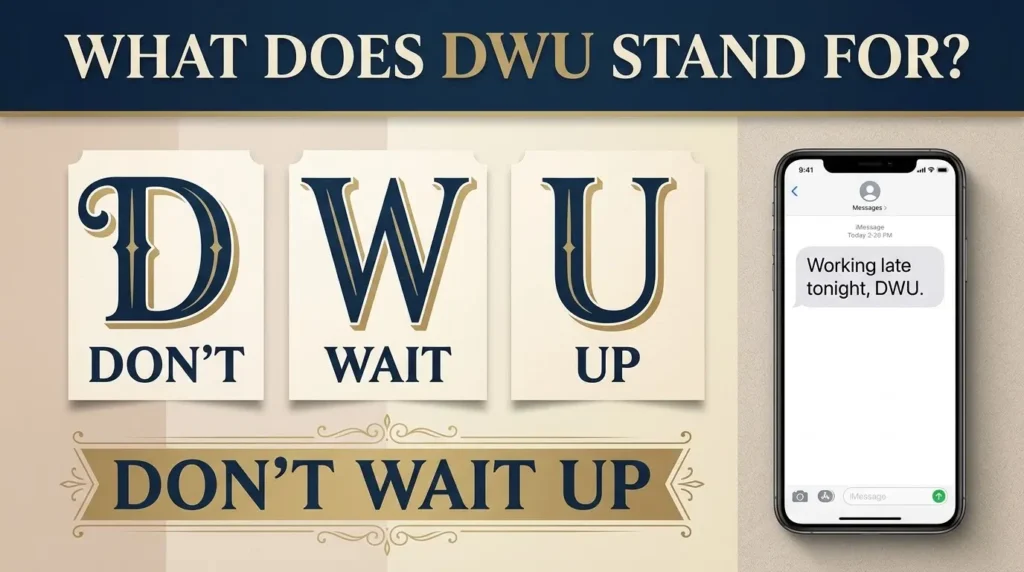
DWU is short for “don’t wait up.” Each letter stands for one word in the phrase:
- D = Don’t
- W = Wait
- U = Up
The phrase “wait up” has long meant staying awake until someone returns home, like a parent waiting for a teenager to come back from a night out. Texting turned that familiar expression into a three-letter shortcut. Instead of typing the full phrase, the sender just adds DWU at the end of the message.
What the Sender Is Really Saying
On the surface, DWU is simple. But it usually carries a few messages at once:
- “I’ll be late.” The sender expects to arrive after the usual time.
- “Go ahead without me.” You don’t need to hold dinner, plans, or a conversation for them.
- “Don’t worry about me.” It often carries a reassuring tone, telling you not to lose sleep over their schedule.
For example, if your roommate texts, “Stuck at work until midnight, DWU,” they’re not just announcing a late finish. They’re also giving you permission to go to bed or eat without them.
How DWU Works in a Sentence
DWU is almost always used as a closing tag, added at the end of a message after the main information:
- “Heading to my cousin’s place after class, DWU.”
- “Might be a late one tonight. DWU!”
It can also stand alone as a quick reply. If someone asks, “Should I wait for you?” you can simply answer, “DWU.”
Because it’s informal shorthand, it’s usually written in capital letters (DWU), though lowercase “dwu” is common in fast, casual chats. It doesn’t change form, and it doesn’t need any extra punctuation to be understood.
Origin and Background of DWU
How Texting Abbreviations Came About
Abbreviations like DWU didn’t appear out of nowhere. They grew out of the early days of mobile messaging, when SMS texts were capped at 160 characters and many people typed each letter by pressing phone keys multiple times. Shorter messages meant less effort, lower costs, and faster replies.
Chat rooms, instant messengers, and early social platforms added to the trend. Acronyms such as BRB, TTYL, and OMW became everyday shorthand, and new ones kept spreading as each generation of users adapted language to its favorite apps. DWU belongs to this same family: a familiar spoken phrase compressed into a few letters.
Where DWU First Appeared
There’s no official record of who coined DWU. Some slang sites suggest it was defined on user-edited dictionaries like Urban Dictionary around 2008, but this is hard to verify, so it’s best treated as an unconfirmed claim. What we can say is that the abbreviation is informal, user-created, and passed along mostly by word of mouth and repeated use in chats.
Why DWU Is Still Around
Despite never becoming as famous as LOL or BRB, DWU has stuck around for a few simple reasons:
- It fills a real need. People often need to tell others not to wait, and DWU does it in three letters.
- It’s easy to guess. The phrase “wait up” is common enough that most people figure it out from context.
- It fits modern messaging. On WhatsApp, Snapchat, Instagram, and iMessage, quick and casual replies are the norm.
Like most slang, it survives because people keep using it, not because any dictionary approved it.
How to Use DWU (With Examples)
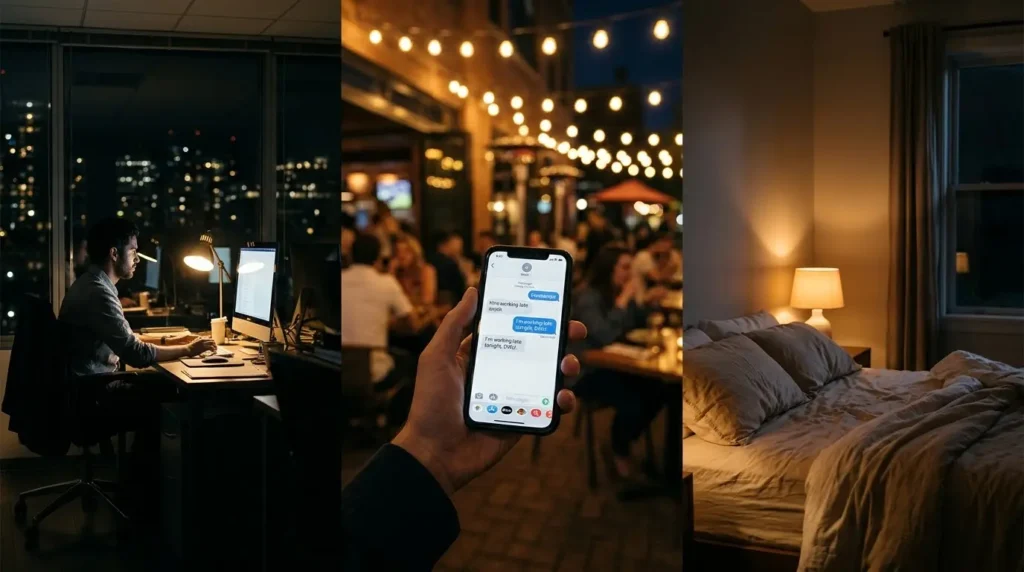
The best way to understand DWU is to see it in real conversations. Here are the most common situations where people use it.
1. Going Out Late or to Events
This is the classic use. You’re heading somewhere that might run late, and you don’t want anyone waiting for you.
You: Heading to Sam’s birthday party now, DWU.
Friend: Have fun! Text me when you’re home.
2. Working Late or Studying
When work or study drags on, DWU lets people know not to hold dinner or stay up.
You: Deadline is tonight, so I’ll be at the office for a while. DWU.
Roommate: Okay, I’ll leave some food in the fridge.
3. Family and Roommates
Among people who share a home, DWU saves time and avoids worry.
You: Going to a late movie with Ali, DWU.
Mom: Alright, take your keys.
4. Couples and Close Friends
With someone close, DWU can sound caring rather than dismissive, especially when paired with a friendly note.
You: Long day ahead, don’t stay up for me, DWU. Sleep well!
Partner: Okay, goodnight. See you in the morning.
5. Group Chats
In a group, DWU tells everyone they can go ahead with the plan.
You: Stuck in traffic. Order without me, DWU.
Friend: Got it, we’ll save you a slice.
Where to Place DWU in a Message
- At the end of the message is the most common spot, because it works as a closing note after the main information.
- As a standalone reply works when someone asks whether to wait for you.
- Before the explanation is rare, but it can work for emphasis: “DWU, the meeting is running long.”
Quick Tips for Using DWU Well
- Add a time estimate if you can. “Back around 11, DWU” is clearer than DWU alone.
- Match the tone to the person. Add a friendly line for people you’re close to so it doesn’t sound abrupt.
- Skip it when the message is important. If someone truly needs a clear answer, spell out “please don’t wait up for me.”
Tone, Context & Etiquette
Knowing what DWU means is only half the picture. How and where you use it affects how your message comes across.
Casual vs. Formal Settings
DWU is informal slang, so it fits best in relaxed conversations with people you know well. It works in:
- Text messages with friends, family, and partners
- Group chats with roommates or classmates
- Casual messages on WhatsApp, Snapchat, Instagram, or iMessage
It does not fit in formal settings such as work emails, messages to a manager, or communication with clients. In those cases, write the full phrase: “Please don’t wait up for me.”
Who Uses DWU Most
DWU is most common among teens and young adults, who tend to adopt shortcuts quickly in everyday chats. That said, it’s easy to understand, and parents, partners, and coworkers who are close friends use it too. If you’re texting someone who rarely uses slang, such as an older relative, spelling it out avoids confusion.
Can DWU Sound Cold or Dismissive?
Sometimes. Because it’s so short, DWU can come across as abrupt, especially when the person was looking forward to seeing you. Compare these two messages:
- “Running late. DWU.”
- “Running late, sorry! Don’t wait up, I’ll see you in the morning.”
The second feels warmer. A few easy ways to soften DWU:
- Add a friendly word: “Sorry, DWU!”
- Give a reason or time: “Meeting ran over, back by 11, DWU.”
- Use an emoji: A smile or heart can lighten the tone.
Why DWU Isn’t Right for Professional Chats
Workplace communication values clarity. A manager or client may not recognize DWU, and an abbreviation can look careless. Even on casual team platforms like Slack, it’s safer to write out the phrase unless you know your colleagues use slang freely.
Other Possible Meanings of DWU
In nearly every text conversation, DWU means “don’t wait up.” Slang is flexible, though, and a few other readings come up. Knowing them helps you avoid misunderstandings.
1. “Don’t Worry” (Usually a Mix-Up)
Some websites list “don’t worry” as a meaning of DWU. This is weakly supported and most likely comes from confusion with DW, the common abbreviation for “don’t worry.”
The two are easy to mix up because they look alike and both reassure the reader. Still, they say different things:
- DW = “don’t worry” (don’t stress about this)
- DWU = “don’t wait up” (go ahead without me)
If someone texts “Late night, DWU,” the “don’t wait up” meaning fits. If the message makes more sense as “don’t worry,” they may have meant DW and typed an extra letter.
2. Non-Texting Meanings
Outside of chat, DWU can be an abbreviation for organizations, institutions, or technical terms. One example is Dakota Wesleyan University in South Dakota, and other uses exist in different industries and regions. You’ll usually see these in formal writing, websites, or documents rather than in text messages. If the context is education, business, or a specific field, the meaning probably isn’t slang.
3. Personal or Group Shorthand
Friend groups and online communities sometimes invent their own meanings for abbreviations, including inside jokes. If DWU appears in a way that doesn’t match “don’t wait up,” it could be one of these private uses.
How to Tell Which Meaning Applies
Context almost always settles it. Ask yourself:
- What’s the situation? Plans, late nights, or schedules point to “don’t wait up.”
- Who’s sending it? A close friend or family member likely means the common slang.
- What’s the platform? A casual chat suggests texting slang, while a formal document suggests an organization’s abbreviation.
- What was said before? The earlier messages often give the answer away.
When You’re Still Unsure
If the meaning isn’t clear, just ask: “Do you mean don’t wait up?” A quick question beats acting on the wrong assumption. When you’re the one sending the message and could be misread, spelling out the full phrase removes any doubt.
DWU vs. DW: What’s the Difference?
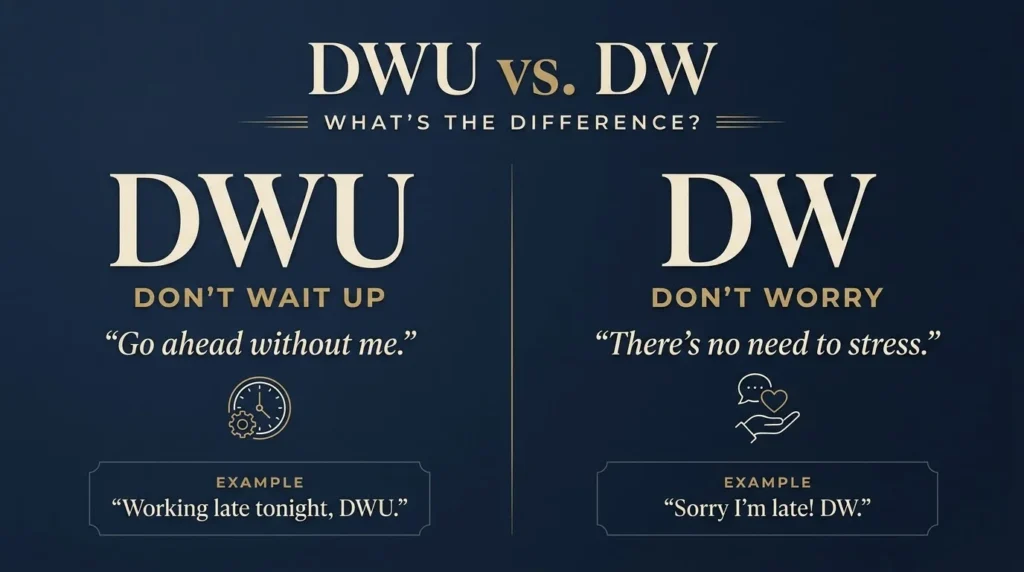
DWU and DW look almost identical, and that’s exactly why people confuse them. One extra letter changes the whole message, so it’s worth knowing which is which.
Side-by-Side Comparison
| DWU | DW | |
| Stands for | Don’t wait up | Don’t worry |
| Main purpose | Tells someone not to wait for you | Reassures someone there’s no need to stress |
| Typical situation | Running late, going out, working late | Apologies, small mistakes, offers of help |
| Tone | Casual, practical | Casual, comforting |
| Example | “Out with friends tonight, DWU.” | “Sorry I forgot to call! DW, I’ll do it now.” |
| Frequency | Less common | Much more common |
Seeing the Difference in Real Messages
The same situation can call for either abbreviation, but the meaning changes completely:
Friend: Sorry, I can’t make it tonight.
You: DW, we’ll catch up another time.
Here, DW means “don’t worry about it.”
Roommate: Do you want me to leave the door unlocked?
You: Yes please, I’ll be home late. DWU.
Here, DWU means “don’t wait up for me.”
Common Mix-Ups
- Typing DWU when you mean DW. An extra U can turn a reassuring message into a confusing one. “DWU, it’s no big deal” doesn’t make sense, but “DW, it’s no big deal” does.
- Reading DW as DWU. If someone texts “DW” after you ask a question, they’re usually telling you not to worry, not telling you to stop waiting.
- Assuming they’re interchangeable. They overlap in tone (both are relaxed and reassuring), but they aren’t synonyms.
A Simple Trick to Remember
Look at the last letter:
- DWU ends in U, which you can read as “up.” Think “wait up.”
- DW has no extra letter, so it’s just “worry.”
How to Avoid Confusion
- Check the context. Plans and timing point to DWU, while apologies and small problems point to DW.
- Proofread quick messages for the extra U.
- When the meaning matters, write the full phrase.
Similar Texting Abbreviations
DWU is one of many shortcuts people use to keep chats quick. If you’re learning DWU, these related abbreviations are worth knowing too, since they often appear in the same kinds of conversations.
Quick Reference Table
| Abbreviation | Meaning | Example |
| DWU | Don’t wait up | “Late shift tonight, DWU.” |
| DW | Don’t worry | “Sorry I’m late! DW, I’m almost there.” |
| BRB | Be right back | “BRB, grabbing my charger.” |
| TTYL | Talk to you later | “Got to run, TTYL!” |
| OMW | On my way | “OMW, see you in ten.” |
| GTG | Got to go | “GTG, dinner’s ready.” |
| IDK | I don’t know | “IDK what time it starts.” |
| NVM | Never mind | “NVM, I found it.” |
| ETA | Estimated time of arrival | “What’s your ETA?” |
| IMO | In my opinion | “IMO, the second option is better.” |
Abbreviations That Pair Well With DWU
Some of these naturally appear alongside DWU in the same message:
- “OMW, but I’ll be late, DWU.” (on my way, but don’t wait up)
- “GTG, long night ahead, DWU.” (got to go, don’t wait up)
- “TTYL, DWU.” (talk to you later, don’t wait up)
How to Choose the Right Abbreviation
- Match the meaning to your goal. Use DWU when you don’t want anyone waiting, DW when you want to reassure, and OMW when you’re actually heading over.
- Consider your audience. Close friends will understand almost anything, while older relatives or coworkers might not.
- Avoid stacking too many. A message full of abbreviations is harder to read than a simple sentence.
- Spell it out when clarity matters. If a misunderstanding could cause a problem, write the full phrase.
FAQs
What does DWU mean in a text message?
DWU stands for “don’t wait up.” People use it to tell someone they’ll be late and don’t need to stay awake or hold off on plans. For example: “Going out with friends tonight, DWU.”
Does DWU mean “don’t worry”?
Usually not. “Don’t worry” is abbreviated as DW. Some websites list it as a meaning of DWU, but this is likely a mix-up caused by the similar spelling. If a message makes more sense as “don’t worry,” the sender probably meant DW.
Is DWU the same as DW?
No. DWU means “don’t wait up,” while DW means “don’t worry.” They look alike and share a relaxed tone, but they communicate different things. DW is also much more common than DWU.
Is DWU rude?
Not by itself. DWU is a casual, practical phrase. It can sound abrupt if it’s sent without any warmth, especially to someone who was looking forward to seeing you. Adding a friendly word, a time estimate, or an emoji keeps it kind: “Sorry, running late! Back around 11, DWU.”
Can I use DWU at work?
It’s best to avoid it in professional settings. Managers, clients, and colleagues may not recognize the abbreviation, and it can look too casual. Write a full sentence instead, such as “Please proceed without me. I’ll join as soon as I can.” The exception is a team that clearly uses relaxed slang in its chats.
Is DWU used on Snapchat, Instagram, or WhatsApp?
Yes. DWU isn’t tied to one app. It appears wherever people send quick, casual messages, including WhatsApp, Snapchat, Instagram, iMessage, and group chats. Its meaning stays the same across platforms.
How do I reply to someone who texts DWU?
Keep it short and friendly. Some easy replies:
- “Okay, see you tomorrow!”
- “Got it, stay safe.”
- “No problem, text me when you’re home.”
- “Thanks for letting me know.”
If you’re not sure what they meant, just ask: “Do you mean don’t wait up?”
Is DWU a formal abbreviation?
No. It’s informal slang with no official definition, spread through everyday use. That’s why meanings can vary slightly and why context matters.
What should I use instead of DWU?
If you’d rather not use slang, try “Don’t wait up,” “Go ahead without me,” or “No need to wait for me.” For work, use a more formal version like “Please don’t wait for me.”
How can I avoid confusing DWU with DW?
Check the last letter. DWU ends in U, which you can read as “up,” as in “wait up.” DW has no extra letter and just means “worry.” When clarity matters, write the full phrase.
Conclusion
So, what does DWU mean in text? In almost every case, it stands for “don’t wait up,” a quick way to tell someone you’ll be late and they should carry on without you. It’s casual, friendly, and best kept for chats with people who know your style.
Remember the key points: don’t confuse it with DW (“don’t worry”), add a little warmth so it doesn’t sound abrupt, and spell it out in professional settings. When you’re unsure, check the context or simply ask.
Found this guide helpful? Share it with a friend who’s still puzzled, and leave a comment with the slang you’d like decoded next.

Hello, I’m Insha, a passionate content writer with 2 years of experience creating clear, engaging, and helpful content. I specialize in the meaning niche, explaining words, slang, phrases, and online terms in simple language that readers can easily understand and use.


1 thought on “DWU Meaning in Text: What Does It Mean and How to Use It?<p class="post-updated-date">🕓 <span class="updated-label">Last updated on</span> <time datetime="2026-11-04T06:48:02+00:00">November 4, 2026</time></p><script type="application/ld+json"> { "@context": "https://schema.org", "@type": "BlogPosting", "mainEntityOfPage": { "@type": "WebPage", "@id": "https://outreachnexa.com/dwu-meaning-in-text-2/" }, "datePublished": "2026-11-04T06:48:00+00:00", "dateModified": "2026-11-04T06:48:02+00:00" } </script>”